The life of Jesus in chronological order: a full timeline
Read the four Gospels back to back and the story comes out of order. Matthew skips the childhood, Mark starts at the Jordan, John moves the Temple scene to the beginning, and none of them gives a single date you could put on a calendar.
Here is the life of Jesus in chronological order, stitched into one timeline: every major event from the prophecy to the Ascension, with its approximate date, its place and the Gospel passage behind it. Then, if you want the whole story on paper, a way to walk it scene by scene.
The life of Jesus at a glance
The life of Jesus falls into six phases: birth and infancy around 6 to 4 BC, the hidden years in Nazareth, the start of the ministry around AD 28, the ministry in Galilee, the final week in Jerusalem, and the resurrection and Ascension in AD 30 or 33. The table gives each phase its dates and sources.
Phase
Approximate dates
Where
Main sources
Birth and infancy
c. 6–4 BC
Nazareth, Bethlehem, Egypt
Matthew 1–2; Luke 1–2
Hidden years
c. 4 BC – AD 28
Nazareth
Luke 2:39–52
Ministry begins
c. AD 28–29
Jordan River, Judean desert, Cana
Mark 1; John 1–2
Ministry in Galilee
c. AD 28–30
Capernaum, Sea of Galilee
Mark 1–9; Matthew 5–17
Final week
AD 30 or 33
Bethany, Jerusalem
Mark 11–15; John 11–19
Resurrection and Ascension
The 40 days after Easter
Jerusalem, Galilee, Mount of Olives
John 20–21; Acts 1
Treat every date as a range, not a fact. The Gospels were written to proclaim, not to file, so historians rebuild the calendar from a handful of fixed points outside them. Those fixed points come later in this guide.
Color the whole story in order, scene by scene
If you want this timeline as something you hold rather than scroll, our Jesus Christ coloring book is built on exactly this order. It runs 33 illustrated scenes from Isaiah’s prophecy to the Ascension, and every page carries a short caption that dates and places the scene before you pick up a pencil.
You never jump around. You start in Nazareth with Gabriel and Mary, walk the road to Bethlehem, wade into the Jordan, climb Mount Tabor and finish on the Mount of Olives. By the last page, the chronology lives in your hands rather than in a table.
It arrives as an instant PDF download, so you can print it at home on US Letter or A4 and start tonight. Reprint any page as often as you like, and use whatever you color with: pencils, markers, watercolor or a tablet. Every illustration is checked by a person before it goes in. Human Validated, no melting hands.
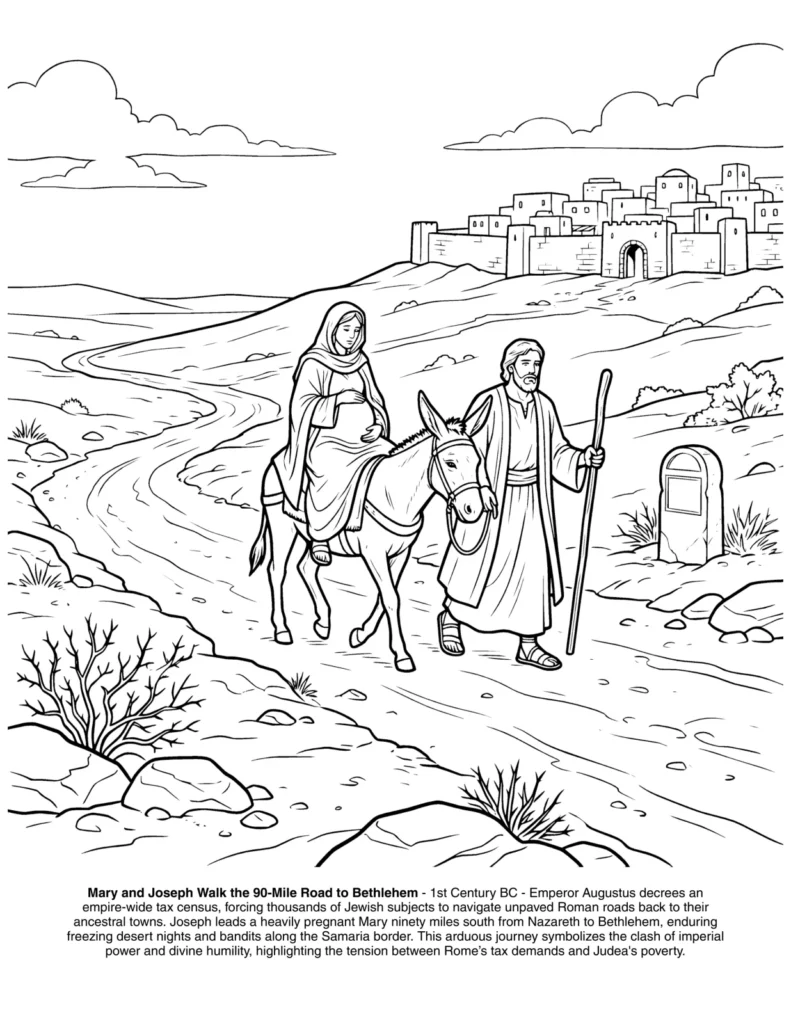
The road to Bethlehem: one scene, one dated caption.
Want the Old Testament story first? The Holy Bible title starts in Eden and runs to the Resurrection, so it works as the prequel. And if you are giving either one, our guide to Christian gifts that aren’t cheesy matches the title to the person.
Birth and infancy (about 6 to 4 BC)
Jesus was born in Bethlehem late in the reign of Herod the Great, who died in 4 BC by the most widely accepted reckoning, so most historians place the birth between 6 and 4 BC. Luke and Matthew tell the infancy from two angles: Luke follows Mary and the Temple, Matthew follows Joseph, the Magi and the escape to Egypt.
The Annunciation. Gabriel visits Mary in Nazareth (Luke 1:26–38).
The Visitation. Mary travels to her relative Elizabeth in the Judean hill country (Luke 1:39–56).
John the Baptist is born. Zechariah writes the name John and speaks again (Luke 1:57–80).
The census. Joseph and Mary travel from Nazareth to Bethlehem (Luke 2:1–5).
The birth. Jesus is laid in a manger and shepherds arrive in the night (Luke 2:6–20).
The presentation in the Temple. Forty days later, Simeon and Anna greet the child in Jerusalem (Luke 2:22–38).
The Magi. Visitors from the east bring gold, frankincense and myrrh (Matthew 2:1–12).
The flight into Egypt. Warned in a dream, Joseph leaves by night (Matthew 2:13–15).
The massacre in Bethlehem. Herod orders the killing of the town’s young boys (Matthew 2:16–18).
The return to Nazareth. After Herod’s death, the family settles in Galilee (Matthew 2:19–23).
Harmonies disagree on one point. Matthew has the Magi find a child in a house, and Herod targets boys up to two years old, so many scholars place their visit months after the presentation in the Temple. Others put the Magi first, and neither Gospel settles it.
Color it: ten of the book’s first eleven pages live here, from Gabriel’s visit to the long road back to Nazareth. It is the busiest stretch of the story, and the one most people only know from Christmas cards.
The hidden years in Nazareth
Between the return from Egypt and the baptism, roughly thirty years, the Gospels record one scene: the twelve-year-old Jesus questioning the teachers in the Temple at Passover. Everything else is a single line in Luke, that he grew in wisdom and in years in Nazareth (Luke 2:52).
Mark adds one clue. The neighbors in Nazareth call him a tektōn (Mark 6:3), usually translated carpenter but closer to builder, someone who worked wood and probably stone. Sepphoris, a city Herod Antipas was rebuilding, stood about four miles away.
Legends rushed in to fill the gap, from journeys to India to visits to Britain, and none has an early source. The honest answer is that he lived as a Galilean villager and worked with his hands, which also tells you a good deal about what Jesus really looked like.
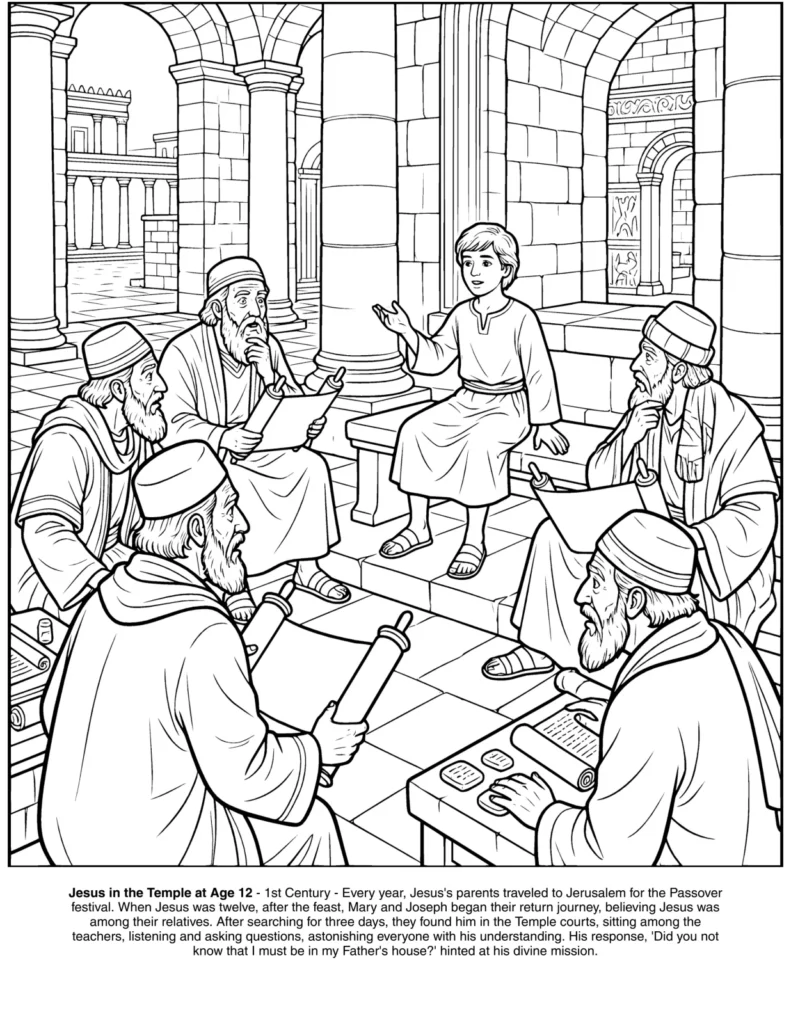
The only scene the Gospels give us from the hidden years.
Color it: the Temple at age twelve is one of the most detailed pages in the book. A boy sits on a stone bench, surrounded by bearded scholars, scrolls and columns, and it rewards a slow evening.
The ministry begins (around AD 28 to 29)
Luke dates John the Baptist’s preaching to the fifteenth year of the emperor Tiberius, which works out to AD 28 or 29. Jesus, about thirty, is baptized by John in the Jordan, fasts forty days in the Judean desert, calls his first disciples and performs his first sign at a wedding in Cana.
John preaches at the Jordan. Crowds come out to be baptized (Luke 3:1–18).
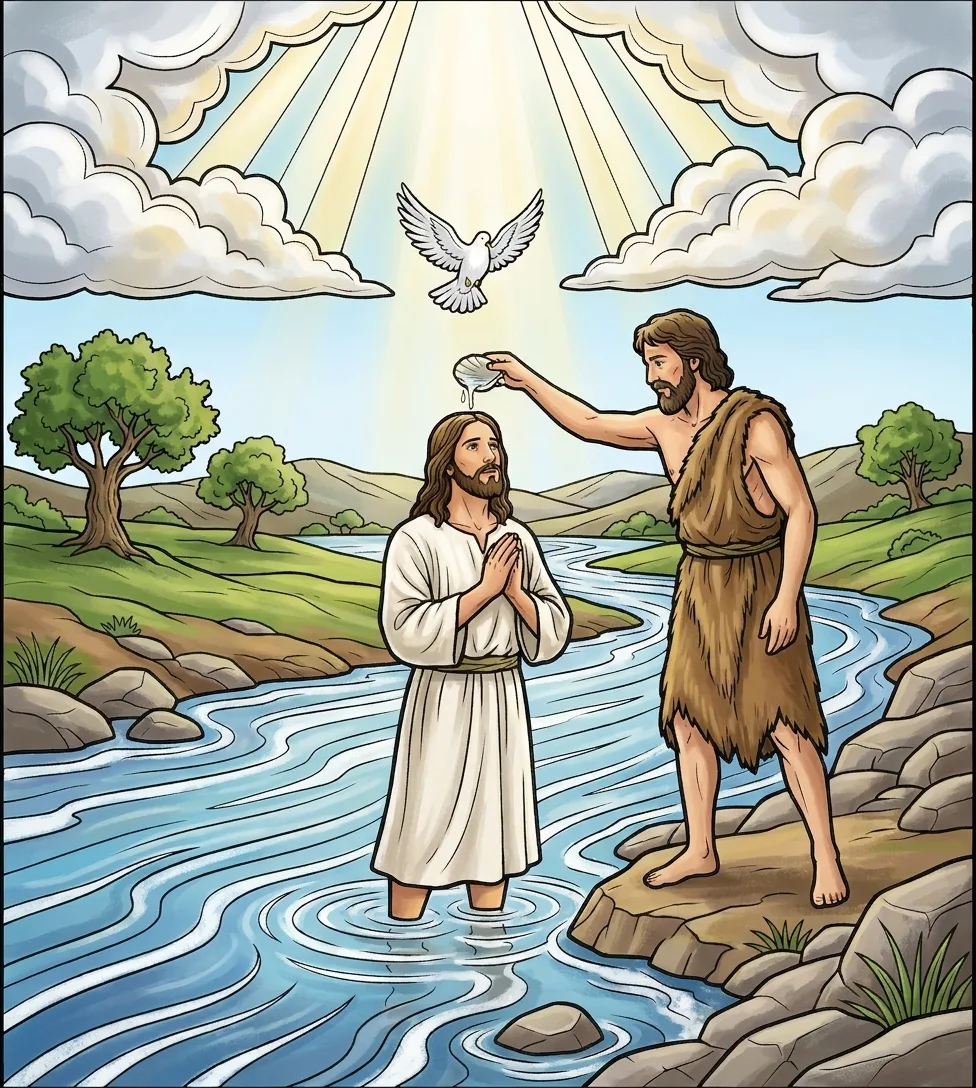
The baptism of Jesus. The Spirit descends like a dove (Mark 1:9–11).
Forty days in the desert. Jesus fasts and refuses the tempter three times (Matthew 4:1–11).
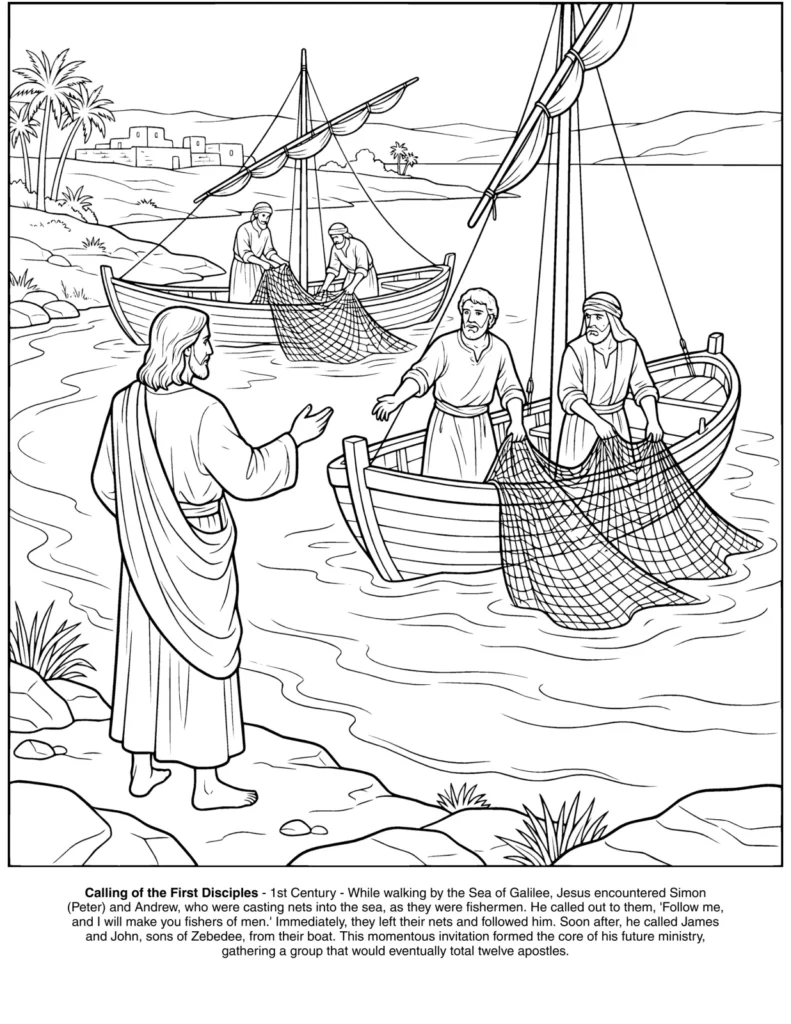
The first disciples. Andrew, Peter, Philip and Nathanael follow him (John 1:35–51).
Water into wine at Cana. John calls it the first of his signs (John 2:1–11).
One scene moves depending on whom you read. John puts the clearing of the Temple traders at the start of the ministry (John 2:13–22), while Matthew, Mark and Luke put it in the final week. Some readers think it happened twice; most scholars think John placed it early for theological reasons.
Follow me: the fishing boats on Galilee.
Color it: the Jordan gets two pages in the book, John baptizing the crowds and then Jesus himself. The desert, the fishing boats and the six stone jars at Cana follow, so the whole opening of the ministry fits in one week of evenings.
The ministry in Galilee
Most of Jesus’s public life unfolds around the Sea of Galilee, with Capernaum as his base. Here he teaches in the synagogue, gives the Sermon on the Mount, heals, calms a storm and feeds five thousand people. How long it lasted depends on the Gospel: about one year in Mark, closer to three in John.
The difference comes from Passovers. John mentions three of them during the ministry (John 2:13, 6:4 and 11:55), which stretches it to two or three years, while the other Gospels mention only the last. Most historians settle on a ministry of one to three years.
Authority in the synagogue. Jesus teaches in Capernaum and the crowd is astonished (Mark 1:21–28).
The Sermon on the Mount. The Beatitudes on a hillside above the lake (Matthew 5–7).
Through the roof. Four friends lower a paralyzed man into a crowded house (Mark 2:1–12).
The storm. Jesus wakes and calms the wind on the lake (Mark 4:35–41).
Five thousand fed. The only miracle besides the resurrection told in all four Gospels (Mark 6:30–44; John 6:1–14).
Peter’s confession. At Caesarea Philippi, Peter names him the Messiah (Mark 8:27–30).
The Transfiguration. On a high mountain, by tradition Mount Tabor, his clothes turn dazzling white (Mark 9:2–8).
Color it: this is where the book widens out. The Galilee pages are full of water, boats, crowds and hillsides, and they take the longest to finish, which is exactly why they stay with you.
The final week in Jerusalem
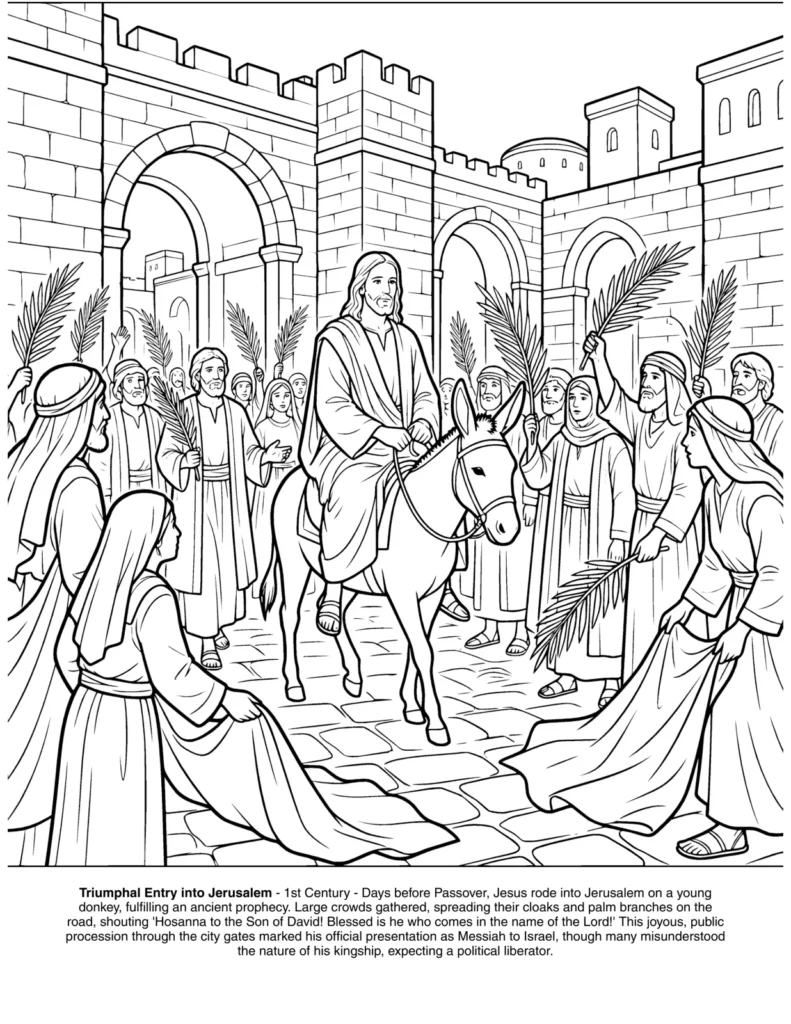
The last week begins when Jesus rides into Jerusalem on a donkey, cheered with palm branches, days before Passover. He teaches in the Temple courts, shares a last meal with the Twelve, is arrested in Gethsemane, questioned by the high priest Caiaphas, sentenced by the Roman prefect Pontius Pilate and crucified on the Friday.
Just before it, John places the raising of Lazarus at Bethany, about two miles from the city (John 11). In his telling, that miracle is what finally moves the Temple authorities to act.
Palm Sunday. The entry into Jerusalem (Mark 11:1–11; John 12:12–15).
Days in the Temple courts. Teaching, debate and the overturned tables (Mark 11:15–12:44).
The Last Supper. Bread and wine in an upper room (Mark 14:12–25).
Gethsemane. Prayer among the olive trees, then arrest after a kiss (Mark 14:32–50).
The trials. Before Annas, Caiaphas, Pilate and Herod Antipas (John 18; Luke 23:6–12).
The crucifixion. At Golgotha, outside the city walls (Mark 15:22–37).
The burial. In the rock tomb of Joseph of Arimathea (Mark 15:42–47).
The Gospels even disagree on how the Last Supper relates to Passover. Matthew, Mark and Luke make it the Passover meal, while John has Jesus die on the afternoon the Passover lambs are slaughtered, a day earlier. It is one reason the year of the crucifixion is still debated.
Palm Sunday, the first page of the final week.
Color it: eight pages cover this stretch, from Lazarus to Golgotha. Coloring them during Holy Week itself is one of the best ways to keep Lent, and our Lent ideas for adults map every page of the book to a day.
Get 5 illustrations from our bestselling coloring books, for free.
You will receive in your mail box the link to download the 5 illustrations in high quality and PDF format.
Resurrection and Ascension
On the Sunday morning Mary Magdalene finds the tomb open and empty. The Gospels then record appearances to her, to two disciples on the road to Emmaus, to the Eleven in Jerusalem and by the Sea of Galilee. Forty days later, Acts places the Ascension on the Mount of Olives.
The empty tomb. Mary Magdalene meets the risen Jesus in the garden (John 20:1–18).
The road to Emmaus. Two disciples recognize him as he breaks bread (Luke 24:13–35).
Thomas. The doubter touches the wounds (John 20:24–29).
Breakfast on the shore. A charcoal fire by the Sea of Galilee (John 21).
The Ascension. From the Mount of Olives, forty days after Easter (Acts 1:3–12).
Color it: the book closes on two pages, Mary Magdalene at the rolled-away stone and the Ascension above the Mount of Olives. Easter, in two scenes, and the natural place to stop and look back at everything you have colored.
How do historians date the life of Jesus?
Historians anchor the timeline to people known outside the Gospels: Herod the Great, who died in 4 BC, the emperor Tiberius, Pontius Pilate, prefect of Judea from AD 26 to 36, and the high priest Caiaphas. Two non-Christian writers, Tacitus and Josephus, confirm that Jesus was executed under Pilate.
Fixed point
Date
Evidence
Death of Herod the Great
4 BC (most estimates)
Josephus, Antiquities 17
Fifteenth year of Tiberius
AD 28–29
Luke 3:1
Pontius Pilate, prefect of Judea
AD 26–36
Josephus; the Pilate Stone, found at Caesarea in 1961
Caiaphas, high priest
c. AD 18–36
Josephus; an ossuary bearing the family name, found in Jerusalem in 1990
The crucifixion
7 April AD 30 or 3 April AD 33
Astronomical Passover calculations
Tacitus, writing around AD 116, says Christus “suffered the extreme penalty during the reign of Tiberius at the hands of one of our procurators, Pontius Pilatus” (Annals 15.44). Josephus, around AD 93, mentions Jesus twice, once in a passage later expanded by Christian copyists and once in passing as the brother of James.
Why isn’t Jesus born in the year 1? Because a sixth-century monk, Dionysius Exiguus, built the AD calendar around a birth year that landed a few years too late, and the error stuck. Luke’s census under Quirinius, which Josephus dates to AD 6, is another knot scholars still argue over, as the chronology of Jesus literature shows.
Every caption in the book opens with a date or an era for exactly this reason. You know where each scene sits before you start, so the order builds up page after page without any effort.
What else helps you keep the order straight
A Gospel harmony, a map and one Gospel read straight through do most of the work. A harmony prints the four accounts side by side in a single sequence, a map shows how short the distances were, and Mark, the shortest Gospel, takes under two hours to read aloud.
A Gospel harmony. A. T. Robertson’s Harmony of the Gospels, first published in 1922, is the classic, and many study Bibles print one at the back.
A map of first-century Palestine. Nazareth to Jerusalem is under a hundred miles, and Capernaum to Jerusalem a few days’ walk.
One Gospel in one sitting. Read Mark from start to finish and you feel the pace of the story, not just its episodes.
A pencil. Reading puts the order in your head, and coloring it page by page puts it in your hands.
That last one is not just a slogan. The research on drawing and memory, which we look at in learning history through coloring, shows why a picture with a caption sticks better than either one alone.
Life of Jesus in chronological order: your questions answered
The questions people ask most about the order of events, answered straight.
What are the main events in the life of Jesus in order?
The birth in Bethlehem, the presentation in the Temple, the visit of the Magi, the flight into Egypt, childhood in Nazareth, the Temple at age twelve, the baptism in the Jordan, forty days in the desert, the first disciples, the wedding at Cana, the ministry in Galilee, the Transfiguration, the raising of Lazarus, the entry into Jerusalem, the Last Supper, the arrest, the trials, the crucifixion, the resurrection and the Ascension.
What year was Jesus born?
Most historians place the birth between 6 and 4 BC. Matthew sets it under Herod the Great, who died in 4 BC by the most widely accepted reckoning. The AD calendar comes from the sixth-century monk Dionysius Exiguus, whose calculation of the birth year landed a few years too late.
How old was Jesus when he died?
Probably somewhere between about 33 and 38. Luke says he was about thirty when his ministry began, the ministry lasted one to three years, and the crucifixion is dated to AD 30 or 33. The traditional age of 33 is a round figure built from Luke’s ‘about thirty’ and John’s three Passovers.
How long was the ministry of Jesus?
Between one and three years. Matthew, Mark and Luke can be read as describing about a year, ending at a single Passover. John mentions three Passovers during the ministry, which stretches it to two or three years, and that longer count is the one most often taught.
What did Jesus do between the ages of 12 and 30?
The Gospels do not say, beyond one line in Luke that he grew in wisdom and in years in Nazareth. Mark calls him a tektōn, a builder or carpenter, so he most likely worked with his hands in and around Nazareth. Later legends of travel to India or Britain have no early source.
Is there a printable timeline of the life of Jesus?
Yes. Our Jesus Christ coloring book is a printable timeline you color: 33 illustrated scenes in chronological order, from Isaiah’s prophecy to the Ascension, each with a short dated caption. It arrives as an instant PDF download that you print at home on US Letter or A4, as many times as you like.
Walk it once, start to finish
Read in order, the life of Jesus stops being a set of famous scenes and becomes one journey. It runs ninety miles to Bethlehem, thirty quiet years in Nazareth, a few Passovers on the road and one week in Jerusalem that split the calendar in two.
Pick the version you will actually finish. For most people that means one Gospel straight through, then the whole story again with a pencil in hand. Print the first scene of the life of Jesus coloring book tonight and color your way to the Ascension.
We use cookies to enhance your browsing experience, serve personalized content and analyze our traffic. You can accept all cookies, reject non-essential ones, or manage your preferences.
Required for the website to function and cannot be switched off. They are usually set in response to actions you make, such as setting privacy preferences or logging in.
Allow the website to remember choices you make (such as language or region) to provide enhanced, personalized features.
Help us understand how visitors interact with the website by collecting and reporting information anonymously.
Used to track visitors across websites to display relevant advertising and measure campaign effectiveness.