Close your eyes and picture Jesus. Long light-brown hair parted in the middle, a fair face, a white robe, perhaps a blue mantle. That face is real, but it is about 1,500 years old, and the man who walked Galilee lived two thousand years ago.
So what did Jesus look like? Nobody who met him wrote it down, yet skeletons, textiles, texts and early art give a surprisingly clear outline. Here is what the evidence says, how the familiar face was invented, and how to bring the history back the next time you color him.
What did Jesus look like? The short answer
No eyewitness description survives. Working from skeletons, ancient texts and textiles, historians reconstruct a Galilean Jewish man about 5 ft 5 in (166 cm) tall, with olive-brown skin, dark brown eyes, dark hair kept fairly short and a beard, dressed in an undyed wool tunic, a mantle with tassels and leather sandals.
Feature
Most likely
Based on
Height
About 5 ft 5 in (166 cm)
Male skeletons from first-century Judea
Skin
Olive to light brown
The population of the region; forensic reconstructions
Eyes
Dark brown
The population of the region
Hair
Dark brown to black, short to collar length
1 Corinthians 11:14; the earliest paintings
Beard
Short and practical
Jewish custom (Leviticus 19:27)
Build
Lean, used to walking and manual work
Mark 6:3; a ministry on foot
Clothing
Knee-length undyed wool tunic, mantle, sandals
The Gospels; Judean desert textiles
Each line is a probability, not a portrait. Together they describe someone who disappeared into a crowd in Capernaum, which is exactly how the Gospels describe him: Judas has to kiss him so the arresting party knows which man to seize (Mark 14:44).
Why don’t the Gospels describe his face?
Because they were not written as portraits. The Gospels proclaim what Jesus said and did, they come from a Jewish culture wary of images, and ancient biographers rarely lingered on looks unless they were remarkable. The silence itself suggests there was nothing unusual to report.
The closest thing to a description is a prophecy Christians applied to him: “he had no form or majesty that we should look at him” (Isaiah 53:2). The white hair and bronze feet of Revelation 1:14–15 belong to a vision, not to a memory of a man in Galilee.
Later writers filled the gap anyway. A letter in the name of a Roman official, Publius Lentulus, describing hazelnut-colored hair parted in the middle, surfaced in the late Middle Ages and is a forgery. The Shroud of Turin was radiocarbon-dated in 1988 to between 1260 and 1390.
Color him from the evidence: a palette for every page
Line art fixes shapes, not skin tones. On every page of a Jesus coloring book the color is your decision, which makes it the place where history comes back in: warm olive skin, near-black hair and beard, cream and oatmeal wool, a darker mantle and a single thread of blue.
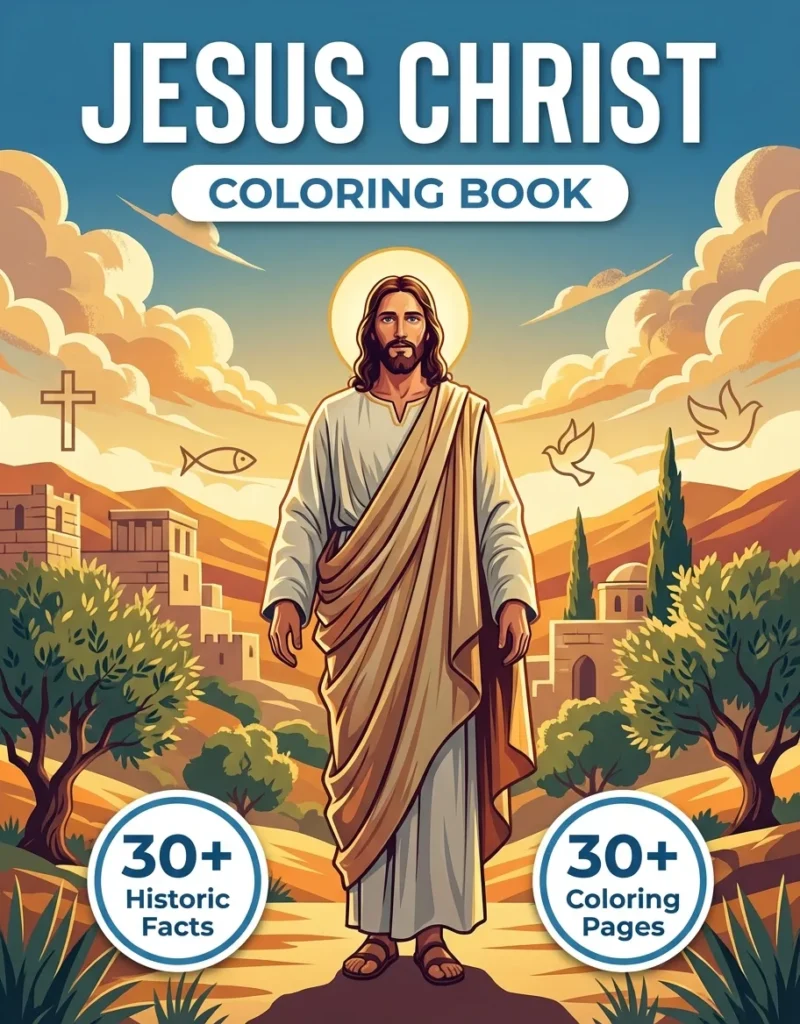
Our own illustrations draw Jesus the way most readers recognize him from centuries of Christian art: the beard, the long hair, the flowing robe and the mantle over one shoulder. That is a deliberate choice for recognition, the same reason a cover of Cleopatra shows the Cleopatra people expect.
The book doesn’t stop there. One page sets Jesus among Galilean farmers and stonemasons, and its caption describes knee-length wool tunics, leather sandals, short beards and sun-weathered olive skin. Another puts his plain seamless tunic beside the gold and fine linen of the Temple priests.
Element
Historical palette
Colored-pencil approach
Skin
Warm olive to light brown
Light ochre base, deepened with burnt sienna, shadowed with raw umber
Hair and beard
Dark brown to black
Dark sepia, with a cool gray for highlights instead of white
Eyes
Dark brown
Van Dyck brown, with a speck of bare paper for the catchlight
Tunic
Undyed wool: cream, oatmeal, pale gray-brown
Cream or warm gray, never pure white
Mantle
Heavier wool, natural or darker brown
Walnut or raw umber, built up in layers
Tassels
Pale cord with one blue thread
A single line of deep blue (Numbers 15:38)
Sandals
Undyed leather
Burnt ochre, darker at the straps
Save pure white for the one scene where the Gospel asks for it. On the mountain of the Transfiguration his clothes become “dazzling white, whiter than anyone in the world could bleach them” (Mark 9:3), a line that only works if they were not normally white.
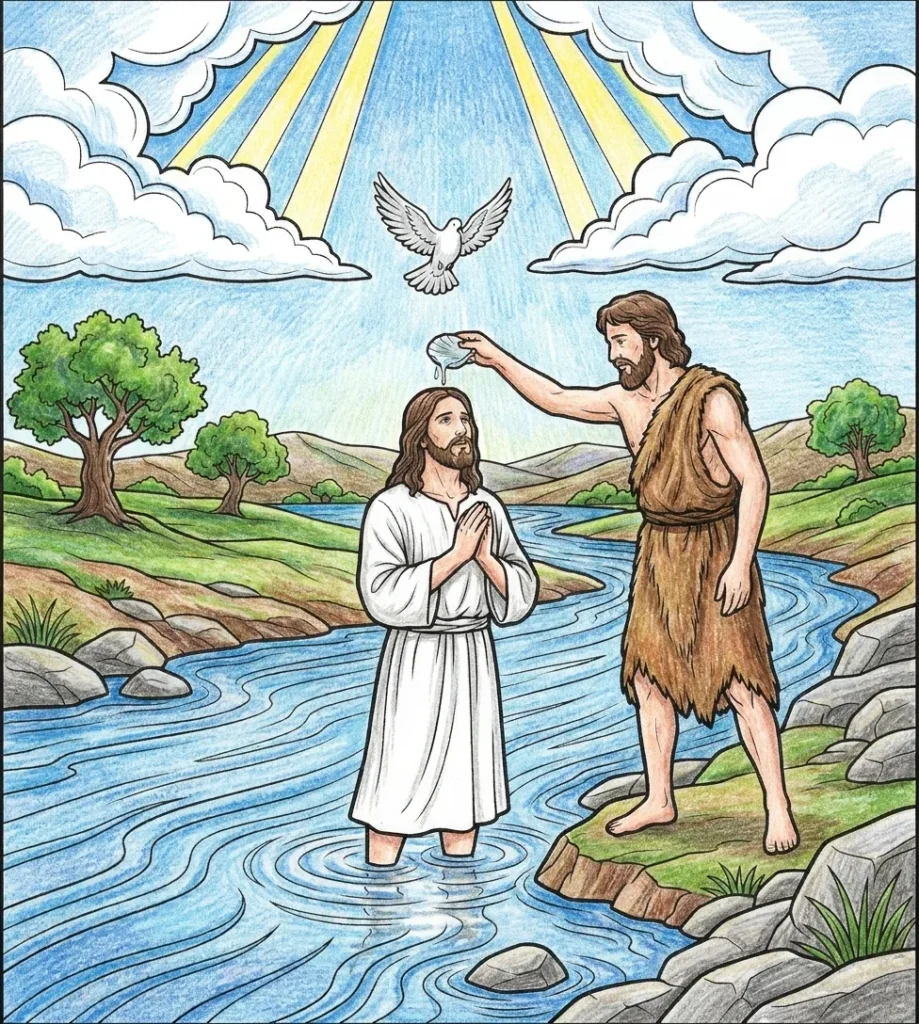
Finished here in the traditional palette. The line art leaves the choice to you.
It arrives as an instant PDF, so you can print the same page twice and color it both ways, traditional and historical, side by side. If you are buying it for someone else, our guide to Christian gifts that aren’t cheesy covers who it suits.
Skin, hair and height: what the evidence says
Jesus was a Galilean Jew, so he most likely looked like other Jewish men of the region: olive to light-brown skin, dark eyes and dark hair. Skeletons from first-century Judea put the average man at about 5 ft 5 in (166 cm), lean from walking and physical work.
In 2001 the medical artist Richard Neave, working for the BBC documentary Son of God, modeled a face from first-century Jewish skulls excavated in Israel: broad, dark-eyed, with short curly hair and a weathered olive complexion. It is not Jesus’s face, and Neave never claimed it was. It is a typical face of his time and place.
Hair is the biggest break with tradition. Paul, writing about twenty years after the crucifixion, calls long hair a disgrace for a man (1 Corinthians 11:14), an odd thing to write if Jesus had worn it long. The exception was a Nazirite vow, and the Gospels show Jesus drinking wine, which the vow forbids.
The beard is safer ground. Observant Jewish men generally wore one while Romans of the period shaved, so a beard marked you as a Judean. Joan Taylor, emerita professor of Christian origins at King’s College London, argues that both his hair and his beard were most likely kept short.
On your page: sun-weathered skin takes layering far better than a single flat peach, so build it in two or three passes. Slowing down like this is also why the scene sticks, as we explain in learning history through coloring.
What did Jesus wear?
Jesus most likely wore a knee-length tunic of undyed wool, belted at the waist, a woolen mantle over it with tassels at the corners, and leather sandals. Nothing in it signaled wealth: no purple, no fine linen, no embroidery. It was the everyday dress of a Galilean working man.
The Gospels confirm the pieces. A sick woman touches the fringe of his cloak (Matthew 9:20), John the Baptist feels unworthy to untie his sandals (Mark 1:7), and at the cross the soldiers gamble for a tunic “woven in one piece from top to bottom” (John 19:23).
Color mattered socially. Purple came from murex shellfish and cost a fortune, so it marked the rich man “dressed in purple and fine linen” (Luke 16:19). Ordinary people wore wool in its natural cream, beige, brown or gray, and Jewish law asked for a cord of blue in each tassel (Numbers 15:38).
The ankle-length robe of later art is, ironically, the garment Jesus mocks: “Beware of the scribes, who like to walk around in long robes” (Mark 12:38). Taylor’s study compares the Gospels with textiles recovered from caves in the Judean desert, and the short tunic is what the evidence supports.
On your page: the book’s Temple-courts scene sets his single seamless tunic against the priests’ gold breastplates and fine Egyptian linen. Color the contrast hard, plain wool against everything else, and the scene tells its own story.
The colors the Gospels actually name
The Gospels name very few colors, which makes each one worth noticing. Dazzling white appears at the Transfiguration and at the empty tomb, green grass at the feeding of the five thousand, and darkness at noon at the crucifixion. Treat them as the fixed points of your palette.
Scene
What the text says
Reference
On your page
Five thousand fed
the green grass
Mark 6:39
Spring green: it happens near Passover (John 6:4)
The Transfiguration
dazzling white
Mark 9:3
The only pure white in the book
Entry into Jerusalem
branches of palm trees
John 12:13
Date-palm green over a dusty road
The crucifixion
darkness over the whole land
Mark 15:33
Let the sky go gray-violet, not blue
The empty tomb
a young man dressed in a white robe
Mark 16:5
Dawn light, and the white returns
The Magi
gold, frankincense and myrrh
Matthew 2:11
Amber resin and a deep red-brown
One color appears only in mockery. The soldiers drape him in scarlet (Matthew 27:28) or purple (Mark 15:17), the colors of power, to ridicule a king who wore undyed wool.
Every scene in that table is a page in the book. Color them with the text in mind and the whole story picks up a quiet logic: plain wool all the way through, and white only where the Gospels say heaven breaks in.
Get 5 illustrations from our bestselling coloring books, for free.
You will receive in your mail box the link to download the 5 illustrations in high quality and PDF format.
How the familiar face was invented
The long-haired, bearded Jesus took shape between the fourth and sixth centuries. The earliest surviving images, from around AD 235, show a short-haired, beardless young man in a tunic. As Christianity became the religion of the empire, artists borrowed the majesty of emperors and enthroned gods, and the bearded face took hold.
Around 235, Dura-Europos, Syria. The oldest known images of Jesus, in a house-church baptistery, show him beardless and short-haired, healing a paralyzed man. The fresco, from the Dura-Europos church, is now at the Yale University Art Gallery.
Third and fourth centuries, the Roman catacombs. Jesus appears as a young, beardless Good Shepherd with a lamb across his shoulders.
Late fourth century, the catacomb of Commodilla. One of the earliest bearded Christs.
Sixth century, Saint Catherine’s Monastery, Sinai. The Christ Pantocrator icon: long hair, full beard, the template for Byzantine and then Western art.
1940, Warner Sallman’s Head of Christ. A light-haired, fair-skinned portrait reproduced more than half a billion times by the end of the twentieth century.
Every culture has also painted Jesus as one of its own, from Ethiopian icons to Chinese ink paintings to Andean colonial canvases. That is less an error than a statement of belonging. It just isn’t history.
The familiar face: recognizable at a glance, and about 1,500 years old.
Here is the twist for a colorist: the Dura-Europos painting shows the healing of the paralytic, and that scene is in the book too, a man lowered through a Capernaum roof. The line art keeps the familiar silhouette, but your colors can take it back toward Galilee: dark hair, weathered skin, plain wool. To see where it falls in the story, follow the life of Jesus in chronological order.
What else to read and look at
Three sources do most of the work. Joan Taylor’s book lays out the full evidence, the Yale University Art Gallery holds the earliest known images, and the BBC’s reconstruction shows what a Galilean man of the period typically looked like. Start with Taylor if you only read one.
Joan E. Taylor, What Did Jesus Look Like? (Bloomsbury T&T Clark, 2018). The most thorough single book on the question, from skeletons to clothing to the earliest art.
The Dura-Europos collection at Yale. The paralytic fresco and the rest of the baptistery, much of it viewable online.
Son of God (BBC, 2001). The documentary behind Richard Neave’s reconstruction.
A Gospel with a pencil. Read the scene, then color it with the palette above, one page an evening.
Jesus’s appearance: your questions answered
The questions people ask most about his appearance, answered straight.
What did Jesus look like according to the Bible?
The Bible never describes his physical appearance. The Gospels record what he said and did, not his face. Isaiah 53:2, which Christians apply to him, says he had no form or majesty that would make people look at him, and the white hair of Revelation 1:14 belongs to a vision rather than an eyewitness description.
What color was Jesus’s skin?
Most likely olive to light brown, like other Jewish men of first-century Galilee. No source describes his skin, so historians reason from the population of the region and from forensic reconstructions such as Richard Neave’s 2001 model, built from first-century Jewish skulls excavated in Israel.
How tall was Jesus?
About 5 ft 5 in (166 cm), the average height of a Jewish man in first-century Judea according to skeletal remains. Nothing in the Gospels suggests he was unusually tall or short, and Judas had to identify him with a kiss, which implies he did not stand out in a crowd.
Did Jesus have long hair?
Probably not. Jewish and Roman men of the period mostly kept their hair short, Paul calls long hair a disgrace for a man in 1 Corinthians 11:14, and the earliest images, from around AD 235, show Jesus with short hair. The long-haired, bearded Jesus became standard between the fourth and sixth centuries.
What is the oldest picture of Jesus?
The oldest known images come from the house church at Dura-Europos in Syria, painted around AD 235. One shows Jesus healing a paralyzed man, beardless, short-haired and dressed in a tunic. The fresco is now held by the Yale University Art Gallery.
Why is Jesus usually shown with light skin?
Because artists have always painted him in their own image. Byzantine icons gave him the majesty of emperors, Renaissance painters gave him European features, and twentieth-century prints such as Warner Sallman’s Head of Christ, reproduced more than half a billion times, fixed the light-haired version in popular memory.
Color him the way Galilee saw him
The face on the wall and the man in Capernaum are both real in their way. One is two thousand years of devotion, the other is history, and you don’t have to choose between them to enjoy the story. Both can sit on the same page.
But the next time you sit down with a page, try the evidence: warm olive skin, a short dark beard, cream wool and one thread of blue. Print the Galilee scenes from the Jesus Christ coloring book tonight and see how different the same story looks.
We use cookies to enhance your browsing experience, serve personalized content and analyze our traffic. You can accept all cookies, reject non-essential ones, or manage your preferences.
Required for the website to function and cannot be switched off. They are usually set in response to actions you make, such as setting privacy preferences or logging in.
Allow the website to remember choices you make (such as language or region) to provide enhanced, personalized features.
Help us understand how visitors interact with the website by collecting and reporting information anonymously.
Used to track visitors across websites to display relevant advertising and measure campaign effectiveness.