American Revolution timeline: 20 dates that made a nation
Most American Revolution timelines hand you forty dates and wish you luck. You read Stamp Act, Townshend Acts, Coercive Acts, and by the time you reach Saratoga the first half has already slipped away.
This American Revolution timeline keeps the 20 dates that actually changed the outcome, explains in plain words why each one mattered, and pairs the turning points with a scene you can color. Read it in ten minutes, or spend a winter living inside it.
The American Revolution timeline at a glance
The American Revolution runs from Britain’s first new taxes in 1765 to the Treaty of Paris in 1783. Fighting lasted eight years, from Lexington and Concord in April 1775 to the surrender at Yorktown in October 1781. The table below lists the 20 dates that decided it.
Date
Event
Why it mattered
Oct 7, 1763
Proclamation of 1763
Closes land west of the Appalachians to settlers and angers colonists who fought for it
Mar 22, 1765
Stamp Act
First direct tax on the colonies; “no taxation without representation” spreads
Mar 18, 1766
Stamp Act repealed
Parliament backs down but passes the Declaratory Act, claiming full power over the colonies
Jun 29, 1767
Townshend Acts
Duties on glass, paper, paint and tea; boycotts and British troops in Boston follow
Mar 5, 1770
Boston Massacre
Soldiers kill five colonists; Paul Revere’s engraving turns it into propaganda
Dec 16, 1773
Boston Tea Party
342 chests of tea dumped in the harbor; London decides to punish Massachusetts
1774
Coercive (Intolerable) Acts
Boston’s port is closed; twelve colonies answer by meeting in Philadelphia
Sep 5, 1774
First Continental Congress
The colonies coordinate a boycott and act together for the first time
Apr 19, 1775
Lexington and Concord
The first shots; militia drive the British back to Boston
Jun 17, 1775
Bunker Hill
A British victory that costs them more than 1,000 casualties
Jul 3, 1775
Washington takes command
The Continental Army gets the leader who keeps it alive
Jan 10, 1776
Common Sense
Thomas Paine’s pamphlet makes independence sound like common sense
Jul 4, 1776
Declaration of Independence
The war becomes a fight for a new nation, not for rights within the empire
Dec 26, 1776
Trenton
Washington crosses the icy Delaware and saves a collapsing cause
Oct 17, 1777
Saratoga
Burgoyne surrenders his army; the turning point that brings in France
Dec 1777
Valley Forge
A starving winter that turns militia into a trained army
Feb 6, 1778
Treaty of Alliance with France
French money, troops and above all the French navy join the war
May 12, 1780
Fall of Charleston
The worst American defeat; the war moves south
Oct 19, 1781
Yorktown
Cornwallis surrenders, trapped between Washington and the French fleet
Sep 3, 1783
Treaty of Paris
Britain recognizes the United States from the Atlantic to the Mississippi
Twenty dates is enough to tell the whole story. The rest of this guide walks through them in five stages, so each date has a reason to stay in your head.
What caused the American Revolution (1763 to 1774)?
The American Revolution was caused by Britain taxing and governing colonies that had no vote in Parliament. After the costly Seven Years’ War, London passed the Stamp Act and Townshend duties to raise money. Colonists answered with boycotts and protest, then violence in Boston, until Britain closed the city’s port in 1774.
Notice how each British move made the next protest bigger. The Stamp Act brought petitions. The Townshend Acts brought boycotts and soldiers on Boston’s streets. The soldiers brought the Boston Massacre, and the tea tax brought 342 chests of tea into the harbor.
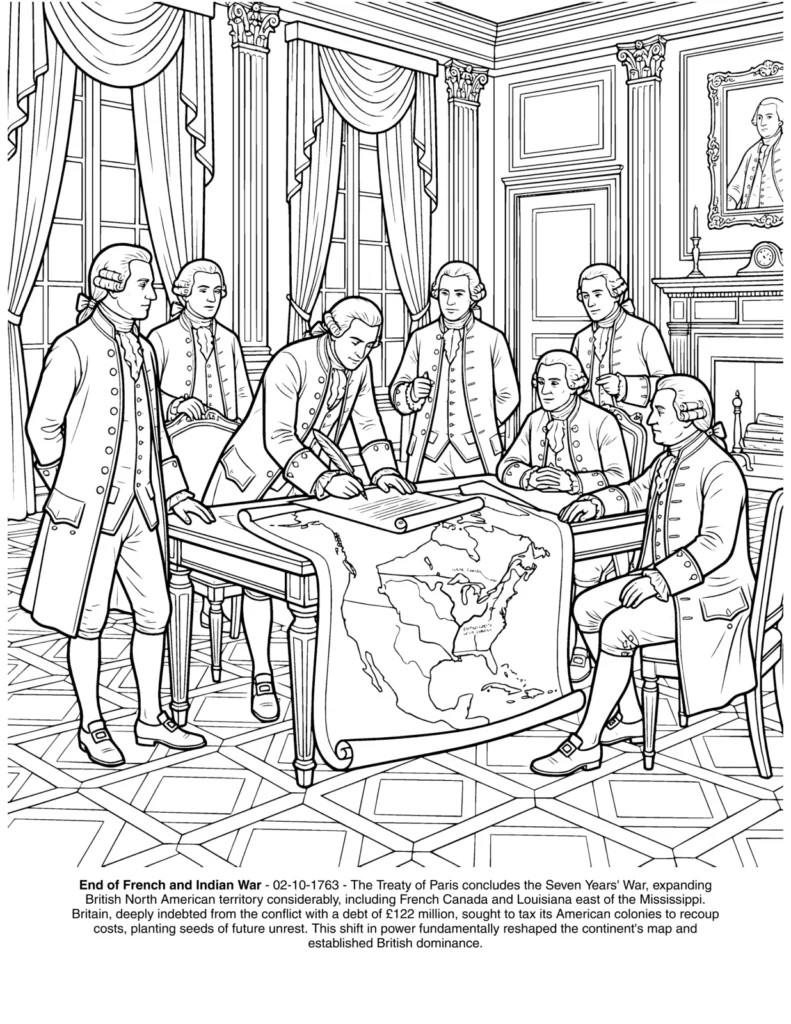
This is where The American Revolution coloring book begins: with the spark of taxation without representation, then the Boston Massacre of 1770. You color the night on King Street, and the caption beside the scene tells you how five deaths became a rallying cry.
An early scene from the book, ready to color.
How did the war begin in 1775?
The war began on April 19, 1775, when British troops marched from Boston to seize militia weapons at Concord. Shots were fired at Lexington, the militia fought back at Concord’s North Bridge, and the British retreated under fire all the way to Boston. Within two months the colonies had an army and a commander.
Bunker Hill in June showed both sides what was coming. The British took the hill, but only after three assaults and more than 1,000 casualties. Two weeks later George Washington took command of the new Continental Army outside Boston.
Lexington and Concord is one of the six turning points you color in the book. It is a good place to slow down, because this is the moment the protest becomes a war.
Why was 1776 the year of independence?
In 1776 the colonists stopped fighting for their rights as British subjects and started fighting for a separate country. Thomas Paine’s Common Sense, published in January, sold tens of thousands of copies and made the case in plain language. On July 4 the Second Continental Congress adopted the Declaration of Independence.
Independence nearly died within months. Washington lost New York after the Battle of Long Island in August, and by December his army was melting away. Then, on the night of December 25, he crossed the frozen Delaware and took Trenton the next morning, followed by Princeton a week later.
If you are teaching this period, the change from rights to independence is the idea students most often miss. Our guide to learning history through coloring explains why a dated scene and a short caption make that kind of idea stick better than a list.
What was the turning point of the American Revolution?
The turning point of the American Revolution was the American victory at Saratoga in October 1777. General Burgoyne surrendered an entire British army, and the news convinced France that the Americans could win. France signed a Treaty of Alliance in February 1778, bringing money, soldiers and a navy into the war.
Between those two dates came Valley Forge. Washington’s army spent the winter of 1777 to 1778 short of food, shoes and blankets, and thousands died of disease. In the spring, drilled by the Prussian officer Baron von Steuben, it marched out as a professional force.
Valley Forge and the French alliance are two of the six turning points in the book. The Valley Forge pages are some of the most absorbing to color: a winter camp, an army close to breaking, and a caption explaining how it survived.
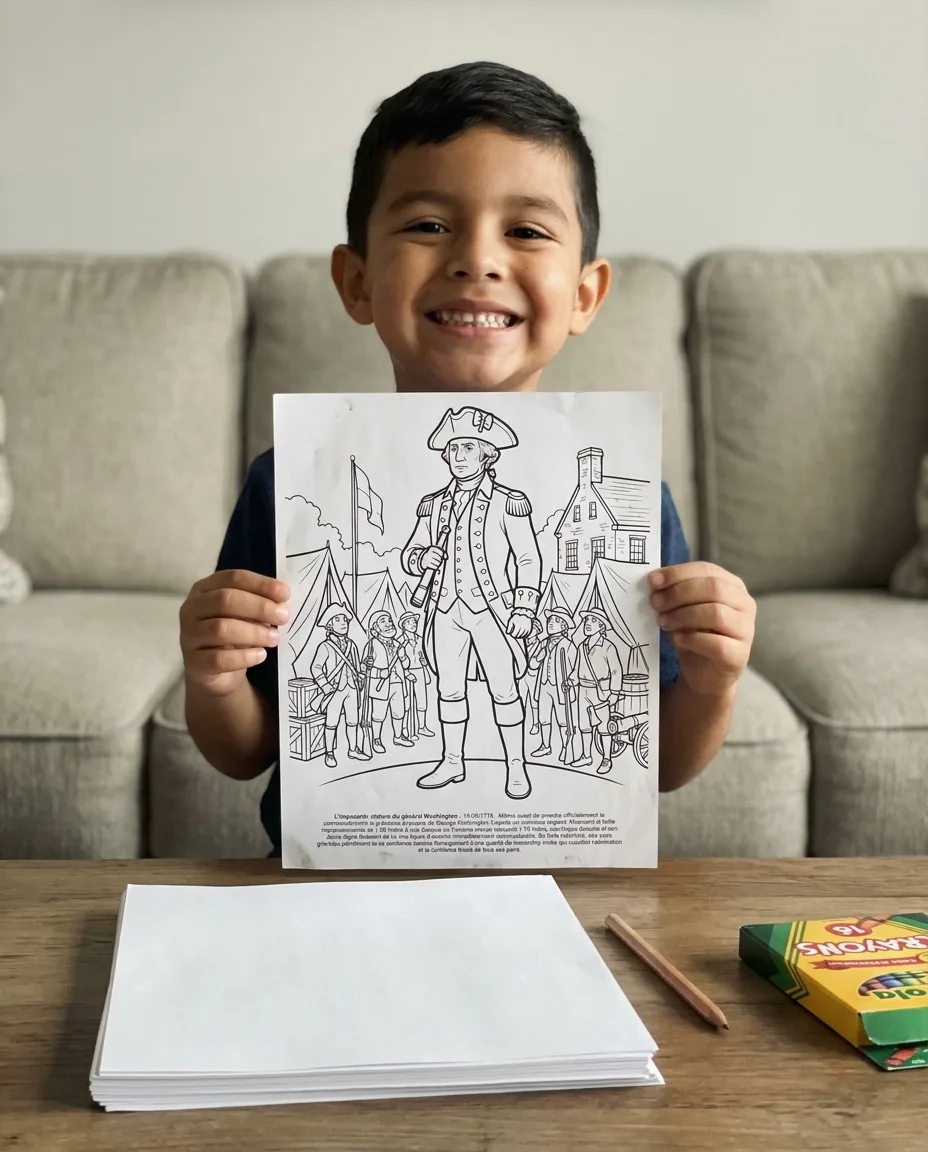
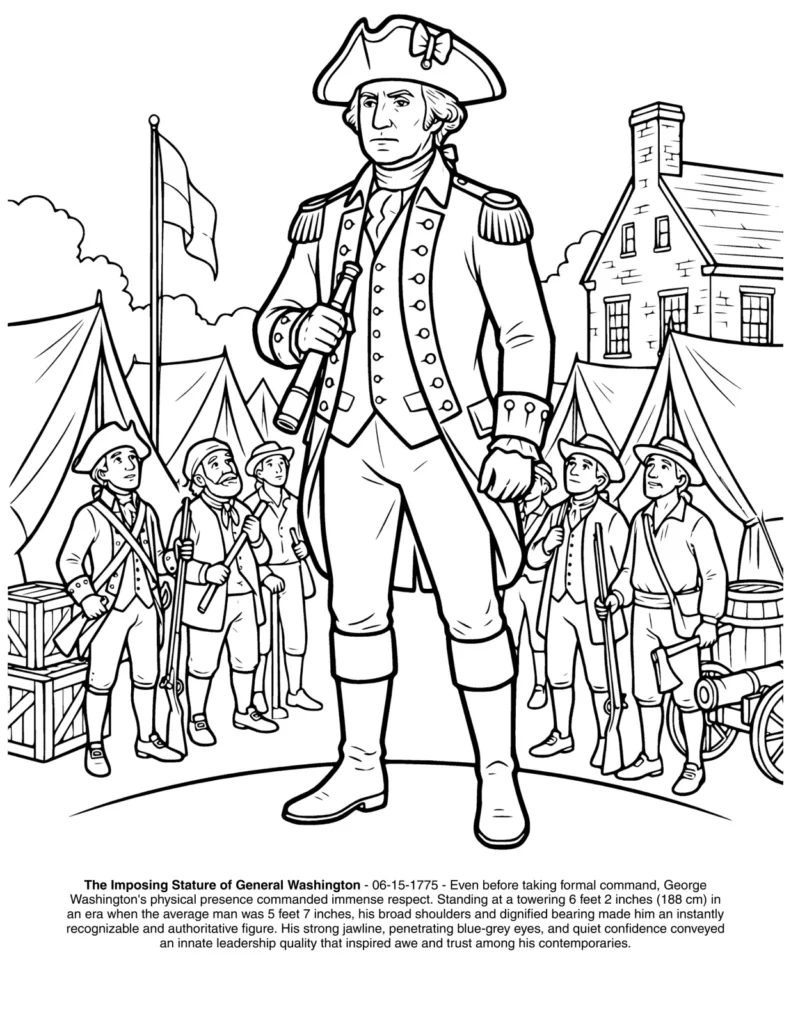
Inside the book: one of the 30+ scenes, in chronological order.
Get 5 illustrations from our bestselling coloring books, for free.
You will receive in your mail box the link to download the 5 illustrations in high quality and PDF format.
How did the American Revolution end?
The American Revolution ended in two steps. Militarily, it ended at Yorktown on October 19, 1781, when General Cornwallis surrendered after Washington’s army and the French fleet trapped him on the Virginia coast. Officially, it ended with the Treaty of Paris on September 3, 1783, when Britain recognized American independence.
The road to Yorktown ran through the South. Britain took Savannah and then Charleston in 1780, capturing over 5,000 American soldiers. American victories at Kings Mountain and Cowpens turned the southern campaign around and pushed Cornwallis north into Virginia.
Yorktown is the final scene of the book’s journey. You finish where the nation began, with a caption that ties the surrender back to the French alliance you colored a few pages earlier.
Who were the key people of the American Revolution?
The key people of the American Revolution include George Washington, who commanded the army; Thomas Jefferson, who drafted the Declaration; Benjamin Franklin, who won the French alliance; and Thomas Paine, who argued for independence. On the British side, George III, General Howe, Burgoyne and Cornwallis shaped the war.
Person
Role
Key date
George Washington
Commander of the Continental Army
Takes command, July 3, 1775
Thomas Paine
Author of Common Sense
January 10, 1776
Thomas Jefferson
Main author of the Declaration
July 4, 1776
Benjamin Franklin
Diplomat in Paris
Treaty of Alliance, February 6, 1778
Baron von Steuben
Drillmaster at Valley Forge
Winter 1777 to 1778
Marquis de Lafayette
French general in Washington’s army
Yorktown, 1781
Charles Cornwallis
British general
Surrenders, October 19, 1781
Names stick better with a face attached. That is why each scene in the book pairs a figure with a moment, so Washington is never just a name in a list.
How to use this timeline with a coloring book
To use this timeline with a coloring book, read one stage, then color the matching scene before moving on. Twenty minutes of coloring per stage is enough. The scene gives the date somewhere to live, and the short caption beside it does the explaining a textbook would.
The American Revolution coloring book follows the same order as this guide, with 30+ coloring pages and a verified fact on every scene. It is an instant PDF: print a page tonight on A4 or US Letter, reprint your favorite scenes, or color on a tablet. Our PDF vs physical coloring book guide helps if you are deciding between the two formats.
Print a page, follow the timeline, color the moment.
Want the next chapter? The Revolution and Civil War bundle pairs this book with The Civil War coloring book, which picks up the American story in 1861. To see how that war unfolded, read our Civil War battles in order.
Start with the Revolution, continue with the Civil War
American Revolution timeline: your questions answered
When did the American Revolution start and end?
The fighting started on April 19, 1775, at Lexington and Concord and ended with the British surrender at Yorktown on October 19, 1781. The war officially ended with the Treaty of Paris on September 3, 1783. The wider revolution began with protests against the Stamp Act in 1765.
What are the 5 main events of the American Revolution?
Five events carry the story: the Boston Tea Party (1773), Lexington and Concord (1775), the Declaration of Independence (1776), the victory at Saratoga that brought in France (1777) and the surrender at Yorktown (1781).
Why did the colonists win the American Revolution?
They fought on home ground, Washington kept the army together through defeats, and the French alliance after Saratoga gave them money, troops and a navy. The French fleet’s blockade at Yorktown made Cornwallis’s surrender possible.
How long did the American Revolutionary War last?
About eight years of fighting, from April 1775 to October 1781, and eight and a half years until the Treaty of Paris in September 1783.
Is there a coloring book about the American Revolution for adults?
Yes. The American Revolution coloring book by Motiv Colors follows the war in chronological order across 30+ pages, from the Stamp Act protests to Yorktown, with a verified historical fact beside every scene. It is an instant PDF you print at home.
Color the Revolution, one date at a time
Twenty dates, five stages, one story: taxes, protest, war, independence and an alliance that tipped the balance at Yorktown. Learn them once in order and they stay.
Print the first scene tonight and start with the spark in Boston. By the time you color the surrender at Yorktown, the timeline will be yours.
We use cookies to enhance your browsing experience, serve personalized content and analyze our traffic. You can accept all cookies, reject non-essential ones, or manage your preferences.
Required for the website to function and cannot be switched off. They are usually set in response to actions you make, such as setting privacy preferences or logging in.
Allow the website to remember choices you make (such as language or region) to provide enhanced, personalized features.
Help us understand how visitors interact with the website by collecting and reporting information anonymously.
Used to track visitors across websites to display relevant advertising and measure campaign effectiveness.