Civil War battles in order: from Fort Sumter to Appomattox
Most lists of Civil War battles are either a wall of 400 engagements or a top ten with no dates. Neither tells you how the war actually moved, year by year, from a fort in Charleston Harbor to a farmhouse at Appomattox.
Here are the Civil War battles in order: the 20 that shaped the war, with dates, winners and one line on why each one mattered. Then you can color the turning points and keep the order in your head for good.
Civil War battles in order: the 20 that shaped the war
The American Civil War was fought from April 12, 1861, to April 9, 1865. It opened with the Confederate attack on Fort Sumter and effectively ended when Robert E. Lee surrendered to Ulysses S. Grant at Appomattox Court House. These 20 battles, in order, carried the war between those dates.
Date
Battle
Result
Why it mattered
Apr 12-13, 1861
Fort Sumter, SC
Confederate
The first shots; Lincoln calls for 75,000 volunteers
Jul 21, 1861
First Bull Run (Manassas), VA
Confederate
Ends hopes of a short war
Feb 16, 1862
Fort Donelson, TN
Union
Grant’s “unconditional surrender” opens Tennessee
Mar 9, 1862
Hampton Roads, VA
Draw
Monitor vs Virginia, the first duel of ironclads
Apr 6-7, 1862
Shiloh, TN
Union
Over 23,000 casualties shock both sides
Jun 25-Jul 1, 1862
Seven Days, VA
Confederate
Lee drives McClellan away from Richmond
Aug 28-30, 1862
Second Bull Run, VA
Confederate
Lee moves north toward Maryland
Sep 17, 1862
Antietam, MD
Union (strategic)
The bloodiest single day; leads to the Emancipation Proclamation
Dec 13, 1862
Fredericksburg, VA
Confederate
A costly Union defeat at Marye’s Heights
Apr 30-May 6, 1863
Chancellorsville, VA
Confederate
Lee’s boldest win; Stonewall Jackson is mortally wounded
Jul 1-3, 1863
Gettysburg, PA
Union
Lee’s invasion of the North fails
May 18-Jul 4, 1863
Siege of Vicksburg, MS
Union
The Union controls the Mississippi River
Sep 18-20, 1863
Chickamauga, GA
Confederate
The largest Confederate win in the West
Nov 23-25, 1863
Chattanooga, TN
Union
Opens the road to Atlanta
May 5-7, 1864
The Wilderness, VA
Inconclusive
Grant keeps pushing south instead of retreating
May 31-Jun 12, 1864
Cold Harbor, VA
Confederate
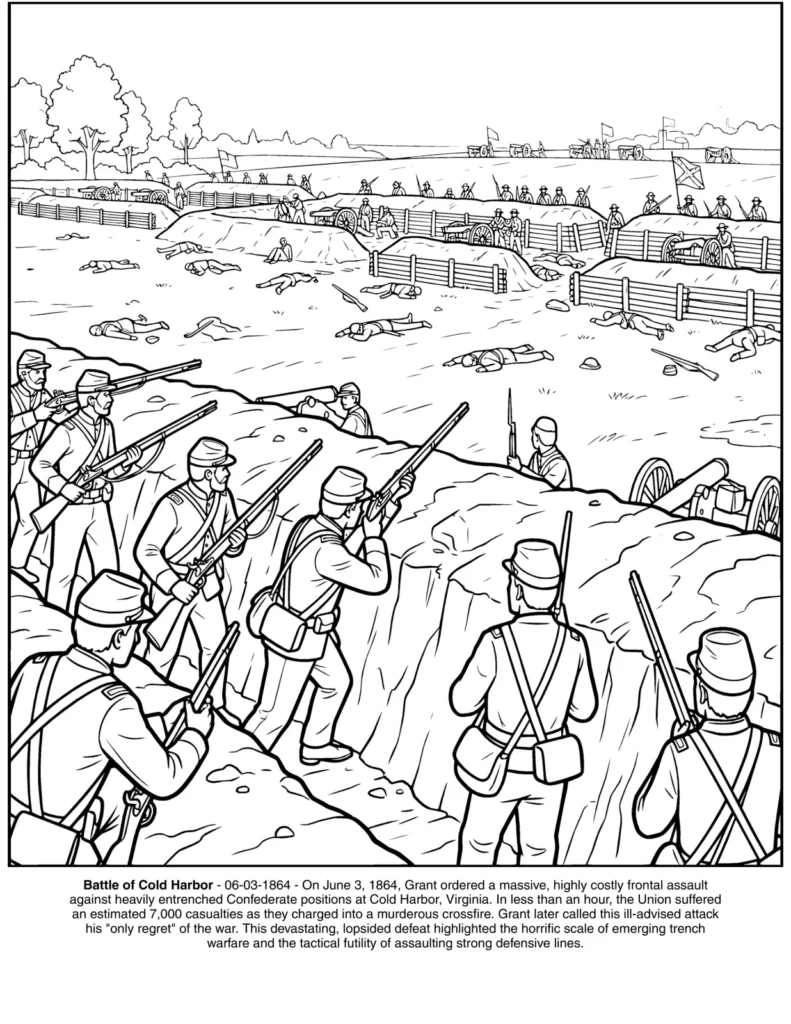
Grant’s worst assault of the war
Jun 1864-Apr 1865
Siege of Petersburg, VA
Union
Nine months of trenches pin Lee’s army down
Sep 2, 1864
Fall of Atlanta, GA
Union
Secures Lincoln’s re-election
Nov 30, 1864
Franklin, TN
Union
Six Confederate generals are killed in one afternoon
Apr 9, 1865
Appomattox Court House, VA
Union
Lee surrenders the Army of Northern Virginia
Read the table top to bottom and a pattern appears. The Confederacy wins most big fights in Virginia until mid-1863, while the Union wins steadily in the West, then everything turns in a single week in July 1863.
How did the Civil War start in 1861?
The Civil War started on April 12, 1861, when Confederate batteries fired on Fort Sumter in Charleston Harbor. Seven Southern states had already seceded after Abraham Lincoln’s election, and four more joined them after the attack. The first major land battle, First Bull Run in July, ended any hope of a quick war.
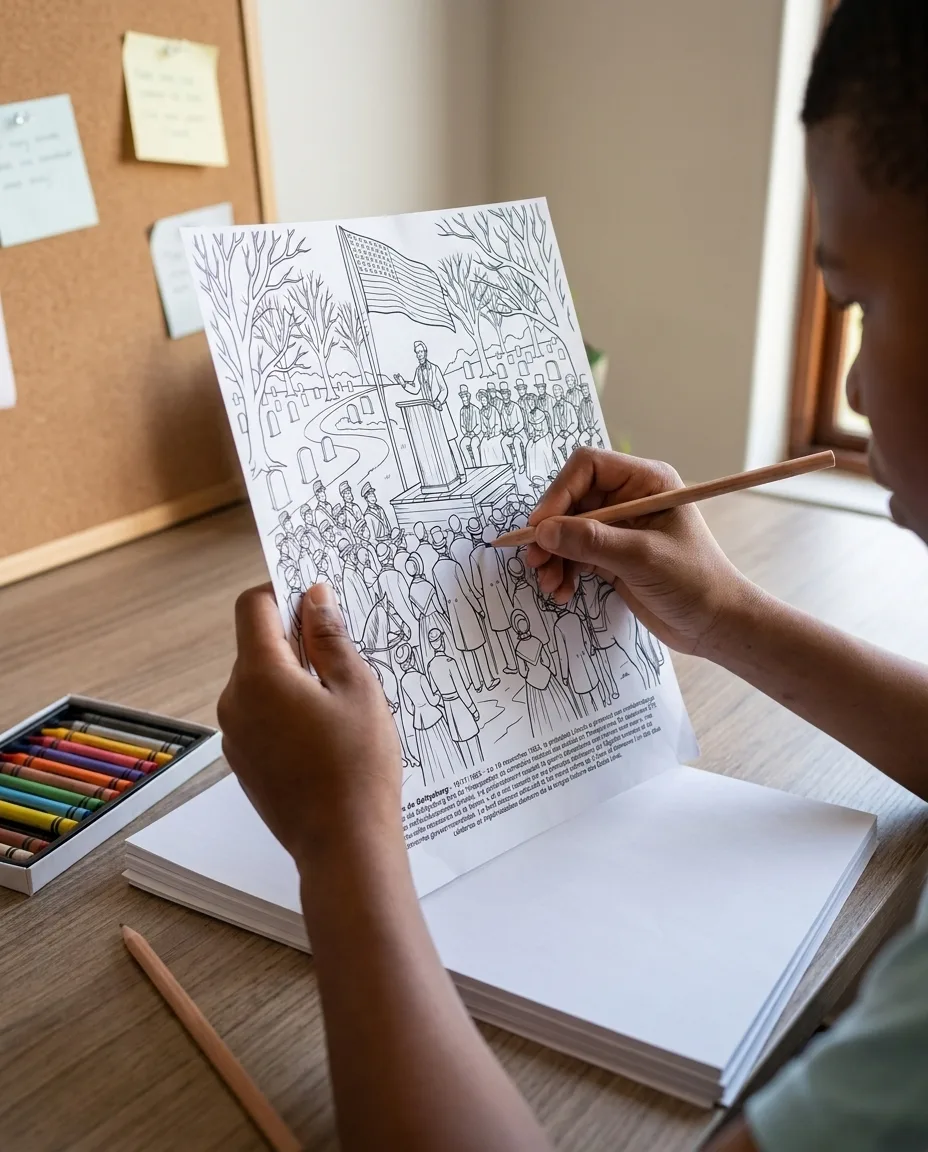
The Civil War coloring book opens exactly here. First the nation divides, as eleven states leave the Union, then the attack on Fort Sumter starts four years of war. Each scene carries a short caption, so you color the moment and learn what it set in motion.
An early scene from the book, ready to color.
What were the major battles of 1862?
The major battles of 1862 were Fort Donelson, Shiloh, the Seven Days, Second Bull Run, Antietam and Fredericksburg. In the West, Grant won Fort Donelson and held on at Shiloh. In the East, Lee pushed the Union back from Richmond, invaded Maryland and was stopped at Antietam.
Antietam, on September 17, 1862, remains the bloodiest single day in American history, with about 23,000 men killed, wounded or missing. It was not a clear win on the field, but Lee retreated. Five days later Lincoln announced the Emancipation Proclamation.
The year ended badly for the Union at Fredericksburg, where wave after wave of attacks broke against Confederate lines on Marye’s Heights. For our readers who served, our guide to gifts for veterans who love history covers the books and maps that do this period justice.
Why was 1863 the turning point of the Civil War?
1863 was the turning point because two Union victories came in the same week. At Gettysburg, on July 1 to 3, Lee’s invasion of the North failed. On July 4, Vicksburg surrendered to Grant, giving the Union control of the Mississippi River and splitting the Confederacy in two.
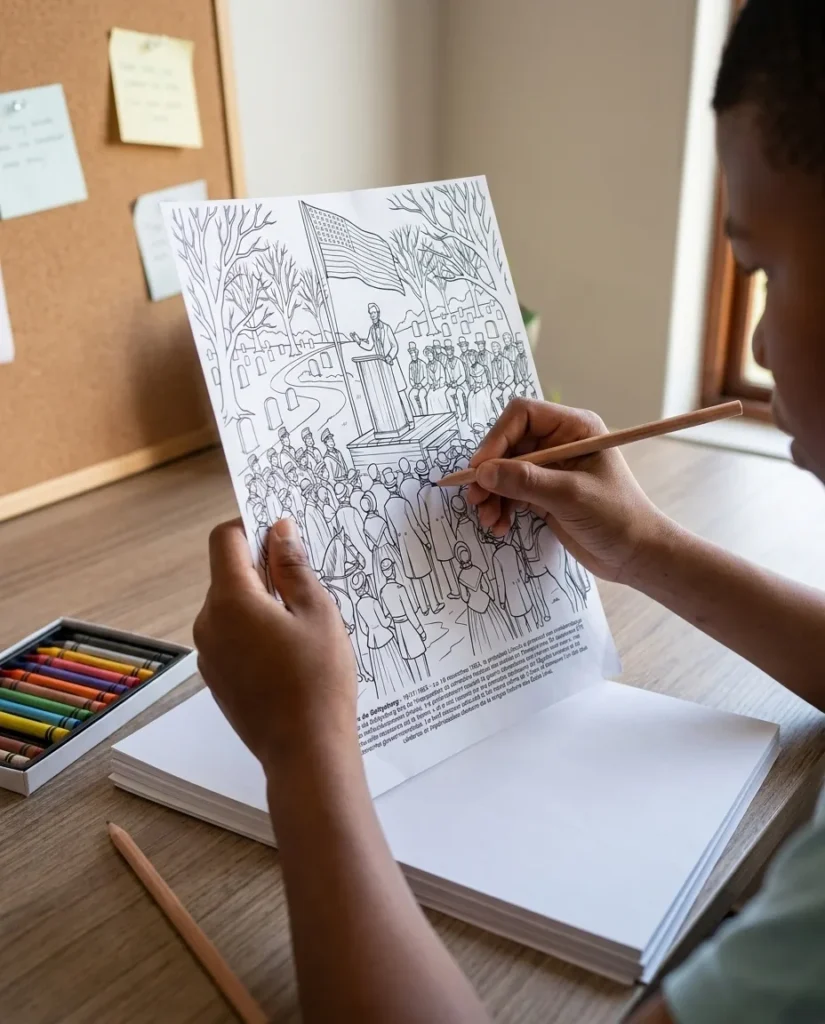
Gettysburg cost about 51,000 casualties over three days, the highest of any battle in the war. Pickett’s Charge on the third day became the symbol of the Confederacy’s high-water mark. In November, Lincoln returned to the battlefield to give the Gettysburg Address.
Gettysburg is the turning point the book is built around, and the Emancipation Proclamation sits beside it: the moment freedom became the Union’s defining cause. Coloring the two together makes the link between the battlefield and the war’s purpose hard to forget.
In 1864 the Union used its size to grind the Confederacy down. Grant fought Lee in Virginia without retreating, through the Wilderness, Spotsylvania and Cold Harbor, then laid siege to Petersburg. In the West, Sherman took Atlanta in September and marched to the sea at Savannah.
Sherman’s March to the Sea, from November 15 to December 21, 1864, cut a path up to 60 miles wide across Georgia. It destroyed railroads, factories and supplies the Confederate armies depended on. The fall of Atlanta also helped Lincoln win re-election in November, which ended any chance of a negotiated peace.
The March to the Sea is one of the book’s six turning points. It is a different kind of scene from the battlefields before it, a war against supply lines and industry rather than armies, and the caption explains why it mattered so much.
Inside the book: the last year of the war.
Get 5 illustrations from our bestselling coloring books, for free.
You will receive in your mail box the link to download the 5 illustrations in high quality and PDF format.
How did the Civil War end in 1865?
The Civil War ended in the spring of 1865. Petersburg and Richmond fell on April 2 and 3, and Lee surrendered to Grant at Appomattox Court House on April 9. Five days later Lincoln was shot at Ford’s Theatre. The last Confederate forces surrendered over the following weeks.
The cost was enormous. Historians estimate that between 620,000 and 750,000 soldiers died, more than in any other American war. The Thirteenth Amendment, ratified in December 1865, abolished slavery throughout the United States.
Appomattox is the last scene of the book. You color the surrender that ended four years of war and preserved the United States, and the story you began at Fort Sumter comes full circle.
How to learn the Civil War battles in order
To learn the Civil War battles in order, group them by year and theater, East and West, and attach one image to each turning point. Four years and two theaters is easier to hold than twenty separate names. Coloring the key scenes gives each one a picture you will remember.
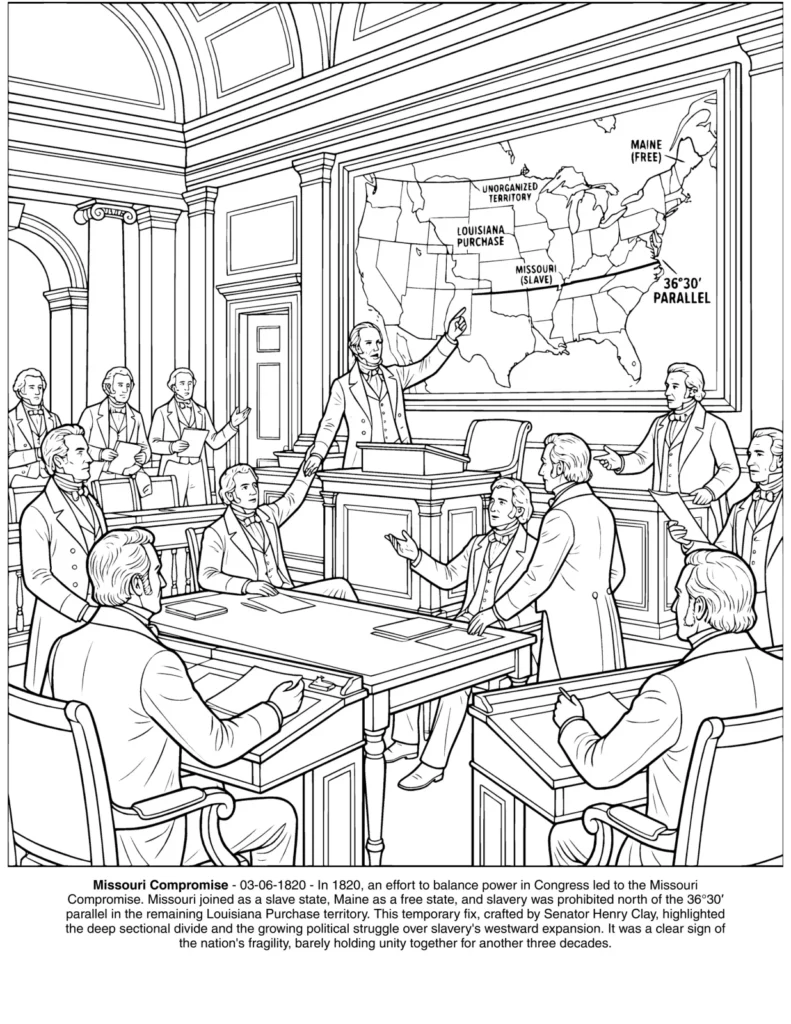
That is the idea behind The Civil War coloring book: 30+ realistic scenes in chronological order, each with a verified caption. It is an instant PDF, so you can print a battle tonight on A4 or US Letter and reprint any page. We explain why the method works in learning history through coloring.
Teachers often print one battle per lesson for the class; see our gifts for history teachers. If you are comparing publishers, our Dover vs Motiv Colors comparison sets the books side by side.
Civil War battles in order: your questions answered
What was the first battle of the Civil War?
The first battle was the Confederate bombardment of Fort Sumter in Charleston Harbor, South Carolina, on April 12 and 13, 1861. The first major land battle was First Bull Run, or First Manassas, in Virginia on July 21, 1861.
What was the bloodiest battle of the Civil War?
Gettysburg, fought July 1 to 3, 1863, had the most casualties, about 51,000 over three days. Antietam, on September 17, 1862, was the bloodiest single day, with about 23,000 casualties.
What was the last battle of the Civil War?
Lee’s surrender at Appomattox Court House on April 9, 1865, effectively ended the war. Fighting continued in places for weeks, and the Battle of Palmito Ranch in Texas, in May 1865, is usually called the last land battle.
What were the turning points of the Civil War?
The usual answer is July 1863, when the Union won at Gettysburg and took Vicksburg in the same week. Antietam in 1862, which led to the Emancipation Proclamation, and the fall of Atlanta in 1864 are the other turning points historians point to.
Is there a Civil War coloring book for adults?
Yes. The Civil War coloring book by Motiv Colors follows the war in chronological order across 30+ realistic scenes, from secession and Fort Sumter to Gettysburg, the March to the Sea and Appomattox, with a verified caption on every page. It is an instant PDF you print at home.
Color the war in the order it was fought
Twenty battles, four years, two theaters, and one week in July 1863 that turned everything. Learn them in order once and the whole war makes sense.
Print the first scene tonight, start with the nation dividing, and color your way to Appomattox.
We use cookies to enhance your browsing experience, serve personalized content and analyze our traffic. You can accept all cookies, reject non-essential ones, or manage your preferences.
Required for the website to function and cannot be switched off. They are usually set in response to actions you make, such as setting privacy preferences or logging in.
Allow the website to remember choices you make (such as language or region) to provide enhanced, personalized features.
Help us understand how visitors interact with the website by collecting and reporting information anonymously.
Used to track visitors across websites to display relevant advertising and measure campaign effectiveness.