The First World War is hard to hold in your head. It ran for four years on half a dozen fronts, and most timelines bury the dates that changed the war under the dozens that did not.
This WW1 timeline goes year by year from the shots in Sarajevo to the silence of 11 a.m. on 11 November 1918. Each year gets its key dates, a short answer on why it mattered, and the scene from the war you can color to make it stay.
WW1 timeline at a glance
The First World War began on 28 July 1914, when Austria-Hungary declared war on Serbia, and the fighting ended with the Armistice at 11 a.m. on 11 November 1918. The Treaty of Versailles, signed on 28 June 1919, formally closed the war with Germany. These are the dates that shaped it.
Date
Event
Why it mattered
28 Jun 1914
Assassination of Franz Ferdinand in Sarajevo
The spark that sets the alliance system off
28 Jul 1914
Austria-Hungary declares war on Serbia
The war formally begins
4 Aug 1914
Germany invades Belgium; Britain declares war
A Balkan crisis becomes a European war
6-12 Sep 1914
First Battle of the Marne
Stops the German advance on Paris; trench warfare follows
Dec 1914
Christmas truce
Soldiers of both sides meet in no man’s land
22 Apr 1915
Chlorine gas at Ypres
The first large-scale gas attack on the Western Front
25 Apr 1915
Gallipoli landings
The Allied attempt to knock out the Ottoman Empire fails by January 1916
7 May 1915
Lusitania sunk
1,198 dead, many American; US opinion turns against Germany
21 Feb 1916
Battle of Verdun begins
Ten months, over 300,000 dead, lines barely move
31 May 1916
Battle of Jutland
The only great fleet battle; the British blockade holds
1 Jul 1916
Battle of the Somme begins
57,000 British casualties on the first day
15 Sep 1916
First tanks in battle
British tanks go into action at Flers-Courcelette
6 Apr 1917
United States declares war
Fresh men and money reach the Allies
31 Jul 1917
Passchendaele begins
A battle fought in mud that becomes the war’s symbol
7 Nov 1917
Bolshevik Revolution
Russia leaves the war
3 Mar 1918
Treaty of Brest-Litovsk
Germany frees its eastern armies for one last offensive
21 Mar 1918
German Spring Offensive
Germany’s final gamble on the Western Front
8 Aug 1918
Battle of Amiens
The start of the Hundred Days that end the war
11 Nov 1918
Armistice
The guns fall silent at 11 a.m.
28 Jun 1919
Treaty of Versailles
Peace with Germany, five years to the day after Sarajevo
Notice the first and last dates: 28 June 1914 and 28 June 1919. The treaty was signed five years to the day after the assassination that started it all.
How did World War 1 start in 1914?
World War 1 started when a Bosnian Serb, Gavrilo Princip, shot Archduke Franz Ferdinand of Austria-Hungary in Sarajevo on 28 June 1914. Austria-Hungary declared war on Serbia on 28 July. The alliances then pulled in Russia, Germany, France and, after Germany invaded Belgium on 4 August, Britain.
Germany’s plan was to defeat France quickly before turning on Russia. It failed at the Marne in September, and by the end of 1914 both sides had dug trenches running about 700 km from the Belgian coast to Switzerland. That December, soldiers on parts of the front left their trenches for an unofficial Christmas truce.
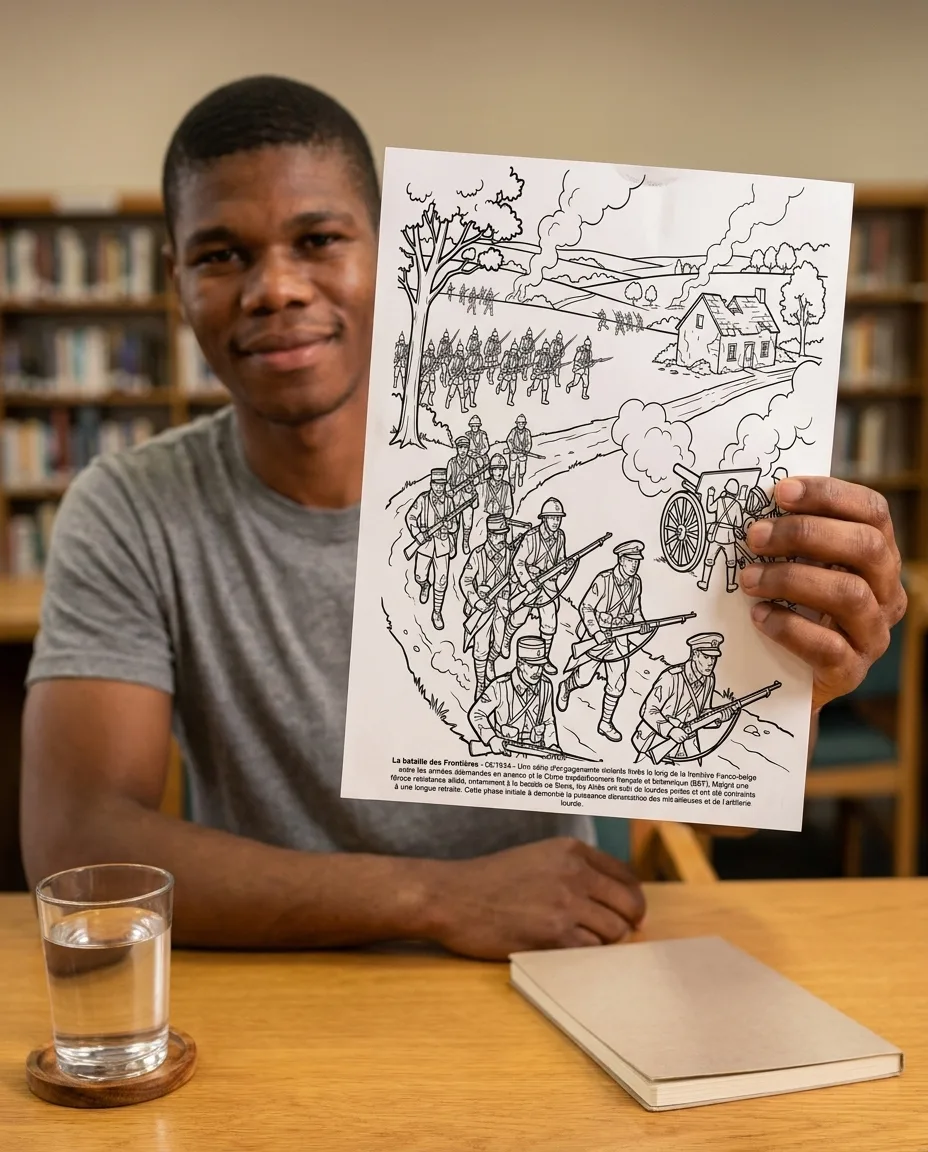
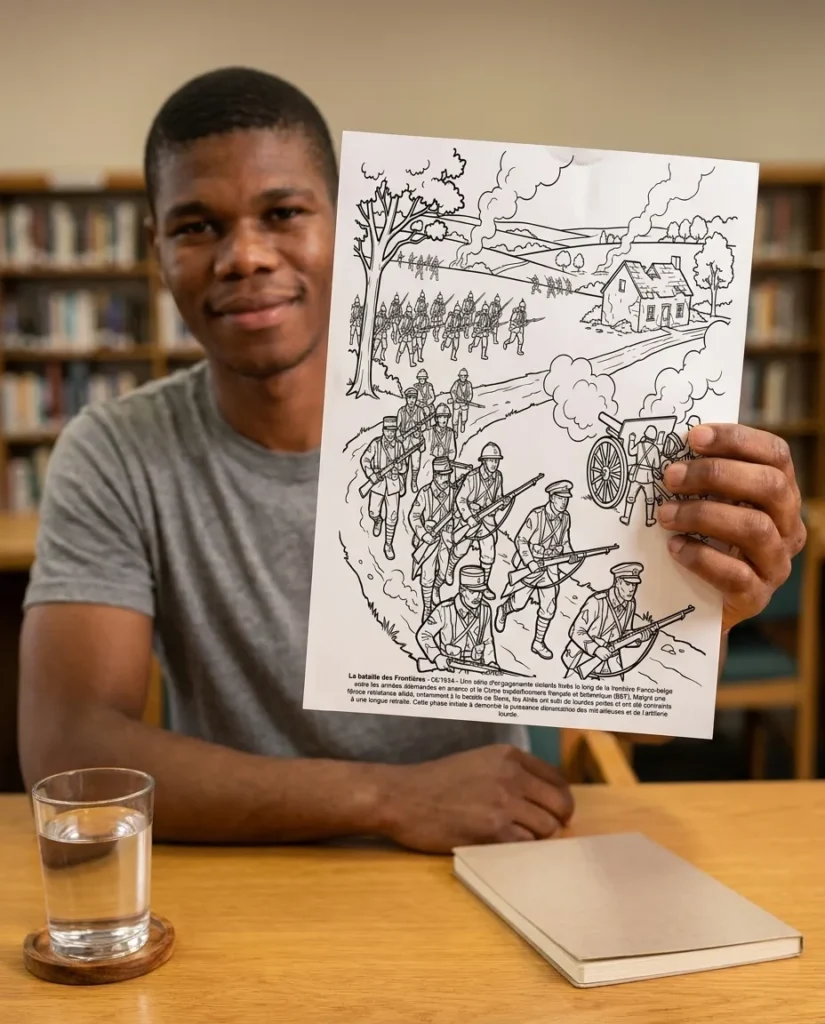
The First World War coloring book opens with that spark in Sarajevo, then moves to the Western Front. You color the cascade of ultimatums and the first trenches, and the caption beside each scene explains how one shot became a world war.
An early scene from the book, ready to color.
What happened in WW1 in 1915?
In 1915 the war spread and both sides searched for a way past the trenches. Germany used chlorine gas at Ypres in April. The Allies landed at Gallipoli to strike the Ottoman Empire, and failed. A German U-boat sank the Lusitania in May, and Italy joined the Allies the same month.
Gallipoli became a defining memory for Australia and New Zealand, whose ANZAC troops landed on 25 April, now commemorated as ANZAC Day. The campaign dragged on until the last Allied troops left in January 1916, with nothing gained.
Why was 1916 the deadliest year of the war?
1916 was the year of the great battles of attrition. At Verdun, from February to December, France and Germany lost over 300,000 dead between them. On the Somme, the British Army suffered 57,000 casualties on 1 July alone. On the Eastern Front, Russia’s Brusilov Offensive cost both sides enormous losses.
Neither Verdun nor the Somme broke the line. They did change the war: the first tanks went into action on the Somme on 15 September 1916, and both battles became, for France and Britain, the defining image of the Great War.
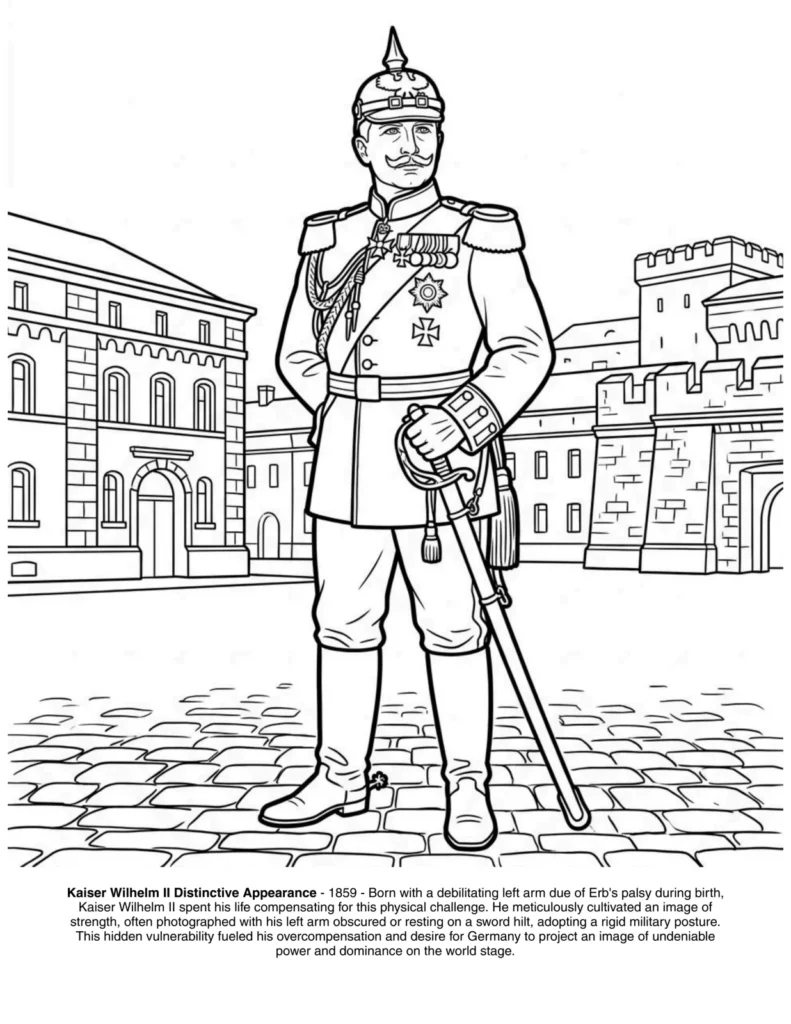
The Somme and Verdun are two of the six turning points in the book. They are also the pages people linger on longest, because the scale of what happened only lands when you spend time inside one scene.
Color the Great War from Sarajevo to the Armistice
1917 changed the balance of the war. Germany’s return to unrestricted submarine warfare brought the United States into the war on 6 April. In Russia, revolution toppled the Tsar in March, and the Bolsheviks seized power in November and took Russia out of the war.
On the Western Front, the British offensive at Passchendaele from July to November ground through mud for a few kilometres of ground. At Cambrai in November, massed tanks broke the German line for the first time, a glimpse of how the war would end.
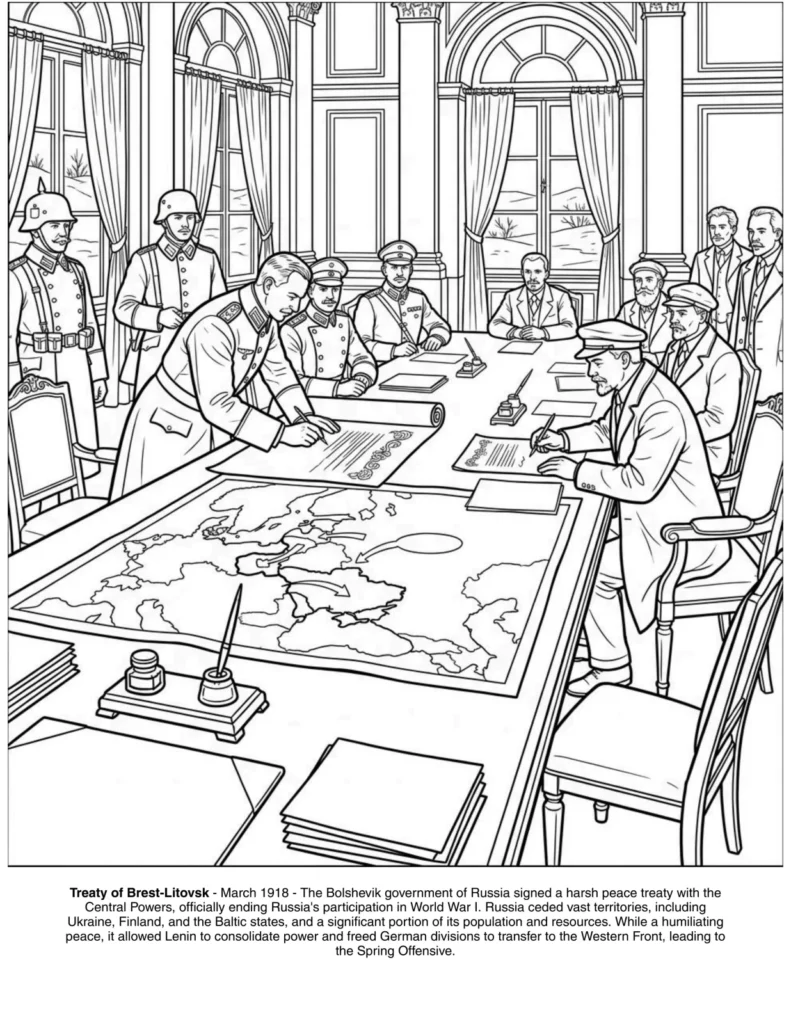
The Eastern Front has its own chapter in the book, from the vast Russian armies of 1914 to the revolution that shattered the Tsar’s empire. It is the front most timelines skip, and the one that explains why Germany could attack again in 1918.
Inside the book: the last chapters of the war.
Get 5 illustrations from our bestselling coloring books, for free.
You will receive in your mail box the link to download the 5 illustrations in high quality and PDF format.
How did the First World War end in 1918?
The First World War ended with the Armistice signed in a railway carriage at Compiègne, which took effect at 11 a.m. on 11 November 1918. Germany’s Spring Offensive had failed, the Allied Hundred Days offensive from August pushed its armies back, and its allies collapsed one after another.
Around 9 to 10 million soldiers died, and millions of civilians. The Armistice stopped the fighting, but the war was settled only by the Treaty of Versailles in June 1919, which redrew the map of Europe and the Middle East.
The Armistice is the final scene of the book: the moment the guns fall silent and a broken world begins counting its losses. On Armistice Day, Remembrance Day or Veterans Day, it is a quiet, fitting page to color. Our gifts for veterans who love history guide has more ideas for the occasion.
How to remember the WW1 timeline
To remember the WW1 timeline, hang it on one image per year: Sarajevo for 1914, Gallipoli for 1915, the Somme for 1916, the US entry for 1917 and the Armistice for 1918. Five anchors carry the whole war. Coloring one scene for each turns the anchors into pictures.
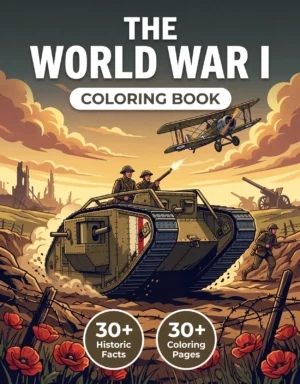
The First World War coloring book follows the war in that order, with 30+ researched scenes and a verified fact on each. It is an instant PDF you can print tonight on A4 or US Letter, and reprint for every family member or student. See why the method works in learning history through coloring, or compare formats in our PDF vs physical coloring book guide.
One year of the war, one evening of coloring.
For the war that followed, the First and Second World War bundle carries the story on to 1945. It also makes a gift that gets used; see our best gifts for history lovers.
World War 1 started on 28 July 1914, when Austria-Hungary declared war on Serbia, a month after the assassination of Franz Ferdinand. The fighting ended with the Armistice at 11 a.m. on 11 November 1918, and the Treaty of Versailles was signed on 28 June 1919.
What were the main causes of WW1?
Historians often summarize them as militarism, alliances, imperialism and nationalism. The assassination of Archduke Franz Ferdinand in Sarajevo was the trigger that set the alliance system in motion.
What was the deadliest battle of WW1?
The Battle of the Somme in 1916 had over a million casualties on both sides. Verdun, the same year, lasted ten months and killed over 300,000 soldiers. On 1 July 1916, the first day of the Somme, the British Army suffered 57,000 casualties.
Why is 11 November remembered?
The Armistice that ended the fighting took effect at the eleventh hour of the eleventh day of the eleventh month, 11 a.m. on 11 November 1918. It is marked as Armistice Day in France, Remembrance Day in Britain and the Commonwealth, and Veterans Day in the United States.
Is there a WW1 coloring book for adults?
Yes. The First World War coloring book by Motiv Colors follows the war in chronological order across 30+ researched scenes, from Sarajevo through the Somme, Verdun and the Eastern Front to the Armistice, with a verified fact beside every scene. It is an instant PDF you print at home.
Color the Great War, one year at a time
Five years from Sarajevo to Versailles, four of them at war, and five anchor dates that carry the whole story. Learn them in order and the war stops being a blur.
Print the first scene tonight, start with the shot in Sarajevo, and color your way to the silence of 11 November.
We use cookies to enhance your browsing experience, serve personalized content and analyze our traffic. You can accept all cookies, reject non-essential ones, or manage your preferences.
Required for the website to function and cannot be switched off. They are usually set in response to actions you make, such as setting privacy preferences or logging in.
Allow the website to remember choices you make (such as language or region) to provide enhanced, personalized features.
Help us understand how visitors interact with the website by collecting and reporting information anonymously.
Used to track visitors across websites to display relevant advertising and measure campaign effectiveness.