World War 2 timeline: the war in 30 moments, 1939 to 1945
Six years, a hundred countries and more battles than any one book can hold. Most timelines of the Second World War either list every date or stop halfway, and either way the shape of the war gets lost.
This World War 2 timeline keeps it to 30 moments, from the invasion of Poland on September 1, 1939 to the surrender in Tokyo Bay on September 2, 1945. For each one you get the date, what happened and why it mattered, then the story of each year, and a way to color the war in order, one scene at a time.
World War 2 timeline in 30 moments
The Second World War runs from Germany’s invasion of Poland on September 1, 1939 to Japan’s formal surrender on September 2, 1945. It turns in three places: the Battle of Britain in 1940, the run from Midway to Stalingrad in 1942 and 1943, and the D-Day landings of June 1944.
#
Date
Moment
1
Sep 1, 1939
Germany invades Poland
2
Sep 3, 1939
Britain and France declare war on Germany
3
Apr 9, 1940
Germany invades Denmark and Norway
4
May 10, 1940
Attack on the West; Churchill becomes prime minister
5
May 26 to Jun 4, 1940
The evacuation of Dunkirk
6
Jun 22, 1940
France signs an armistice
7
Jul 10 to Oct 31, 1940
The Battle of Britain
8
Sep 7, 1940
The Blitz begins on London
9
Jun 22, 1941
Operation Barbarossa: Germany invades the Soviet Union
10
Sep 8, 1941
The siege of Leningrad begins
11
Dec 7, 1941
Pearl Harbor; the United States enters the war
12
Jan 20, 1942
The Wannsee Conference
13
Jun 4 to 7, 1942
The Battle of Midway
14
Aug 7, 1942
US Marines land on Guadalcanal
15
Aug 23, 1942
The Battle of Stalingrad begins
16
Oct 23, 1942
The Second Battle of El Alamein
17
Nov 8, 1942
Operation Torch lands in North Africa
18
Feb 2, 1943
The German Sixth Army surrenders at Stalingrad
19
Jul 5, 1943
The Battle of Kursk
20
Sep 8, 1943
Italy’s armistice is announced
21
Jan 27, 1944
The siege of Leningrad is lifted
22
Jun 6, 1944
D-Day in Normandy
23
Aug 25, 1944
Paris is liberated
24
Oct 23 to 26, 1944
The Battle of Leyte Gulf
25
Dec 16, 1944
The Battle of the Bulge
26
Jan 27, 1945
Soviet troops liberate Auschwitz
27
Feb 19, 1945
US Marines land on Iwo Jima
28
May 8, 1945
Victory in Europe
29
Aug 6 and 9, 1945
Atomic bombs on Hiroshima and Nagasaki
30
Sep 2, 1945
Japan signs the surrender aboard the USS Missouri
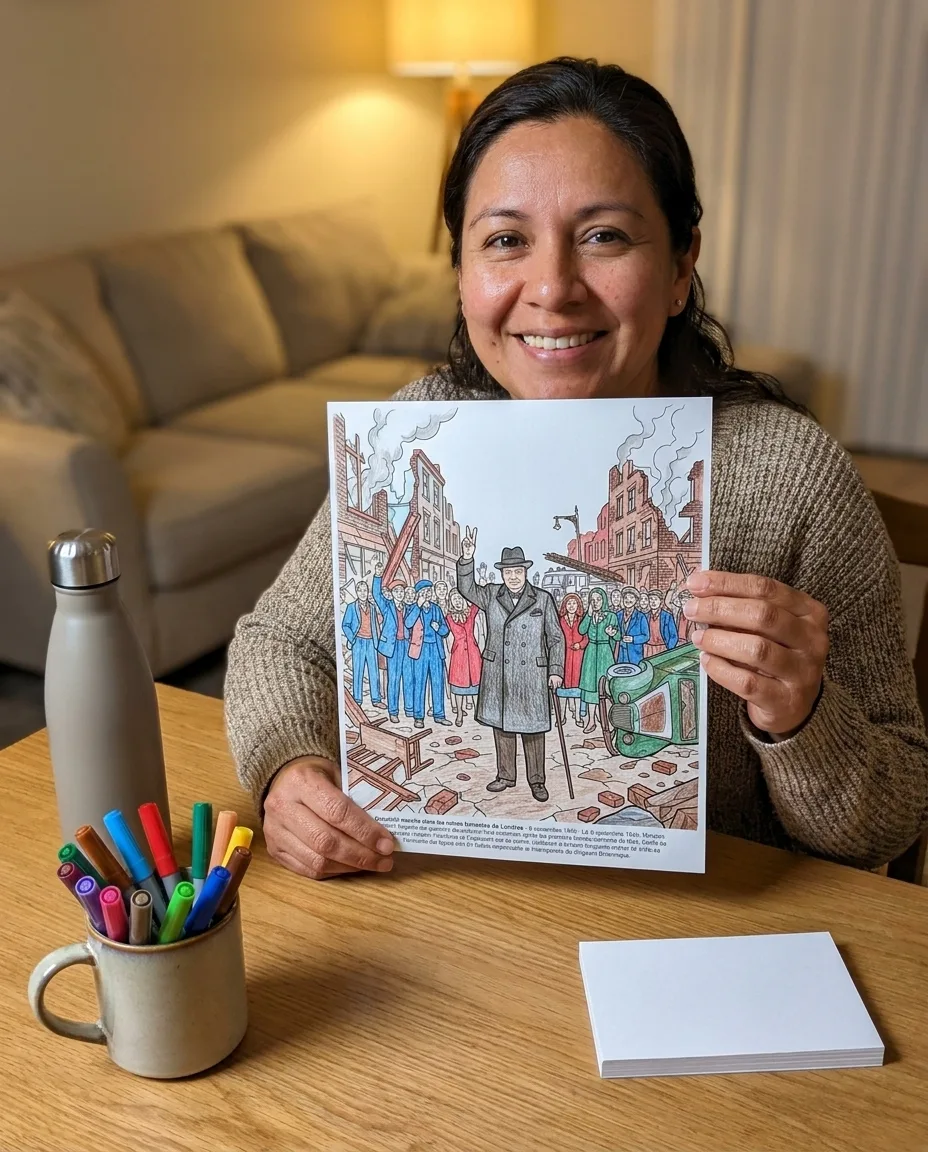
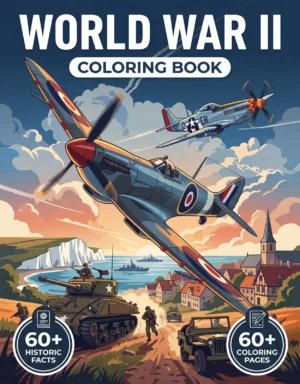
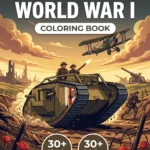
The World War II coloring book follows the same road across 60+ scenes, from the road to war and the fall of France to the Eastern Front, the Pacific, D-Day and victory, with a caption giving the date and context on every page.
World War 2 began on September 1, 1939, when Germany invaded Poland after years of rearmament and land grabs that Britain and France had tried to appease. Britain and France declared war two days later. On September 17 the Soviet Union, bound to Germany by a secret pact, invaded Poland from the east.
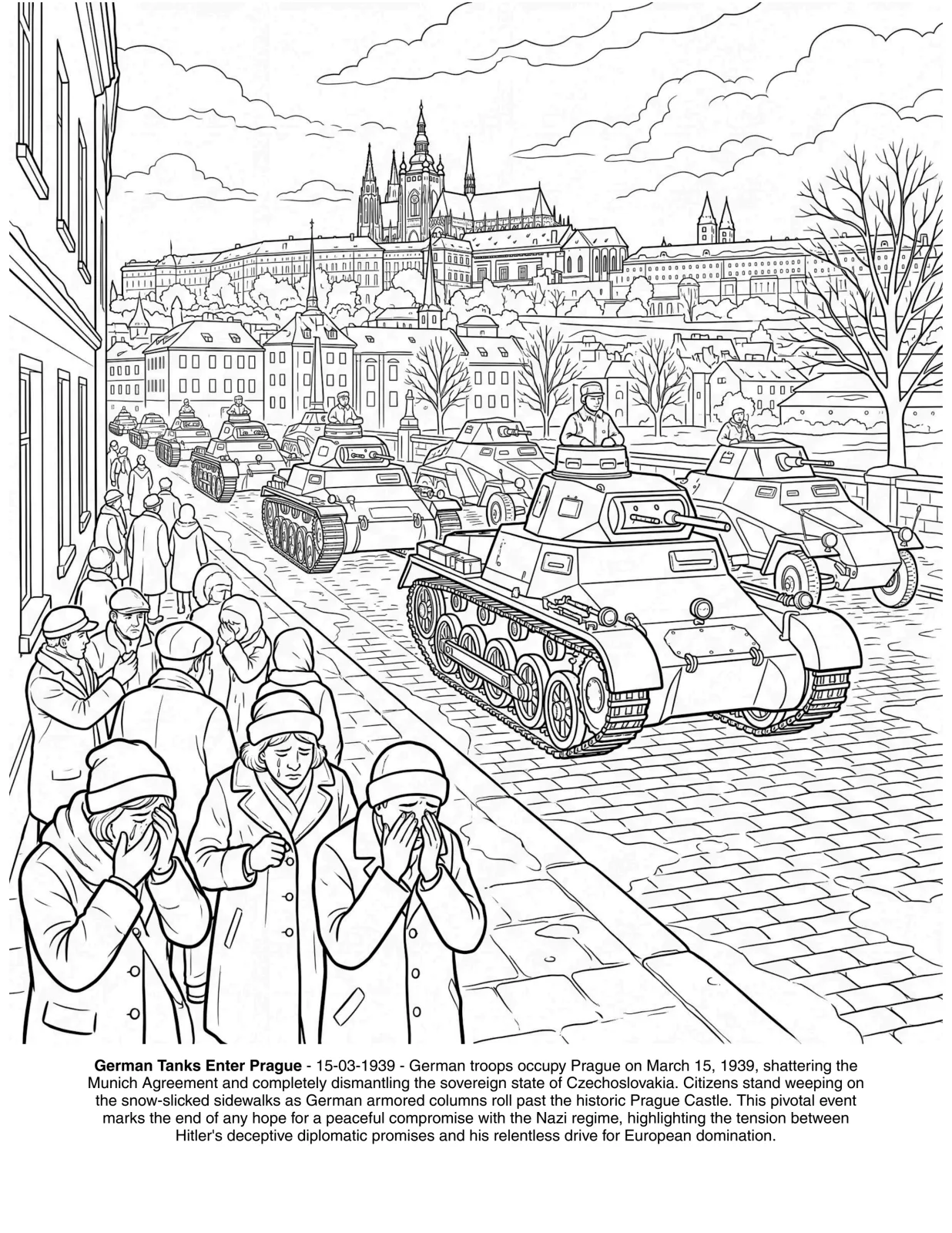
The road ran through Munich. In September 1938, Britain and France let Hitler take the Sudetenland from Czechoslovakia in return for a promise of peace; six months later he took the rest of the country.
Poland fought for five weeks. Then came the Phoney War, months in which the Western Allies and Germany faced each other with almost no fighting in the West.
1940: why did France fall so fast?
France fell in six weeks because German armored divisions went through the Ardennes forest, which the Allies thought too difficult for tanks, and cut the Allied armies in two. More than 338,000 Allied soldiers escaped from the beaches of Dunkirk, and France signed an armistice on June 22, 1940.
On May 10, the day the attack began, Winston Churchill became prime minister. By June 14 German troops marched down the Champs-Élysées.
Britain then fought alone. Through the summer, RAF Spitfires and Hurricanes fought the Luftwaffe over southern England in the Battle of Britain, and from September 7 bombers struck London night after night in the Blitz, as families slept in Underground stations.
The fall of France and the Battle of Britain are chapters of their own in the World War II coloring book.
An early scene from the World War II coloring book, ready to color.
1941: how did the war become global?
In 1941 the war became a world war twice over. On June 22 more than three million Axis soldiers invaded the Soviet Union, opening the largest front in history. On December 7 Japanese carriers struck Pearl Harbor, and within days the United States was at war with both Japan and Germany.
In the east, German armies reached the outskirts of Moscow before winter stopped them. Leningrad was encircled in September and held out for 872 days, while hundreds of thousands of its people starved.
Pearl Harbor sank or damaged eight battleships but missed the American carriers, which were at sea. On December 11 Hitler declared war on the United States, bringing American industry against him in Europe too.
1942: when did the tide start to turn?
The tide began to turn in the second half of 1942. At Midway in June, US dive bombers sank four Japanese carriers in a single battle. In August the Marines landed on Guadalcanal. In November the British won at El Alamein and the Allies landed in North Africa, while the Red Army prepared to encircle Stalingrad.
The year also brought the worst news. At the Wannsee Conference in January, Nazi officials coordinated the murder of Europe’s Jews, a genocide already under way that would kill six million people.
At Stalingrad, German and Soviet soldiers fought street by street from late August. In November the Red Army closed a ring around the German Sixth Army. The Pacific and the Eastern Front each have their own chapter in the coloring book.
Get 5 illustrations from our bestselling coloring books, for free.
You will receive in your mail box the link to download the 5 illustrations in high quality and PDF format.
1943: how did the Allies take the initiative?
In 1943 the Allies went on the attack for good. The German Sixth Army surrendered at Stalingrad on February 2. The German offensive at Kursk in July, the largest tank battle in history, failed. The Allies landed in Sicily on July 10, and Italy’s armistice was announced on September 8.
After Kursk, the Red Army never again lost the initiative in the east. Germany fought the rest of the war in retreat there.
Italy changed sides, but German troops occupied the country and the fighting up the peninsula lasted until 1945. In the Atlantic, Allied escorts and long-range aircraft finally turned the battle against the U-boats in May.
1944: what made D-Day decisive?
D-Day opened the second front in the West that Stalin had demanded for years. On June 6, 1944, more than 150,000 Allied troops landed on five Normandy beaches, code-named Utah, Omaha, Gold, Juno and Sword. By late August Paris was free, and Germany faced armies closing in from east and west at once.
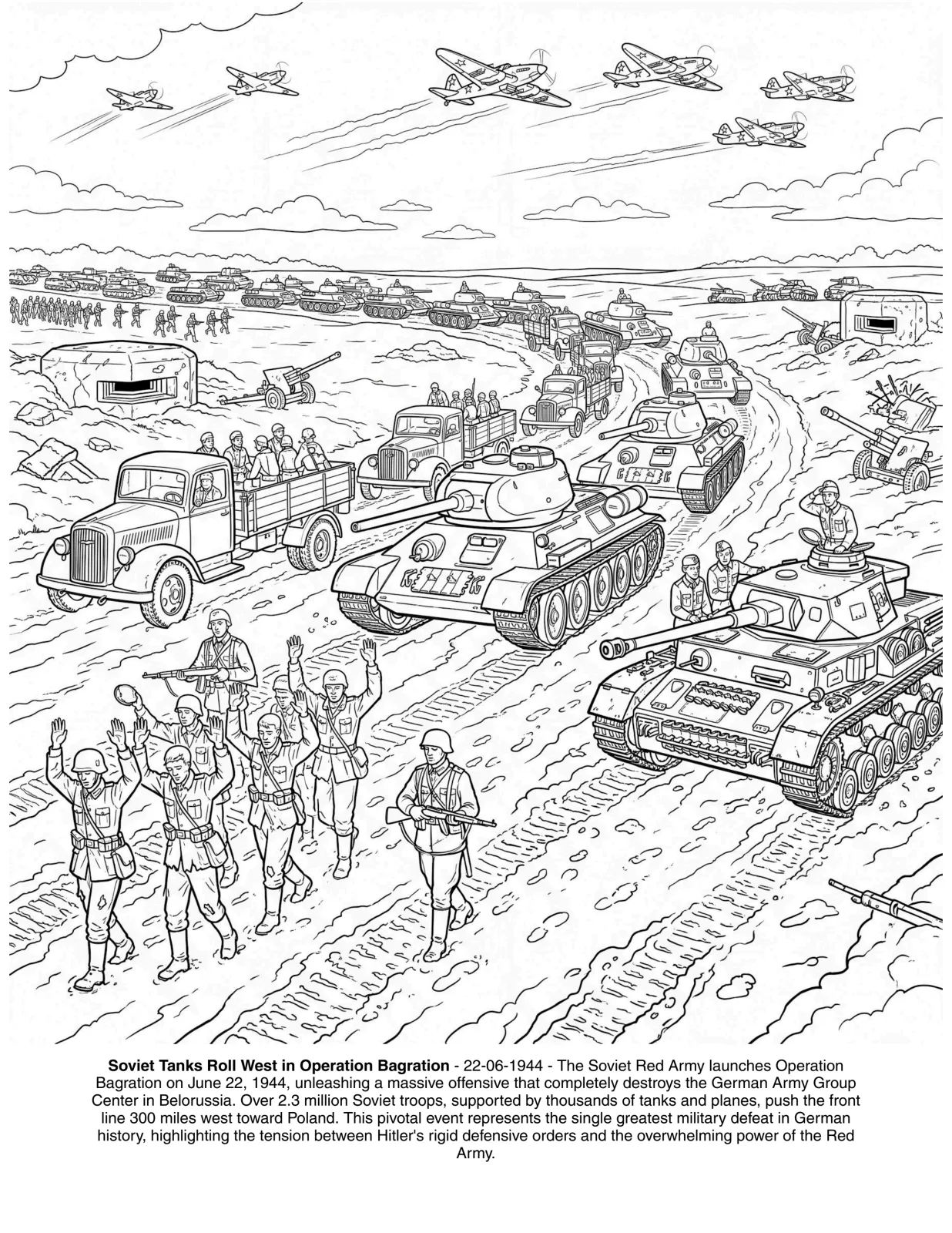
Weeks after D-Day, the Soviet summer offensive destroyed a whole German army group in Belarus. In the Pacific, Leyte Gulf in October became the largest naval battle in history.
In December Hitler gambled on one last attack through the Ardennes. The Battle of the Bulge surprised the Americans but failed by January. In the World War II book, the D-Day chapter runs from the beaches to the liberation of Paris.
A scene from the last part of the World War II book, before color.
1945: how did World War 2 end?
The war in Europe ended on May 8, 1945, a week after Soviet soldiers raised their flag over the Reichstag in Berlin and Hitler killed himself. The war in the Pacific went on until August, when atomic bombs struck Hiroshima and Nagasaki and the Soviet Union attacked Manchuria. Japan signed its surrender on September 2.
In January Soviet troops reached Auschwitz and found about seven thousand prisoners still alive. In February the Marines landed on Iwo Jima, where the flag-raising photograph was taken on Mount Suribachi.
The surrender ceremony took place aboard the battleship USS Missouri in Tokyo Bay. It is the last scene of the World War II coloring book, as it is the last line of this timeline.
How do you color the war in order?
Take one year a week for seven weeks, from 1939 to 1945. Read the moments for that year, color one or two scenes from the matching chapter, and read the caption aloud if you share it with someone. In two months you will know the shape of the war for good.
If you color with someone who lived through the war or served after it, a scene a week is also a conversation a week. Our gifts for veterans guide has more ideas in the same spirit.
World War 2 started on September 1, 1939, when Germany invaded Poland, and ended on September 2, 1945, when Japan signed its surrender aboard the USS Missouri. The war in Europe ended earlier, on May 8, 1945.
What were the turning points of World War 2?
Historians usually name the Battle of Britain in 1940, Midway in June 1942, Stalingrad from August 1942 to February 1943, Kursk in July 1943 and D-Day in June 1944.
When did the United States enter World War 2?
The United States entered the war after Japan attacked Pearl Harbor on December 7, 1941. It declared war on Japan the next day, and Germany and Italy declared war on the United States on December 11.
What was the largest battle of World War 2?
By the number of soldiers involved, the largest battles were on the Eastern Front, above all Stalingrad and Kursk. Kursk is often called the largest tank battle in history, and Leyte Gulf the largest naval battle.
Why is it called D-Day?
D-Day is the military term for the day an operation begins. It became the name of June 6, 1944, when the Allies landed in Normandy, because of the scale of that landing.
Is there a World War 2 coloring book for adults?
Yes. The World War II coloring book by Motiv Colors follows the war in order across 60+ researched scenes, from the invasion of Poland to Dunkirk, Stalingrad, Midway, D-Day and the surrender in Tokyo Bay, with a dated caption on every page. It is an instant PDF you print at home.
Color the war that remade the world
Thirty moments hold the shape of the Second World War. Sixty scenes let you live inside it, from the beaches of Dunkirk to the deck of the Missouri.
Buying for a military history fan? See our gifts for military history buffs, and pair the war with the one before it or the jets after it.
We use cookies to enhance your browsing experience, serve personalized content and analyze our traffic. You can accept all cookies, reject non-essential ones, or manage your preferences.
Required for the website to function and cannot be switched off. They are usually set in response to actions you make, such as setting privacy preferences or logging in.
Allow the website to remember choices you make (such as language or region) to provide enhanced, personalized features.
Help us understand how visitors interact with the website by collecting and reporting information anonymously.
Used to track visitors across websites to display relevant advertising and measure campaign effectiveness.