Fighter jet generations explained: from the Me 262 to stealth
F-35s are fifth generation, the F-16 is fourth, the Me 262 was the first. Everybody uses the numbers, but few explain what actually changes from one generation to the next, or how to tell them apart at an air show.
Here are the fighter jet generations explained, from the first jets of 1944 to the stealth fighters flying today and the sixth generation in development. You get one table, what defines each step, how to spot each one by shape and paint, and the aircraft to color as you go.
Fighter jet generations at a glance
Fighter jets are grouped into five generations, each defined by a leap in technology rather than a date: first the jet engine itself, then supersonic speed and missiles, then radar-guided multirole combat, then agility and digital controls, and finally stealth and sensor fusion. A sixth generation is in development now.
Generation
Era
The leap
Examples
How to spot it
1st
1944 to mid-1950s
Jet engines, guns, subsonic or transonic
Me 262, Gloster Meteor, F-86 Sabre, MiG-15
Nose intake, bubble canopy, bare metal
2nd
Mid-1950s to early 1960s
Supersonic in level flight, afterburners, first missiles
F-100, F-104, MiG-21, Mirage III
Needle nose, thin or delta wings
3rd
1960s to early 1970s
Radar-guided missiles, multirole, all-weather
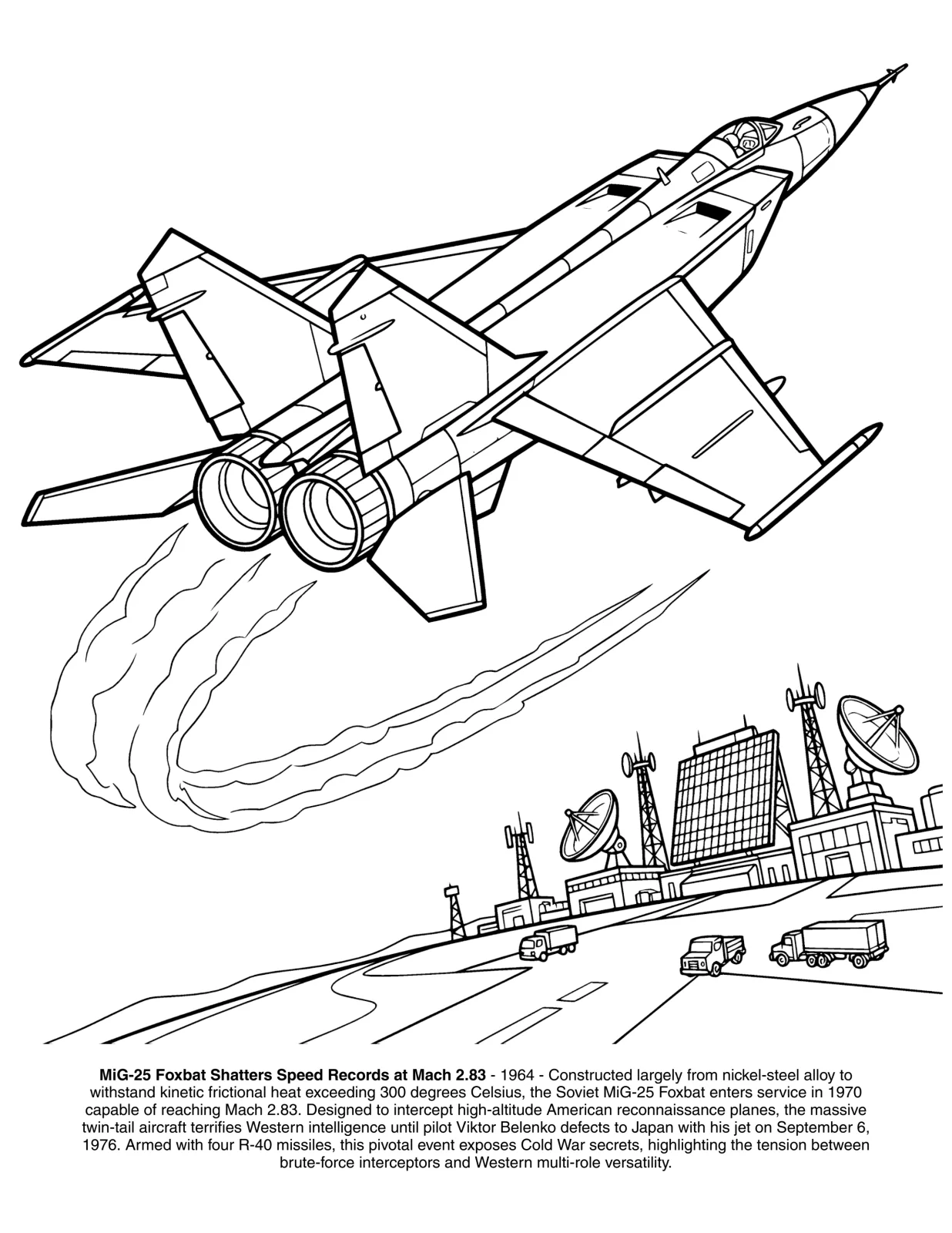
F-4 Phantom II, MiG-23, Mirage F1
Big side intakes, Vietnam camouflage
4th and 4.5
1970s onward
Agility, fly-by-wire, look-down radar, later AESA radar
The Jet Fighters coloring book follows the same road. You start with the Me 262, fly through the first all-jet battles over Korea, break the sound barrier, stand Cold War alert, dogfight over Vietnam and finish in the stealth era, with a caption giving the date and the context on every page.
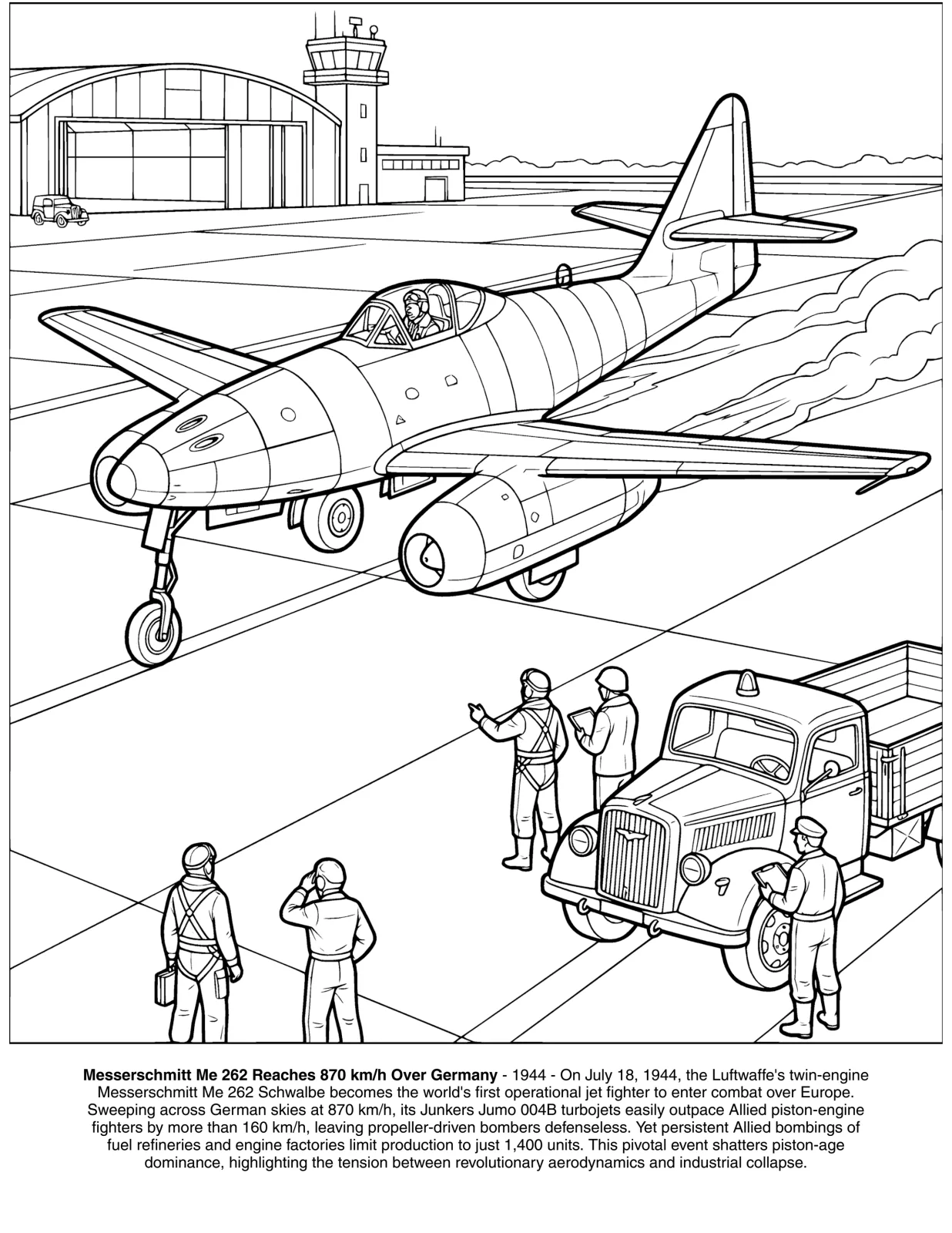
The first generation runs from 1944 to the mid-1950s. These fighters swapped propellers for jet engines but kept guns as their main weapon and flew below or just around the speed of sound. The Messerschmitt Me 262 led the way in 1944, with Britain’s Gloster Meteor entering service the same summer.
The Me 262 was roughly a hundred miles an hour faster than any piston fighter it met, yet it arrived too late and in too few numbers to change the war. Early jet engines also lasted only hours between overhauls.
The decisive first-generation fight came over Korea. Swept-wing American F-86 Sabres and Soviet MiG-15s clashed along the Yalu River in an area pilots called MiG Alley, in the first battles fought between jets on both sides.
Both scenes are in the Jet Fighters book: the Me 262 that opens the jet age and the Sabre against the MiG over Korea. Jet combat built on air fighting that started over the Western Front in 1914, which our WW1 timeline follows year by year.
An early page of the jet age, ready to color.
What changed with the second generation?
The second generation, from the mid-1950s to the early 1960s, broke the sound barrier in level flight. Afterburners, thinner wings and the area rule made supersonic speed routine, and the first air-to-air missiles, such as the heat-seeking AIM-9 Sidewinder, joined the gun. Radar became standard for interception.
The road there opened on October 14, 1947, when Chuck Yeager took the Bell X-1 past Mach 1. Six years later the North American F-100 Super Sabre became the first US Air Force fighter that could fly supersonic in level flight.
Then came the needle-nosed F-104 Starfighter, the first fighter to reach Mach 2, and the delta-winged MiG-21, built in greater numbers than any other supersonic jet: more than 10,000 of them. The Jet Fighters book gives Yeager’s record flight its own page.
Why did the third generation bring back the gun?
Third-generation fighters, from the 1960s to the early 1970s, were built for radar-guided missile combat beyond visual range and for multirole missions. Vietnam showed the limits: early missiles often failed at close range, and the F-4 Phantom II first flew without an internal gun. Pilots had to relearn dogfighting.
The F-4 did almost everything: Navy fleet defense, Air Force strike, reconnaissance. But rules of engagement often forced pilots to identify targets visually, which pulled fights into the close range where missiles of the day were weakest.
The answer came in two parts. The F-4E added an internal M61 cannon, and the US Navy opened its Fighter Weapons School, better known as Top Gun, in 1969 to teach air combat maneuvering again. The Jet Fighters book shows that dogfight revival over Vietnam.
Get 5 illustrations from our bestselling coloring books, for free.
You will receive in your mail box the link to download the 5 illustrations in high quality and PDF format.
What makes a fourth-generation fighter?
Fourth-generation fighters, flying from the mid-1970s onward, were designed around agility. High thrust-to-weight ratios, look-down shoot-down radar, head-up displays and, on many, fly-by-wire controls let them out-turn earlier jets and still fight with missiles. The F-15, F-16, F/A-18, MiG-29 and Su-27 define the class.
Much of the thinking came from John Boyd’s energy-maneuverability theory, which measured how well a fighter trades speed for turns. The F-15 Eagle, in service from 1976, was built for air superiority, and the F-16 brought fly-by-wire controls to a production fighter.
Generation 4.5 covers later designs and upgrades with AESA radar, datalinks and reduced radar signature: the Rafale, the Eurofighter Typhoon, the Gripen and the Super Hornet. Air forces plan to keep many of them flying for decades.
The Jet Fighters book includes iconic fourth-generation jets such as the F-15. Its fine panel lines and twin tails reward a sharp pencil and patience.
What is a fifth-generation fighter?
A fifth-generation fighter is built to be hard to see on radar from the drawing board up. Shaping, coatings and internal weapons bays keep its signature low, while sensor fusion merges radar, infrared and datalink feeds into one picture for the pilot. The F-22 entered service in 2005, followed by the F-35, J-20 and Su-57.
The idea was proven earlier by the F-117 Nighthawk. Despite its F designation it was an attack aircraft, operational in 1983 and kept secret until 1988, but its faceted shape showed that invisibility to radar could matter more than speed.
The F-22 adds supercruise, sustained supersonic flight without afterburner. The F-35 trades some of that performance for its sensors and comes in three versions, including one that lands vertically. The Jet Fighters book ends its journey on this stealth revolution, with the F-117 and the B-2 Spirit.
A page from the end of the book, before color.
What will sixth-generation fighters look like?
Sixth-generation fighters are still in development, and none has entered service. The programs aim for wider stealth, more powerful sensors and networks, and a crewed fighter that commands uncrewed drones flying beside it. The US Air Force picked Boeing’s F-47 in 2025, while Europe builds GCAP and FCAS.
GCAP brings together Britain, Italy and Japan, with a target date in the mid-2030s. FCAS, led by France, Germany and Spain, aims for around 2040. The US Navy runs its own program for a carrier fighter.
The images released so far are artist’s impressions, so nobody outside the programs knows exactly what these jets will look like. For now the sixth generation is still a pencil sketch, which is fitting.
How can you tell the generations apart by shape and paint?
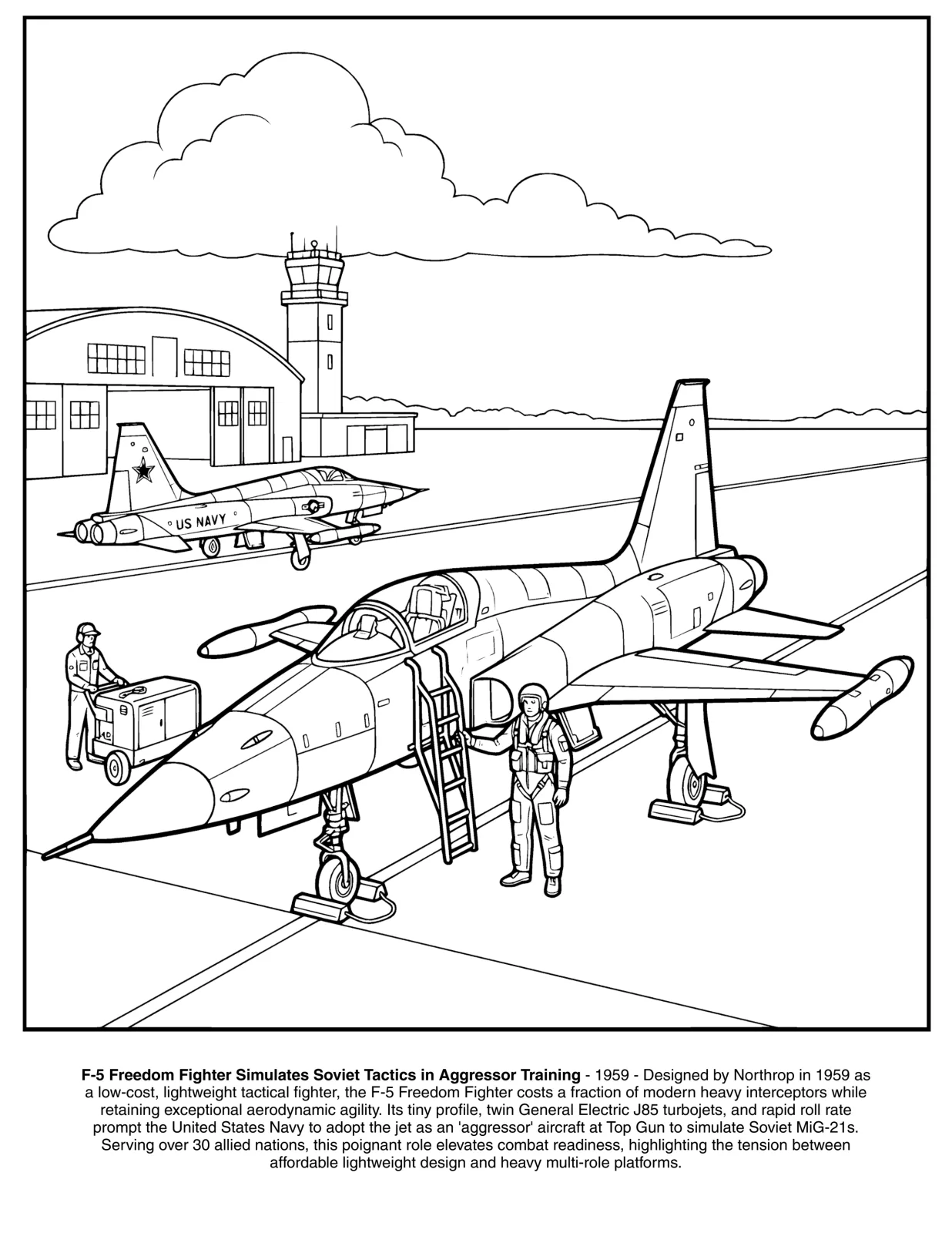
You can often name a fighter’s generation at a glance. First-generation jets have nose intakes and bare metal, second-generation needle noses and delta wings, third-generation big side intakes and Vietnam camouflage, fourth-generation twin tails and soft grays, and fifth-generation faceted edges, sawtooth panels and a dark, matte gray.
Paint tells the story too. The Me 262 wore mottled Luftwaffe greens. Korean War Sabres flew in polished natural metal. Over Vietnam, US Air Force Phantoms wore a tan and two-green camouflage made for the jungle.
From the mid-1970s, air-superiority grays took over, chosen to blend into the sky. Stealth aircraft went darker and flatter: the F-117 almost black, the F-22 and F-35 in grays that hide radar-absorbent coatings.
When you color, follow the era. Build bare metal with layered grays and a little blue, leave white paper for the glint on the canopy, and keep camouflage edges soft for paint, sharp for stealth panels. If you print the PDF, our guide on how to print a coloring book PDF explains the paper that takes many layers.
Fighter jets by generation: your questions answered
How many generations of fighter jets are there?
Five established generations, plus the informal 4.5 category. A sixth generation is in development, led by the US F-47 and the European GCAP and FCAS programs, but none has entered service.
What generation is the F-16?
The F-16 is a fourth-generation fighter, one of the defining jets of that class with its fly-by-wire controls. The latest versions, with AESA radar and modern datalinks, are often described as generation 4.5.
What generation is the F-35?
The F-35 Lightning II is a fifth-generation fighter. It combines stealth shaping, internal weapons bays and sensor fusion, which merges radar, infrared and datalink information into one picture for the pilot.
What was the first jet fighter?
The Messerschmitt Me 262 was the first operational jet fighter, flying combat missions with the Luftwaffe in 1944. Britain’s Gloster Meteor entered service the same summer.
Who decides what generation a fighter belongs to?
No official body does. Air historian Richard P. Hallion proposed a six-step scheme in 1990, and the five-generation scheme in common use today spread in the 2000s, partly through manufacturers’ marketing of the F-22 and F-35.
Is there a fighter jet coloring book for adults?
Yes. The Jet Fighters coloring book by Motiv Colors follows the jet age in order across 30+ detailed pages, from the Me 262 and the Korean War to the sound barrier, Vietnam and the stealth era, with a dated caption on every page. It is an instant PDF you print at home.
Fly every generation, one page at a time
The generations are easiest to remember when you see them in order: the Me 262, the Sabre and the MiG, the X-1, the Phantom over Vietnam, the Eagle and the stealth jets. One book carries you through all of them, with the date and context under every scene.
We use cookies to enhance your browsing experience, serve personalized content and analyze our traffic. You can accept all cookies, reject non-essential ones, or manage your preferences.
Required for the website to function and cannot be switched off. They are usually set in response to actions you make, such as setting privacy preferences or logging in.
Allow the website to remember choices you make (such as language or region) to provide enhanced, personalized features.
Help us understand how visitors interact with the website by collecting and reporting information anonymously.
Used to track visitors across websites to display relevant advertising and measure campaign effectiveness.