Aztec, Maya and Inca differences: who, where and when
Pyramids, gold, human sacrifice, a Spanish conquest at the end. The Aztecs, the Maya and the Incas blur together in most people’s memory, even though they lived thousands of kilometers and sometimes thousands of years apart.
This guide sorts out the Aztec, Maya and Inca differences once and for all. You get one comparison table, a memory trick for where each one lived, how each ruled, wrote and fell, and the scenes to color for every civilization.
Aztec, Maya and Inca: the differences at a glance
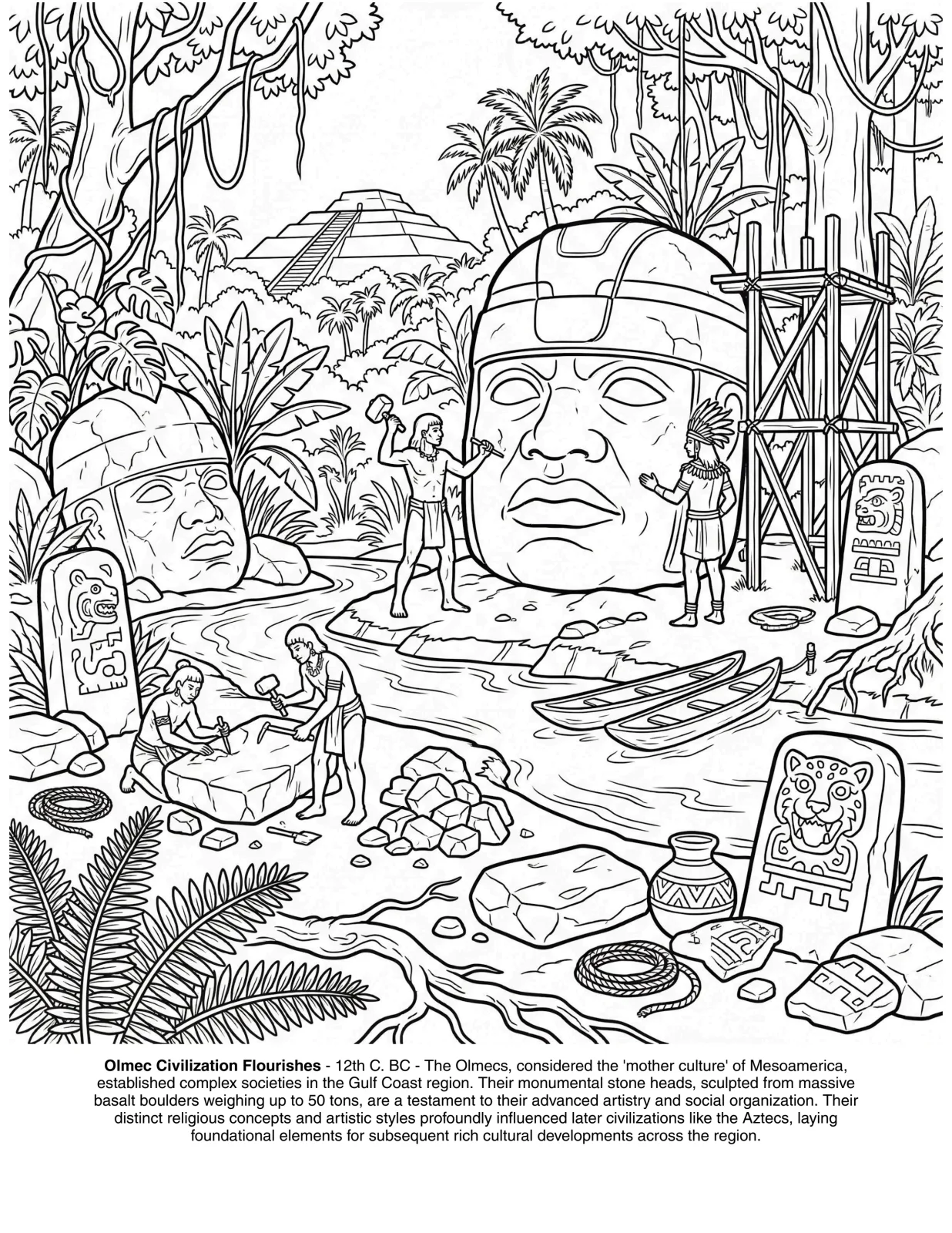
The Maya were the oldest, a network of rival city-states in southern Mexico and Central America for over two thousand years. The Aztecs ruled a tribute empire from Tenochtitlan in central Mexico for under two centuries. The Incas built the largest empire in the Americas along the Andes in South America.
Maya
Aztec
Inca
Where
Yucatán, Guatemala, Belize, Honduras
Valley of Mexico, central Mexico
Andes, from Ecuador to Chile
When
c. 2000 BC to AD 1697
AD 1325 to 1521
c. AD 1200 to 1572
Peak
Classic period, AD 250 to 900
1440 to 1519
1438 to 1532
Capital
None; rival cities such as Tikal and Calakmul
Tenochtitlan
Cusco
Government
Independent city-states under divine kings
Triple Alliance collecting tribute
Centralized empire under the Sapa Inca
Language
About 30 Mayan languages
Nahuatl
Quechua
Records
Full hieroglyphic writing
Pictorial codices
Quipu, knotted cords
Famous site
Tikal, Palenque, Chichén Itzá
Templo Mayor
Machu Picchu
End
Last city, Nojpetén, falls in 1697
Tenochtitlan falls in 1521
Atahualpa seized in 1532; Vilcabamba falls in 1572
The easiest way to remember them is from north to south, in alphabetical order: Aztec in central Mexico, Maya just south of them, Inca far away in South America. A, M, I, top to bottom of the map.
We made one coloring book for each civilization, and each runs in chronological order. Color the Aztecs, the Maya and the Incas side by side and the differences stop being a list to memorize.
One book for each civilization, in the order it happened
The Aztecs lived in the Valley of Mexico, around today’s Mexico City. The Maya lived to the south and east, across the Yucatán peninsula, Guatemala, Belize and western Honduras. The Incas lived in the Andes mountains of South America, along a strip more than 4,000 kilometers long from Ecuador to central Chile.
Geography shaped everything else. The Aztec capital stood on an island in Lake Texcoco, fed by chinampas, the floating gardens built up from the lakebed.
The Maya built in tropical lowland forest and on dry limestone plains, where water came from cenotes, natural sinkholes. The Incas farmed steep mountainsides on stone terraces, growing potatoes and maize at heights where Europeans struggled to breathe.
Tenochtitlan rises from the lake in The Aztecs History.
Which came first, the Maya, the Aztecs or the Incas?
The Maya came first by a long way. Maya villages appear around 2000 BC and their great cities peak between AD 250 and 900, centuries before the Aztecs or Incas existed. The Aztecs and Incas are near contemporaries: both rise in the 1400s and both fall to Spanish conquistadors within twelve years of each other.
That gap surprises most people. When the Aztecs founded Tenochtitlan in 1325, Tikal had already been abandoned for over four hundred years.
The Maya did not vanish, though. Cities in the northern Yucatán such as Chichén Itzá and later Mayapán kept going after the southern collapse, and the last independent Maya kingdom, at Nojpetén in Guatemala, held out until 1697.
How did each civilization govern?
The Maya never had an empire. They lived in dozens of independent city-states, each ruled by a divine king, which allied, traded and fought one another. The Aztecs ran a tribute empire through a Triple Alliance of three cities. The Incas built a single centralized state ruled by the Sapa Inca from Cusco.
The Aztec Triple Alliance of 1428 joined Tenochtitlan, Texcoco and Tlacopan. Conquered towns kept their own rulers but sent cotton, cacao, feathers and warriors as tribute, which is why so many of them joined Cortés later.
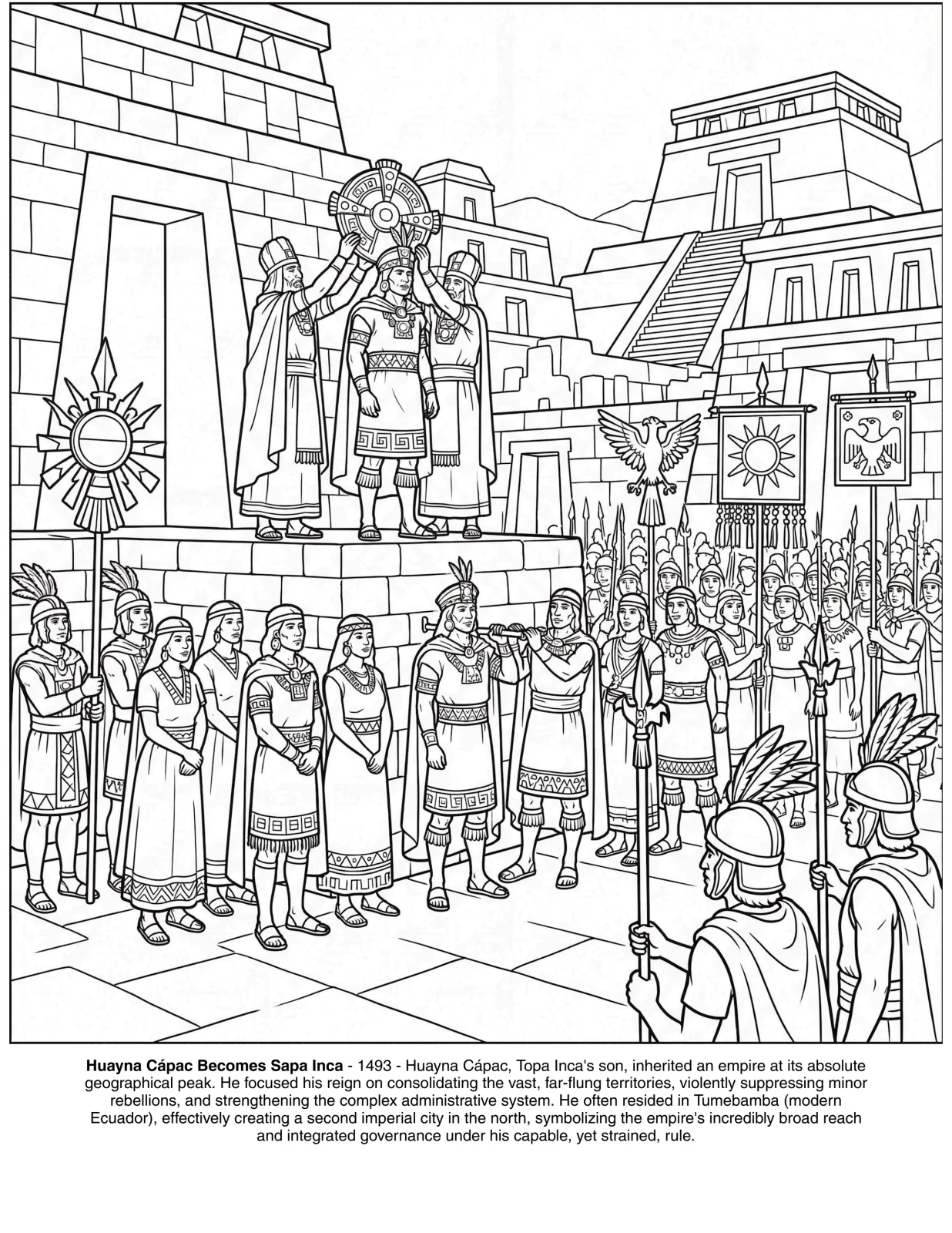
The Incas went further. They moved whole populations, imposed Quechua as a common language, and demanded labor rather than goods through a system called mit’a. They called their state Tawantinsuyu, “the four parts together”.
In the Inca book you color Pachacuti, the ninth Sapa Inca, turning a small kingdom into that empire from 1438, and the road network that held it together.
Did the Aztecs, Maya and Incas have writing?
Only the Maya had a full writing system, able to record any sentence of their language with about 800 glyphs. The Aztecs used pictorial codices, painted books mixing images and symbols for names, places and dates. The Incas had no script but kept precise records on quipus, cords knotted in a base-ten code.
Maya writing was largely deciphered only in the second half of the twentieth century. Today scholars can read king lists, battles and royal births carved on stone at Palenque and Copán.
The quipu is the strangest of the three. Inca officials recorded census counts and tribute with knots, colors and positions on hanging cords. Some quipus may encode narratives too, and no one has yet proved how.
Each book gives these record keepers a page: the Maya scribe, the Aztec calendar stone and the quipu keeper. Color all three in a row and you remember the difference for good.
Get 5 illustrations from our bestselling coloring books, for free.
You will receive in your mail box the link to download the 5 illustrations in high quality and PDF format.
What did they believe, and did they all practice sacrifice?
All three were polytheistic and saw the sun, rain and maize as gifts the gods had to be paid for. All three practiced human sacrifice, on very different scales. The Aztecs sacrificed captives at the Templo Mayor in great numbers, the Maya sacrificed war captives and nobles, and the Incas reserved it for rare state rituals.
The Aztecs believed the sun needed human blood to keep moving. Their Flower Wars against neighboring states were fought to take captives alive. Excavations of the Templo Mayor skull rack since 2015 have confirmed the scale the Spanish described.
For the Incas, the rarest and most solemn offering was the capacocha, the sacrifice of chosen children on mountain peaks. Three mummies found on the summit of Llullaillaco in 1999 are the best preserved.
How did each civilization end?
The southern Maya cities emptied in the 800s, most likely through drought, warfare and overused land, and the Spanish took the last kingdom in 1697. Hernán Cortés and his Indigenous allies took Tenochtitlan on 13 August 1521. Francisco Pizarro seized the Inca ruler Atahualpa at Cajamarca in November 1532.
Disease did as much as steel. Smallpox reached Tenochtitlan during the siege and swept the Andes years before Pizarro arrived, killing the Sapa Inca Huayna Capac and leaving his sons Atahualpa and Huáscar fighting a civil war.
The Inca resistance lasted another forty years in the jungle at Vilcabamba, until the last Sapa Inca, Túpac Amaru, was executed in Cusco in 1572.
A page from The Incas Empire, before color.
Are there Maya, Aztec and Inca people today?
Yes: millions of Maya people live in Mexico, Guatemala and Belize and speak about thirty Mayan languages, and around 1.6 million Mexicans speak Nahuatl, the Aztec language. Quechua, the Inca language, has several million speakers across Peru, Bolivia and Ecuador. These are living cultures, not lost ones.
That changes how you look at the ruins. Machu Picchu, Tikal and the Templo Mayor are the past of people still living nearby, many of whom keep the old calendars, crops and weaving patterns.
How to teach the Aztecs, Maya and Incas with coloring
Teach them in the order they happened and put them on one map. Start with the Maya, two thousand years earlier, then the Aztecs and Incas side by side in the 1400s. Coloring one scene per civilization per lesson fixes the where and the when better than any worksheet.
Why does it work? Choosing colors forces you to look at every detail, and those details stay. We explain the research in learning history through coloring.
All three books are instant PDFs. Print one page from each and lay them side by side: lake-blue Tenochtitlan, jungle-green Tikal, stone-grey Machu Picchu. Our guide on how to print a coloring book PDF covers the settings that keep fine lines crisp.
What is the main difference between the Aztecs, Maya and Incas?
Place, time and government. The Maya were rival city-states in southern Mexico and Central America from about 2000 BC, the Aztecs a tribute empire in central Mexico from 1325 to 1521, and the Incas a centralized empire in the Andes of South America from the 1400s to 1572.
Which is older, Maya or Aztec?
The Maya are far older. Maya settlements date from about 2000 BC and their great cities peaked between AD 250 and 900. The Aztecs founded Tenochtitlan only in 1325.
Did the Aztecs and the Incas ever meet?
There is no evidence they did. They lived about 4,000 kilometers apart, separated by Central American jungle and the Pacific coast, and neither appears in the other’s records.
How can I remember where each civilization lived?
Go alphabetically from north to south: Aztec in central Mexico, Maya just to the south in the Yucatán and Central America, Inca in the Andes of South America.
Did the Incas have writing?
Not in the usual sense. The Incas recorded numbers, census data and tribute on quipus, cords tied with knots in a base-ten system. Whether quipus also recorded stories is still debated.
Are there coloring books on the Aztecs, Maya and Incas for adults?
Yes. Motiv Colors makes one for each: The Aztecs History, The Maya Civilization and The Incas Empire. Each follows its civilization in chronological order with a caption for every scene, as an instant PDF you print at home.
Color three civilizations, one map
Three peoples, three ways of ruling, writing and remembering. Once you place them on the map and in time, they never blur again.
Every scene in our books is checked by a human before it ships. Print the founding of Tenochtitlan tonight, then follow the map south.
We use cookies to enhance your browsing experience, serve personalized content and analyze our traffic. You can accept all cookies, reject non-essential ones, or manage your preferences.
Required for the website to function and cannot be switched off. They are usually set in response to actions you make, such as setting privacy preferences or logging in.
Allow the website to remember choices you make (such as language or region) to provide enhanced, personalized features.
Help us understand how visitors interact with the website by collecting and reporting information anonymously.
Used to track visitors across websites to display relevant advertising and measure campaign effectiveness.