Blackbeard, Calico Jack, Anne Bonny, Captain Kidd. Everyone knows the names, but almost nobody knows who came first, who sailed together, or why the whole thing was over within a single lifetime.
Here is the golden age of piracy in order, from the buccaneers of Tortuga to the mass hanging on the coast of Africa that ended it. You get one dated table, the three generations of pirates, the myths to drop, and the scenes to color along the way.
When was the golden age of piracy?
The golden age of piracy ran from about 1650 to 1726. Historians split it into three waves: the buccaneers of the Caribbean from the 1650s to 1680, the Pirate Round to the Indian Ocean in the 1690s, and the explosion after 1715 that produced Blackbeard, Calico Jack and Black Bart Roberts.
Year
Pirate
What happens
1671
Henry Morgan
Sacks Panama City with more than a thousand buccaneers
1692
Port Royal
An earthquake sinks the “wickedest city on earth”
1695
Henry Every
Takes the Mughal treasure ship Ganj-i-Sawai, then vanishes
1701
William Kidd
Hanged at Execution Dock in London
1717
Sam Bellamy
The Whydah sinks off Cape Cod with its plunder
1718
Blackbeard
Blockades Charleston in May, dies at Ocracoke in November
1718
Woodes Rogers
Arrives in Nassau with the king’s pardon
1720
Calico Jack, Anne Bonny, Mary Read
Captured off Jamaica
1722
Bartholomew Roberts
Killed off Africa; 52 of his crew hanged
1726
William Fly
Hanged in Boston, one of the last of the era
Our pirates coloring book runs in this same order. You start with the Barbary corsairs and the Spanish treasure fleets, then sail into Nassau, Blackbeard’s reign and the women who fought beside him.
The buccaneers were the first generation, from the 1650s to the 1680s: English, French and Dutch raiders based on Tortuga and at Port Royal in Jamaica who attacked Spanish towns and ships, often with a government license. Their name comes from boucan, the smoked meat the first of them sold on Hispaniola.
Henry Morgan was the greatest of them. He took Portobelo in 1668 and sacked Panama City in 1671, then retired as a knight and lieutenant governor of Jamaica, the poacher turned gamekeeper.
The buccaneers were not quite pirates. Most carried letters of marque, which made them privateers in the eyes of their own crown. When England and Spain made peace, those papers dried up, and the raiders had to choose: settle down or go rogue.
On 7 June 1692, an earthquake dropped much of Port Royal into the sea. Preachers called it judgment on the wickedest city on earth, and the buccaneer age went down with it.
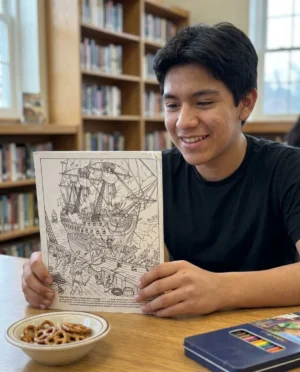
An early scene from The Pirates History, ready to color.
What was the Pirate Round?
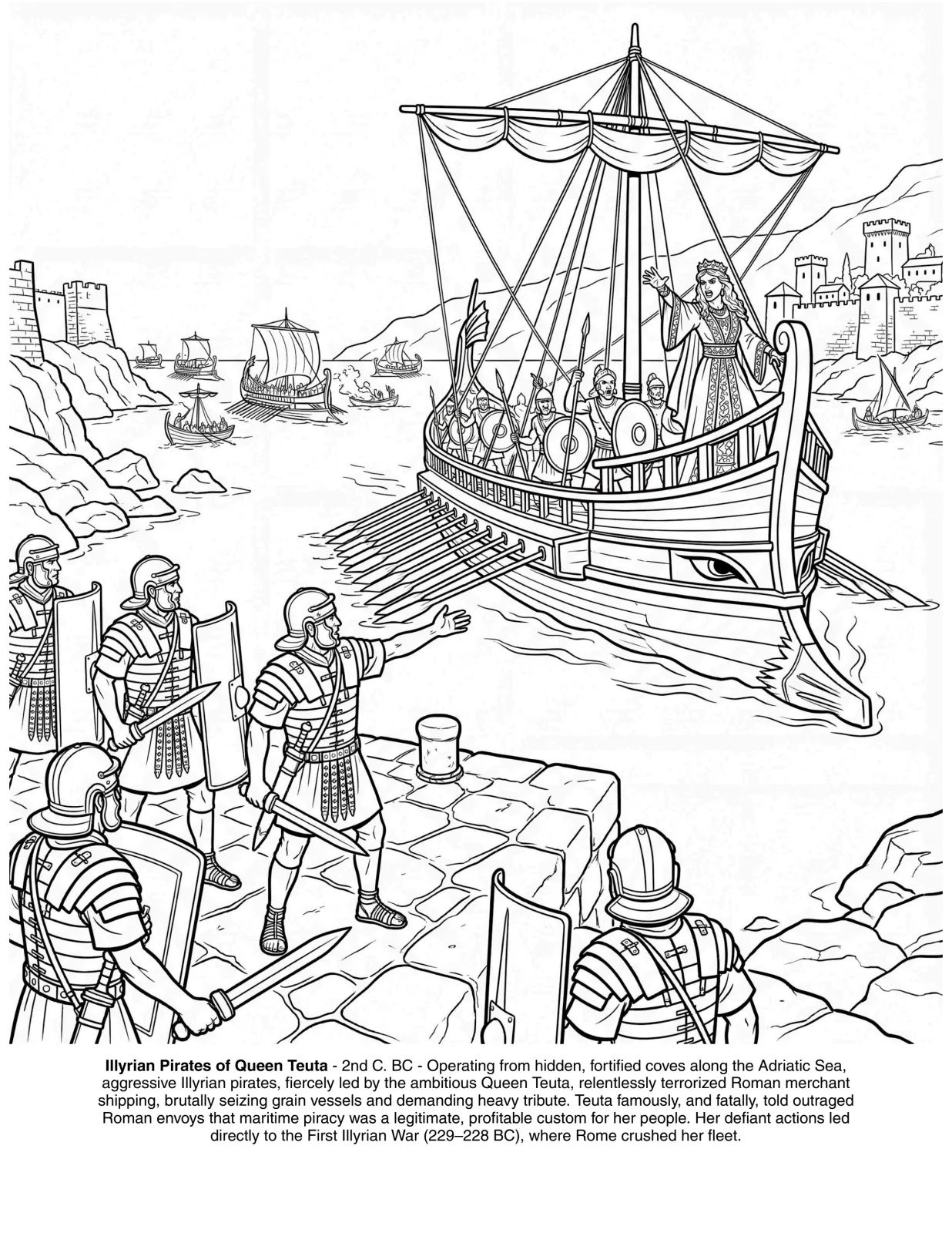
The Pirate Round was the 1690s route from the Americas around Africa to the Indian Ocean, where pirates hunted the treasure ships of the Mughal Empire. It made Henry Every the richest pirate of the age in one raid, and it made Captain Kidd the most famous pirate ever hanged.
In September 1695, Every’s ship Fancy caught the Ganj-i-Sawai, a Mughal ship carrying pilgrims home from Mecca, in the Red Sea. The haul was enormous, and Every disappeared with it. No one knows where he died.
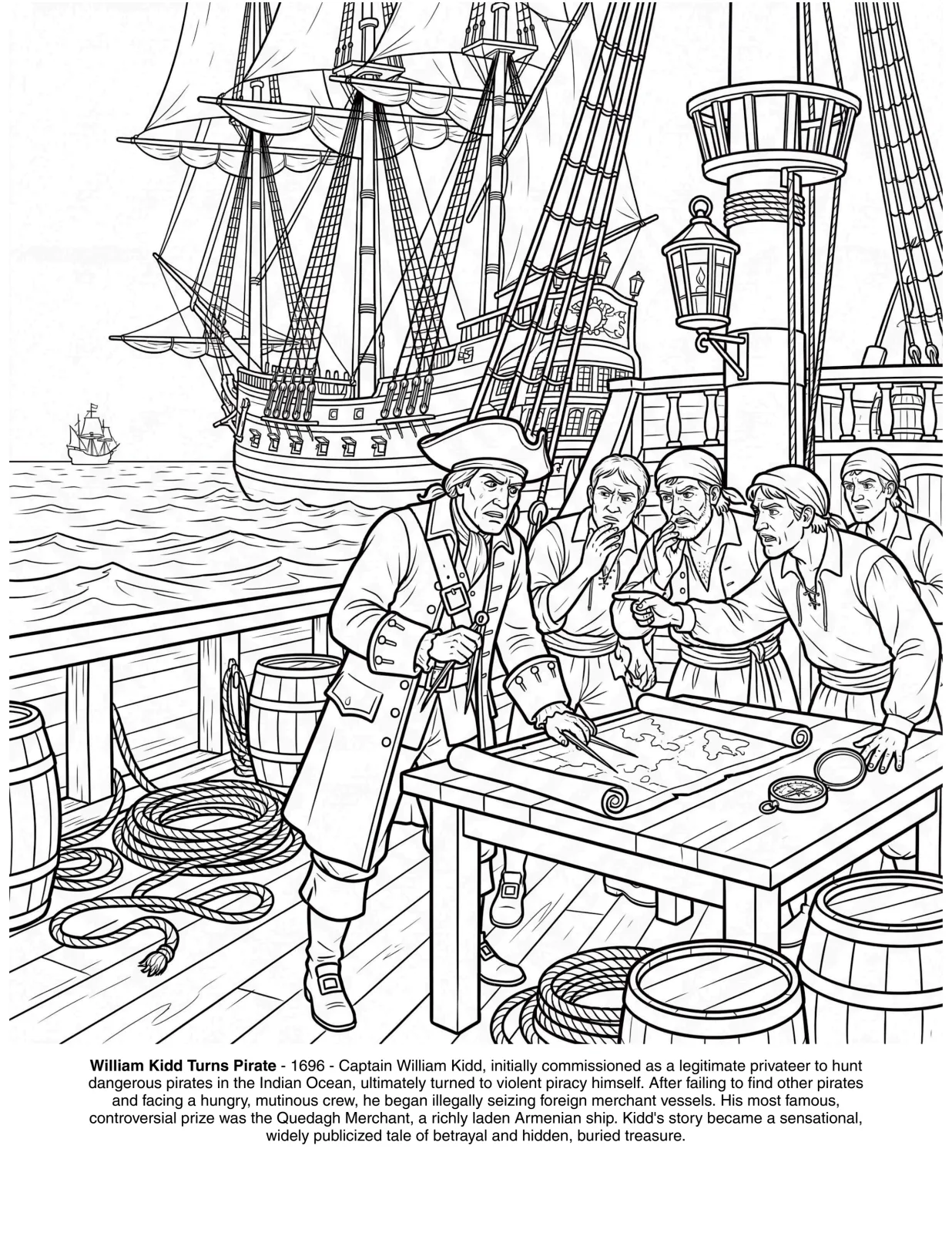
William Kidd sailed in 1696 with a commission to hunt pirates, not to become one. He took the Armenian-owned Quedagh Merchant in 1698, came home to find himself declared a pirate, and was hanged at Execution Dock on the Thames on 23 May 1701.
Kidd is also the only pirate known to have buried treasure. He hid part of his plunder on Gardiners Island off Long Island in 1699, and the authorities dug it up within weeks.
Who ruled the Republic of Pirates in Nassau?
From 1716 to 1718, Nassau on New Providence in the Bahamas became a lawless base known as the Republic of Pirates. Benjamin Hornigold, Blackbeard, Charles Vane, Sam Bellamy and Calico Jack all sailed from its harbor, and no government controlled the island.
The cause was peace. The Treaty of Utrecht in 1713 ended a long war and threw thousands of privateers and navy sailors out of work, many of them in Jamaica and the Bahamas.
Hornigold trained the next generation. His protégé Edward Teach, known as Blackbeard, took his own command in 1717. Sam Bellamy captured the slave ship Whydah, which sank in a storm off Cape Cod in April 1717. Its wreck, found in 1984, was confirmed by its bronze bell, engraved with the ship’s name.
In our pirates book, Nassau gets its own scene: a harbor crowded with stolen sloops, the moment the golden age reached its height.
What made Blackbeard so feared?
Blackbeard was feared because he worked at it. Edward Teach braided his long black beard and, according to the General History of the Pyrates of 1724, tucked lit fuses under his hat in battle. His reputation let him take ships without a fight, and there is no record of him killing anyone before his last battle.
In May 1718, with the Queen Anne’s Revenge and three smaller ships, he blockaded Charleston, South Carolina, for about a week. He took hostages and released them for a chest of medicine.
A few weeks later the Queen Anne’s Revenge ran aground at Beaufort Inlet in North Carolina, and its wreck was found there in 1996. Blackbeard took the king’s pardon, then went back to piracy.
On 22 November 1718, Royal Navy lieutenant Robert Maynard trapped him at Ocracoke Inlet. Blackbeard died in hand-to-hand fighting on Maynard’s deck, and his head hung from the bowsprit on the way home. This is the scene the pirates book saves for its most dramatic page.
Get 5 illustrations from our bestselling coloring books, for free.
You will receive in your mail box the link to download the 5 illustrations in high quality and PDF format.
Who were Anne Bonny and Mary Read?
Anne Bonny and Mary Read were the two best-documented women pirates of the golden age. They sailed with Calico Jack Rackham in 1720, dressed as men in battle, and were captured with his crew off Jamaica. At their trial, witnesses said they fought harder than the men.
Bonny, born in Ireland, left her husband in Nassau for Rackham. Read had already served as a soldier in Flanders disguised as a man before she joined the crew.
When the navy caught them, much of the crew was drunk below deck. Rackham was hanged at Port Royal in November 1720, and Bonny is reported to have told him that if he had fought like a man, he need not have been hanged like a dog.
Both women escaped the rope because they were pregnant. Read died in prison in 1721. What happened to Bonny is unknown. Our book gives them a page of their own, at the helm, not in the background.
Who was the most successful pirate of all?
By ships taken, Bartholomew Roberts, known as Black Bart, was the most successful pirate of the golden age. In under three years, from 1719 to 1722, he captured around 400 vessels from Brazil to Newfoundland to West Africa. He is also known for a strict code of articles for his crew.
Roberts banned gambling for money aboard, put lights out at eight, and set out shares of plunder by rank. Most crews ran on articles like these, signed by every man and far more democratic than any navy ship.
On 10 February 1722, HMS Swallow caught him off Cape Lopez in today’s Gabon. Roberts was killed by grapeshot, and his crew threw his body overboard in his finery, as he had asked.
How did the golden age of piracy end?
The golden age ended between 1718 and 1726 through pardons, navies and the gallows. Woodes Rogers retook Nassau in 1718, the Royal Navy hunted the big captains down, and mass trials followed. The hanging of 52 of Roberts’s men at Cape Coast Castle in 1722 broke the last great fleet.
Rogers arrived in Nassau in July 1718 with warships and the king’s pardon. Hornigold took it and turned pirate hunter. Those who refused, like Charles Vane, were run out and caught later.
Colonial courts stopped sending pirates to London for trial and hanged them locally, by the dozen. By the time William Fly was hanged in Boston in 1726, only a few hundred pirates were left at sea, against perhaps two thousand at the peak ten years earlier.
Which pirate myths should you forget?
Most of what everyone knows about pirates comes from fiction, above all Robert Louis Stevenson’s Treasure Island of 1883. Pirates almost never buried treasure, there is little evidence they made anyone walk the plank, and treasure maps marked with an X are a novelist’s invention.
The Jolly Roger is real, though every captain flew his own design. Blackbeard’s flag is usually shown as a skeleton spearing a heart, but no contemporary source describes it.
The real history is stranger than the myth. Pirate crews elected their captains, voted on targets and paid compensation for lost limbs. Color the real ships and the real faces, and the cartoon version never quite comes back.
How to color the golden age of piracy
Color it in the order it happened. Start with the buccaneers’ sacking of Spanish towns, move to Nassau’s crowded harbor, then Blackbeard’s last fight and the trials. Read the caption on each page first, and the dates in the table above will stick without effort.
The Pirates History is an instant PDF, so you can print tonight and reprint any ship to try a new sea. Try teal shallows and white sand for Nassau, then storm grey and gunsmoke for Ocracoke. Our guide on how to print a coloring book PDF explains the settings that keep rigging lines sharp.
Rigging, sails and sea, waiting for color.
Why color history rather than just read it? Because you have to decide what every rope and sail looks like, and those choices stay with you. We explain the research in learning history through coloring, and why so many adults are picking up colored pencils again.
Pirates of the golden age: your questions answered
When was the golden age of piracy?
Roughly 1650 to 1726. It falls into three waves: the Caribbean buccaneers from the 1650s to 1680, the Pirate Round to the Indian Ocean in the 1690s, and the post-1715 wave of Blackbeard, Calico Jack and Bartholomew Roberts.
Who was the most famous pirate of the golden age?
Blackbeard, Edward Teach, is the most famous. He blockaded Charleston in May 1718 and was killed at Ocracoke, North Carolina, on 22 November 1718. By ships taken, Bartholomew Roberts was the most successful, with around 400 captures.
Were Anne Bonny and Mary Read real?
Yes. Both are recorded at their 1720 trial in Jamaica, where they were tried with Calico Jack Rackham’s crew. Both escaped hanging because they were pregnant. Mary Read died in prison in 1721, and Anne Bonny’s later life is unknown.
What is the difference between a pirate, a privateer and a buccaneer?
A privateer attacked enemy ships with a government license, a letter of marque. A pirate attacked anyone with no license at all. Buccaneers were the 17th-century Caribbean raiders, often licensed, who attacked Spanish targets.
How did the golden age of piracy end?
Through pardons, navy patrols and mass hangings. Woodes Rogers retook Nassau in 1718, Blackbeard was killed that year, and 52 of Bartholomew Roberts’s crew were hanged at Cape Coast Castle in 1722. By 1726 only a few hundred pirates were left at sea.
Is there a pirate coloring book for adults?
Yes. The Pirates History coloring book by Motiv Colors follows piracy in order, from the Barbary corsairs and the Spanish Main to Nassau, Blackbeard and Anne Bonny and Mary Read, with a caption on every scene. It is an instant PDF you print at home.
Color the golden age, ship by ship
Seventy-five years, three generations, and a handful of captains whose names outlived empires. In order, the story finally makes sense: peace made pirates, and pirates made the navies that ended them.
Every scene in the book is checked by a human before it ships. Print the first page tonight and set sail with the buccaneers.
We use cookies to enhance your browsing experience, serve personalized content and analyze our traffic. You can accept all cookies, reject non-essential ones, or manage your preferences.
Required for the website to function and cannot be switched off. They are usually set in response to actions you make, such as setting privacy preferences or logging in.
Allow the website to remember choices you make (such as language or region) to provide enhanced, personalized features.
Help us understand how visitors interact with the website by collecting and reporting information anonymously.
Used to track visitors across websites to display relevant advertising and measure campaign effectiveness.