How did Cleopatra die? The asp, the poison and the evidence
Everyone knows the scene: a basket of figs, a snake, a queen on a golden couch. Fewer people know that the ancient writers who tell it were not sure it happened that way.
So how did Cleopatra die? Here is the short answer, then the last days in Alexandria step by step, what each ancient source actually says, the modern theories, and the scenes from her life you can color for yourself.
How did Cleopatra die? The short answer
Cleopatra VII died by suicide in Alexandria in August 30 BC, aged 39, most likely on the 10th or 12th. She chose death rather than be paraded in chains in Octavian’s triumph in Rome. Ancient writers say she was bitten by an asp, but even they admit the method is uncertain, and poison is just as likely.
Her maids, Iras and Charmion, died with her. The Egyptian cobra, the snake the Greeks called an asp, was a royal symbol in Egypt, worn as the uraeus on every pharaoh’s crown. That is part of why the story took hold so quickly.
Our Cleopatra coloring book follows her whole life in order, from the carpet that carried her to Caesar to the defeat at Actium and her last choice. The death is the final page; the rest of the book shows why it mattered.
Cleopatra took her own life because Octavian had won and meant to take her to Rome. A Roman triumph ended with the defeated leader marched through the streets in chains. Her sister Arsinoë had suffered exactly that in Caesar’s triumph of 46 BC, and Cleopatra refused to follow her.
The road there began at sea. On 2 September 31 BC, the fleets of Cleopatra and Mark Antony lost the Battle of Actium off western Greece to Octavian’s admiral Agrippa. The two fled to Egypt with what was left.
Octavian took his time. In the summer of 30 BC he marched on Alexandria, Antony’s troops deserted, and the city fell on 1 August. Cleopatra had already shut herself into her mausoleum near the palace, with her treasure and two maids.
The young queen at the start of the Cleopatra book.
What happened in Cleopatra’s last days?
Cleopatra’s last days run from 1 August 30 BC, when Alexandria fell and Antony died in her arms, to about 12 August, when she was found dead. In between she was captured in her mausoleum, met Octavian face to face, and learned she would be shipped to Rome within three days.
1 August. Told falsely that Cleopatra is dead, Antony stabs himself. Dying, he is hauled up by ropes into her mausoleum and dies in her arms.
The next days. Octavian’s officer Proculeius climbs in through a window and seizes her before she can stab herself. She is guarded in the palace.
The meeting. Octavian visits her. She hands over a list of her treasure; he assures her she will be treated generously.
The warning. A young Roman, Cornelius Dolabella, tells her privately that she will be sent to Rome within three days.
The last day. She asks to visit Antony’s tomb, bathes, eats a fine meal, and sends Octavian a sealed letter.
The letter asked to be buried beside Antony. Octavian understood at once and sent men running, but they came too late.
Did an asp really kill Cleopatra?
Nobody knows, and the ancient writers say so themselves. Plutarch, writing around 130 years later, describes the asp hidden in a basket of figs, then adds that “the truth of the matter no one knows”. No snake was found in the room, only two faint marks on her arm.
Plutarch gives the scene its famous shape. The guards burst in and find Cleopatra dead on a golden couch in her royal robes, Iras dead at her feet, and Charmion, barely standing, straightening her crown.
One guard asks angrily whether this was well done. “It is very well done,” Charmion answers, “and fitting for the descendant of so many kings.” Then she falls beside her queen.
The snake story owes a lot to Octavian. In his triumph of 29 BC he paraded an image of Cleopatra with an asp clinging to her, and the picture became the official version.
Get 5 illustrations from our bestselling coloring books, for free.
You will receive in your mail box the link to download the 5 illustrations in high quality and PDF format.
What do the ancient sources say?
Three ancient writers describe Cleopatra’s death, and none of them was in the room. Strabo, who visited Alexandria within a few years, gives two versions: an asp bite or a poisoned ointment. Plutarch prefers the asp but lists other theories. Cassius Dio, over two centuries later, says no one knows.
Source
Written
What it says
Strabo, Geography
A generation later
An asp bite or a poisoned ointment
Horace, Ode 1.37
Soon after, in Rome
She handled “fierce serpents” bravely
Plutarch, Life of Antony
About AD 100
An asp in a fig basket, or poison in a hollow hairpin
Suetonius, Augustus
About AD 120
Octavian sent snake charmers to suck out the poison
Cassius Dio, Roman History
About AD 220
Two tiny pricks on her arm; the true cause is unknown
Her doctor, Olympus, wrote an account of her last days. Plutarch read it and quotes from it, but the book itself is lost, and with it the one eyewitness record that might have settled the question.
Could she have used poison instead?
Many historians now think poison is more likely than a snake. An Egyptian cobra can grow to two meters, which is hard to hide in a fig basket, its bite is not always fatal, and it rarely kills three people in a row. A prepared poison would have been faster and surer.
Cleopatra had the knowledge. Plutarch says she tested poisons on condemned prisoners to find a painless death, though that story may also be Roman gossip.
In 2010 the German historian Christoph Schäfer argued for a drink mixing hemlock, wolfsbane and opium, a recipe known in the ancient world. A few writers go further and claim Octavian had her killed, but no ancient source says so, and he had every reason to want her alive for his triumph.
What happened after Cleopatra died?
Octavian buried Cleopatra beside Antony, as she had asked, and made Egypt a Roman province governed directly by him. Her eldest son, Caesarion, was hunted down and killed. Her three children with Antony walked in Octavian’s triumph and were raised in Rome by Octavia, Antony’s abandoned wife.
With Cleopatra’s death, three thousand years of pharaohs ended. She was the last ruler of the Ptolemaic dynasty, founded by a general of Alexander the Great nearly three centuries earlier.
Her daughter Cleopatra Selene did become a queen, of Mauretania in North Africa. Her tomb, and her mother’s, have never been found. The archaeologist Kathleen Martínez has been searching at Taposiris Magna, west of Alexandria, for nearly twenty years.
A scene from the last years of Cleopatra’s reign.
From Tutankhamun to Cleopatra: thirteen centuries of Egypt
Cleopatra lived closer in time to us than to the building of the Great Pyramid, and about thirteen centuries after Tutankhamun. Coloring the two in order is the quickest way to feel how long ancient Egypt lasted, and how differently its first and last chapters ended.
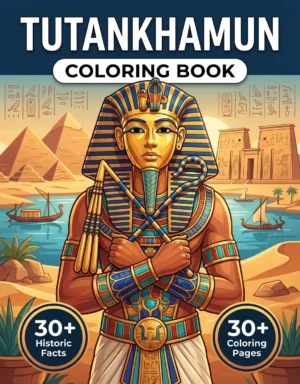
Our Tutankhamun tomb discovery guide follows Howard Carter into the boy king’s burial chamber, step by step. Pair it with the Cleopatra book and you hold both ends of the story.
Buying for someone who loves Egypt? Our guide to gifts for ancient Egypt lovers leads with these two titles and explains who each suits.
How to color Cleopatra’s story
Color her life in order: the exile, the carpet, Caesar, the Nile journey, Caesar’s murder, Antony at Tarsus, Actium and the end. Read each caption before you pick up a pencil, and by the last page you will know why her death closed an entire era.
Give each chapter its own palette. Try Nile greens and gold for the years with Caesar, purple and silver for the fleet at Tarsus, then smoke and bronze for Actium. Coloring forces those choices, and the choices are what make the facts stick, as we explain in learning history through coloring.
The book is an instant PDF, so you can print the first scene tonight and reprint any page to try again. Our guide on how to print a coloring book PDF covers the paper that takes colored pencil and gel pen best.
It also makes a gift that gets used rather than shelved, which is why it appears in our list of gifts for history lovers.
Cleopatra’s death: your questions answered
How did Cleopatra die?
Cleopatra died by suicide in Alexandria in August 30 BC, aged 39. Ancient writers say she let an asp, an Egyptian cobra, bite her, but they admit no one knew for sure. Many historians now think she took poison instead.
When did Cleopatra die?
In August 30 BC, about eleven days after Alexandria fell to Octavian and Mark Antony died. The exact day is uncertain; historians most often give 10 or 12 August.
How old was Cleopatra when she died?
She was 39. Cleopatra was born in 69 BC and became queen at 18 in 51 BC, ruling Egypt for about 21 years.
Why did Cleopatra kill herself?
To avoid being led in chains through Rome in Octavian’s triumph. After her defeat at Actium in 31 BC and the fall of Alexandria in 30 BC, she learned she would be shipped to Rome within days.
Where is Cleopatra buried?
Octavian had her buried beside Mark Antony in Alexandria, as she requested. The tomb has never been found; archaeologists are still searching, notably at Taposiris Magna west of Alexandria.
Is there a Cleopatra coloring book for adults?
Yes. The Cleopatra coloring book by Motiv Colors follows her life in chronological order, from her return to power with Caesar to Antony, Actium and her death, with a caption on every scene. It is an instant PDF you print at home.
Color the last queen of Egypt
The asp may be legend, but the choice was real: a queen who preferred death to a parade. Her story only makes sense in order, from the carpet to the couch.
Every scene in the book is checked by a human before it ships. Print the first page tonight and start with the queen in exile.
We use cookies to enhance your browsing experience, serve personalized content and analyze our traffic. You can accept all cookies, reject non-essential ones, or manage your preferences.
Required for the website to function and cannot be switched off. They are usually set in response to actions you make, such as setting privacy preferences or logging in.
Allow the website to remember choices you make (such as language or region) to provide enhanced, personalized features.
Help us understand how visitors interact with the website by collecting and reporting information anonymously.
Used to track visitors across websites to display relevant advertising and measure campaign effectiveness.