Tutankhamun tomb discovery: open the tomb step by step
On November 4, 1922, a step cut into the rock turned up beneath a row of old workmen’s huts in the Valley of the Kings. Sixteen steps later, a sealed door carried the name of a pharaoh almost nobody remembered.
Here is the Tutankhamun tomb discovery step by step, door by door, from that first step to the golden mask and the last object packed ten years later. You get the dates, what Howard Carter saw behind each door, the truth about the curse, where the treasures are today, and the scenes to color as you go.
Tutankhamun tomb discovery at a glance
Howard Carter found the first step of tomb KV62 on November 4, 1922, peered into the antechamber on November 26, opened the burial chamber on February 16, 1923, and lifted the golden mask in October 1925. Clearing more than 5,000 objects took until 1932. It remains the most intact royal tomb ever found in Egypt.
Date
Step
What Carter found
November 4, 1922
The first step
A step cut into the bedrock below old workmen’s huts
November 6, 1922
The telegram
Carter reburies the stairway and cables Lord Carnarvon in England
November 24, 1922
The sealed door
Sixteen steps, a plastered door, seals naming Tutankhamun
November 26, 1922
Wonderful things
Through a hole in the second door: gold everywhere
November 29, 1922
The antechamber
Official opening: couches, chariots, two guardian statues
February 16, 1923
The burial chamber
A wall of gold: the first of four gilded shrines
April 5, 1923
Carnarvon dies
The patron dies in Cairo; the curse story is born
February 12, 1924
The sarcophagus
The stone lid is raised over three nested coffins
October 28, 1925
The golden mask
The innermost coffin of solid gold, the mask on the mummy
1926 to 1932
Treasury and annex
The canopic shrine, Anubis, models, and the last objects
The Tutankhamun coloring book follows the king the same way, in order: the boy crowned at nine, the restoration of the old gods, the wars on the borders, the sudden death, the forgotten tomb and, on its last scenes, Carter’s discovery.
Tutankhamun was a pharaoh of Egypt’s 18th Dynasty who came to the throne around 1332 BC at about nine years old and died around eighteen. He undid the religious revolution of Akhenaten, restored the old gods and the temples of Amun, and was then struck from the official king lists. Before 1922 he was almost forgotten.
He was born Tutankhaten, a name honoring the sun disc his father’s court worshipped. Within a few years of taking the throne he changed it to Tutankhamun and moved the court away from Akhenaten’s city of Amarna.
His death is still debated. Scans of the mummy show a broken leg and signs of malaria, and the old theory of a blow to the head has lost ground. Later pharaohs erased the Amarna kings from history, which is partly why robbers and builders lost track of his tomb.
Those chapters fill the first half of the Tutankhamun coloring book: the coronation, the restoration and the armies marching against Nubians and Hittites, each with a caption that tells you the context.
How did Howard Carter find the first step?
Carter had searched the Valley of the Kings for Lord Carnarvon since 1917 and found almost nothing. Carnarvon agreed to pay for one last season. On November 4, 1922, Carter’s team cleared the ground below workmen’s huts near the tomb of Ramesses VI and uncovered a step cut into the rock: the top of a staircase.
By the next day the workers had cleared twelve steps and the upper edge of a blocked doorway, plastered and stamped with seals. Carter did not break it.
Instead he filled the stairway back in, posted guards and, on November 6, sent Carnarvon a telegram: at last have made wonderful discovery in Valley; a magnificent tomb with seals intact; re-covered same for your arrival. A later story credits a water boy with spotting the first step, but Carter’s own account names no one.
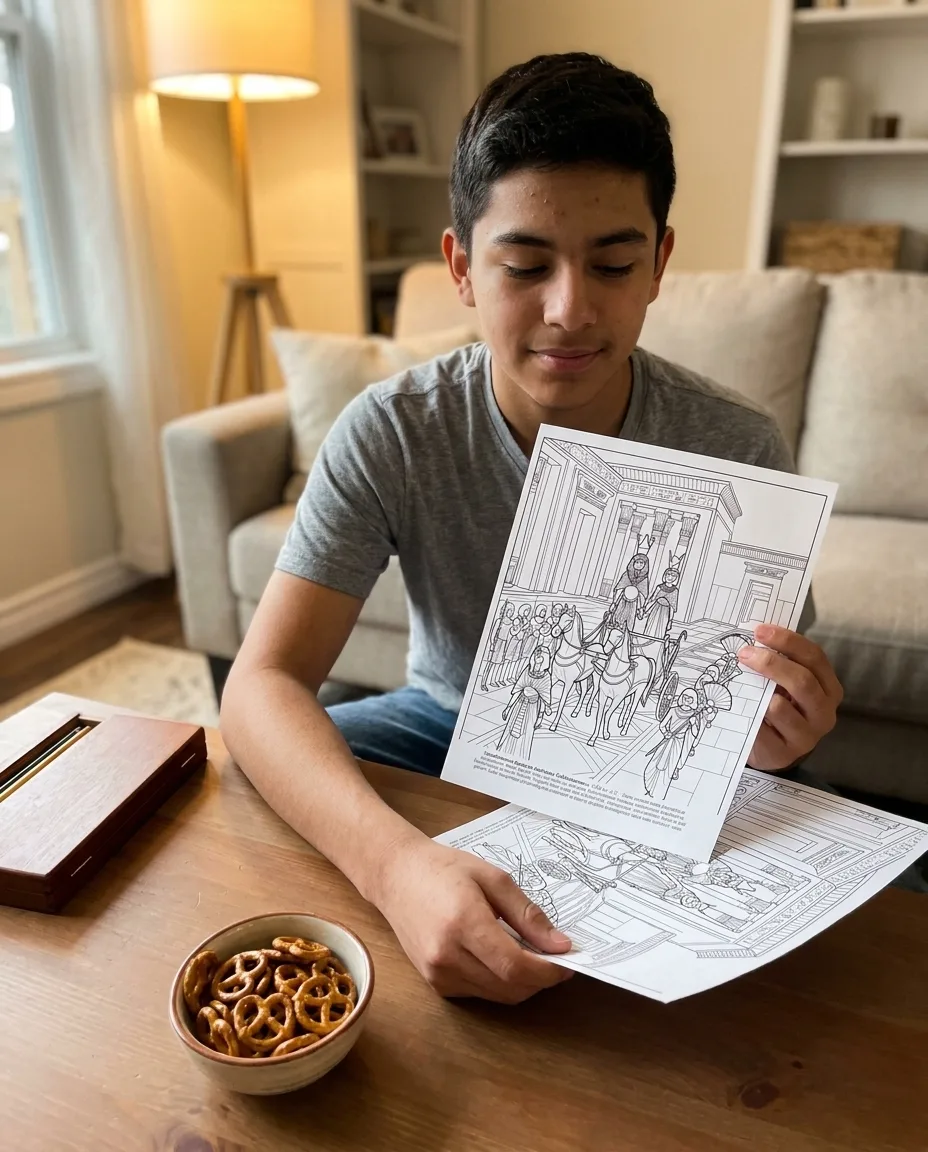
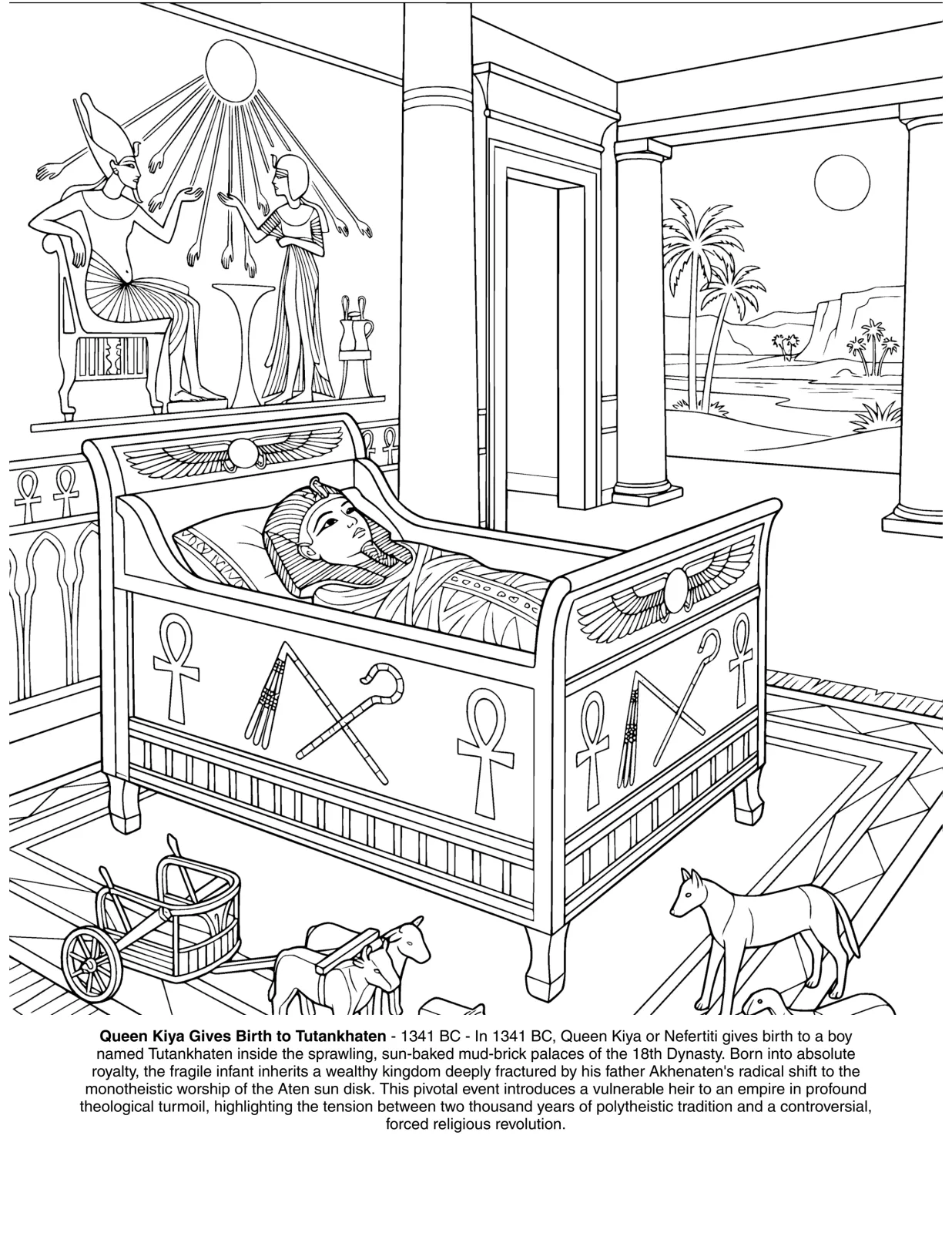
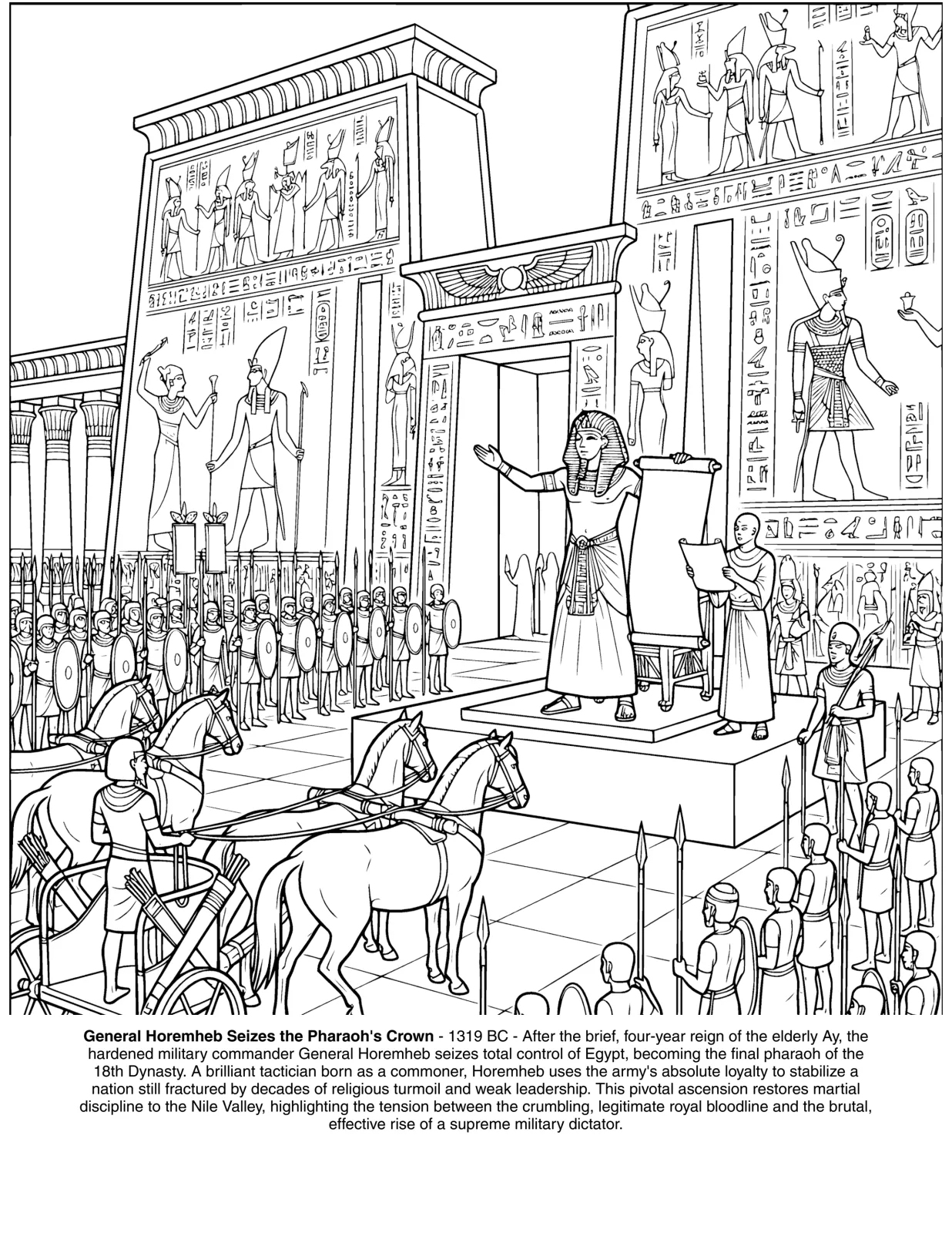
An early scene from the Tutankhamun book, ready to color.
What did Carter see? Wonderful things
On November 26, 1922, Carter reached a second sealed door at the end of a corridor, made a small hole, and held up a candle. Carnarvon asked whether he could see anything. Carter’s famous answer, in the words he published, was yes, wonderful things. Gold glinted from every corner of the room beyond.
Carnarvon and his daughter, Lady Evelyn Herbert, had arrived in Luxor on November 23. On the 24th the full staircase was cleared and the seals on the first door read Tutankhamun.
There was a worry. Parts of the first door had been opened and resealed in antiquity, so robbers had entered. They had been caught quickly, and most of what they disturbed was still in the tomb.
What was inside the antechamber?
The antechamber, officially opened on November 29, 1922, was crammed with the king’s belongings: three gilded couches shaped like animals, dismantled chariots, boxes of clothes and jewels, and two life-size statues of the king in black and gold guarding a sealed wall. Behind that wall lay the burial chamber.
A small door led off to the annex, stacked to the ceiling in a chaotic jumble of food, oils, furniture and games left by the robbers. It would be the last room cleared.
Carter’s team photographed and numbered every object where it lay before anything moved. Harry Burton’s glass-plate photographs of these rooms are still the best record of a royal tomb as it was found.
The empty tomb of Seti II became a laboratory to conserve finds, and moving a single couch could take weeks. That patience is why the Tutankhamun collection survives intact.
When was the burial chamber opened?
The burial chamber was officially opened on February 16, 1923, before an audience of officials. Behind the guarded wall stood a gilded shrine almost filling the room, and inside it three more shrines, nested like boxes, around a stone sarcophagus. Carter could not lift the sarcophagus lid until February 12, 1924.
Carter, Carnarvon and Lady Evelyn had almost certainly crept into the chamber in secret soon after the first opening, through a small hole they later disguised. Carter never admitted it.
Next to the burial chamber lay the room Carter called the treasury. Its doorway was guarded by a black jackal of Anubis on a gilded shrine, and behind him stood the canopic shrine that held the king’s organs.
Work then stopped for most of 1924 in a dispute with the Egyptian authorities over access and the press. When it resumed, the coffins came next.
Get 5 illustrations from our bestselling coloring books, for free.
You will receive in your mail box the link to download the 5 illustrations in high quality and PDF format.
How was the golden mask found?
Inside the sarcophagus lay three coffins, one inside another. The two outer ones were gilded wood; the innermost, opened in October 1925, was solid gold and weighs about 110 kilograms. On October 28, 1925, Carter lifted its lid and saw the golden mask, about 10 kilograms of gold, glass and stone, on the mummy’s head and shoulders.
The mask shows the king with the striped nemes headdress, the vulture and cobra on his brow, and eyes of quartz and obsidian. The stripes are inlaid with blue glass imitating lapis lazuli.
The mummy itself was in poor condition, glued to the coffin by the resins poured over it. Its examination began on November 11, 1925, and it was returned to his tomb, where it still lies today in a climate-controlled case.
When you color it, keep it simple: two golds, a warm one and a cool one, and a single deep blue for the stripes. Leave white paper where the light hits the brow.
A scene from the end of the Tutankhamun book, before color.
Was there a curse of Tutankhamun?
No. Lord Carnarvon died in Cairo on April 5, 1923, of blood poisoning after an infected mosquito bite, and newspapers shut out of the story invented a pharaoh’s curse to sell copies. Carter himself, who opened every door, lived until 1939. Studies of the people present found no higher death rate.
The legend grew because the press had little else. Carnarvon had sold exclusive rights to The Times, so rival papers filled their columns with omens and warnings that no inscription in the tomb contains.
The curse sold, and still sells. But the real story is better: a boy king erased from history, and a tomb that survived because the world forgot him.
Where are Tutankhamun’s treasures today?
Almost all of Tutankhamun’s treasures are now in the Grand Egyptian Museum at Giza, which opened its galleries with the complete collection shown together for the first time. The mummy stays in tomb KV62 in the Valley of the Kings, and the tomb itself is open to visitors on a separate ticket.
Seeing the objects in order, from chariots to the mask, is the closest you can get to standing in Carter’s candlelight. If that trip is a dream for someone you know, our gifts for ancient Egypt lovers has ideas that cost less than a flight.
Howard Carter found the first step of the tomb on November 4, 1922, in the Valley of the Kings. He first looked into the antechamber on November 26, 1922, and the room was officially opened on November 29.
Who discovered Tutankhamun’s tomb?
The British archaeologist Howard Carter, working for his patron George Herbert, 5th Earl of Carnarvon. Carter’s Egyptian workmen uncovered the first step under his direction.
Why was Tutankhamun’s tomb so important?
It is the most intact royal tomb ever found in Egypt. Robbers had entered it in antiquity but taken little, so more than 5,000 objects survived where they were placed, including the golden mask and three nested coffins.
How long did it take to empty the tomb?
About ten years. Carter’s team recorded and conserved every object before moving it, and the last finds left the tomb in 1932.
Is Tutankhamun’s mummy still in the tomb?
Yes. The mummy lies in tomb KV62 in the Valley of the Kings, in a climate-controlled case. Most of the treasures are in the Grand Egyptian Museum at Giza.
Is there a Tutankhamun coloring book for adults?
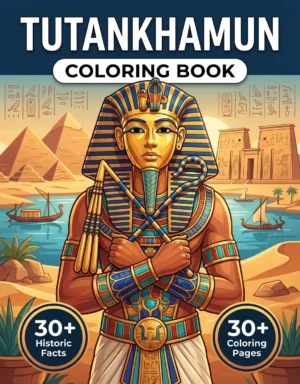
Yes. The Tutankhamun coloring book by Motiv Colors tells his story in order across 30+ detailed scenes, from his coronation at nine to Carter’s discovery in 1922, with a historical caption on every page. It is an instant PDF you print at home.
Open the tomb yourself, one page at a time
Tutankhamun’s story only makes sense in order: the boy king, the restored gods, the sudden death, three thousand years of sand, then a single step in 1922. Color it that way and you will remember every door.
We use cookies to enhance your browsing experience, serve personalized content and analyze our traffic. You can accept all cookies, reject non-essential ones, or manage your preferences.
Required for the website to function and cannot be switched off. They are usually set in response to actions you make, such as setting privacy preferences or logging in.
Allow the website to remember choices you make (such as language or region) to provide enhanced, personalized features.
Help us understand how visitors interact with the website by collecting and reporting information anonymously.
Used to track visitors across websites to display relevant advertising and measure campaign effectiveness.