Joan of Arc timeline: from Domrémy to the fire at Rouen
A farm girl hears voices, crosses enemy country, breaks a siege, crowns a king, and is burned alive at nineteen. Joan of Arc’s whole public life lasts about two years, and every month of it counts.
This Joan of Arc timeline puts it all in order, from her birth in Domrémy to the trial that condemned her and the retrial that cleared her. You get one dated table, each stage explained, the dates other timelines get wrong, and the scenes to color.
Joan of Arc timeline at a glance
Joan of Arc was born around 1412 in Domrémy, heard her voices from about 1425, lifted the siege of Orléans on 8 May 1429 and saw Charles VII crowned at Reims on 17 July 1429. Captured at Compiègne on 23 May 1430, she was burned at Rouen on 30 May 1431, aged 19.
Date
Event
c. 1412
Born in Domrémy, Lorraine, to Jacques d’Arc and Isabelle Romée
c. 1425
First hears her voices in her father’s garden, about age 13
May 1428
Turned away by Robert de Baudricourt at Vaucouleurs
Feb 1429
Rides eleven days across enemy country to Chinon
Mar 1429
Meets the Dauphin Charles at Chinon; examined at Poitiers
29 Apr 1429
Enters besieged Orléans
8 May 1429
The English lift the siege of Orléans
18 Jun 1429
Victory at Patay
17 Jul 1429
Charles VII crowned in Reims Cathedral
8 Sep 1429
Wounded in the failed attack on Paris
23 May 1430
Captured by the Burgundians at Compiègne
Nov 1430
Sold to the English for 10,000 livres
Dec 1430
Taken to Rouen
21 Feb 1431
Public sessions of her trial begin
24 May 1431
Abjures under threat of the fire
30 May 1431
Burned at the stake in the Old Market, Rouen
7 Jul 1456
The verdict is declared null
18 Apr 1909
Beatified by Pius X
16 May 1920
Canonized by Benedict XV
Our Joan of Arc coloring book follows this same order: the voices, the audience with the Dauphin, Orléans, the march to Reims, the capture and the fire. Each scene carries its date and a short caption, so the table above becomes a story you color page by page.
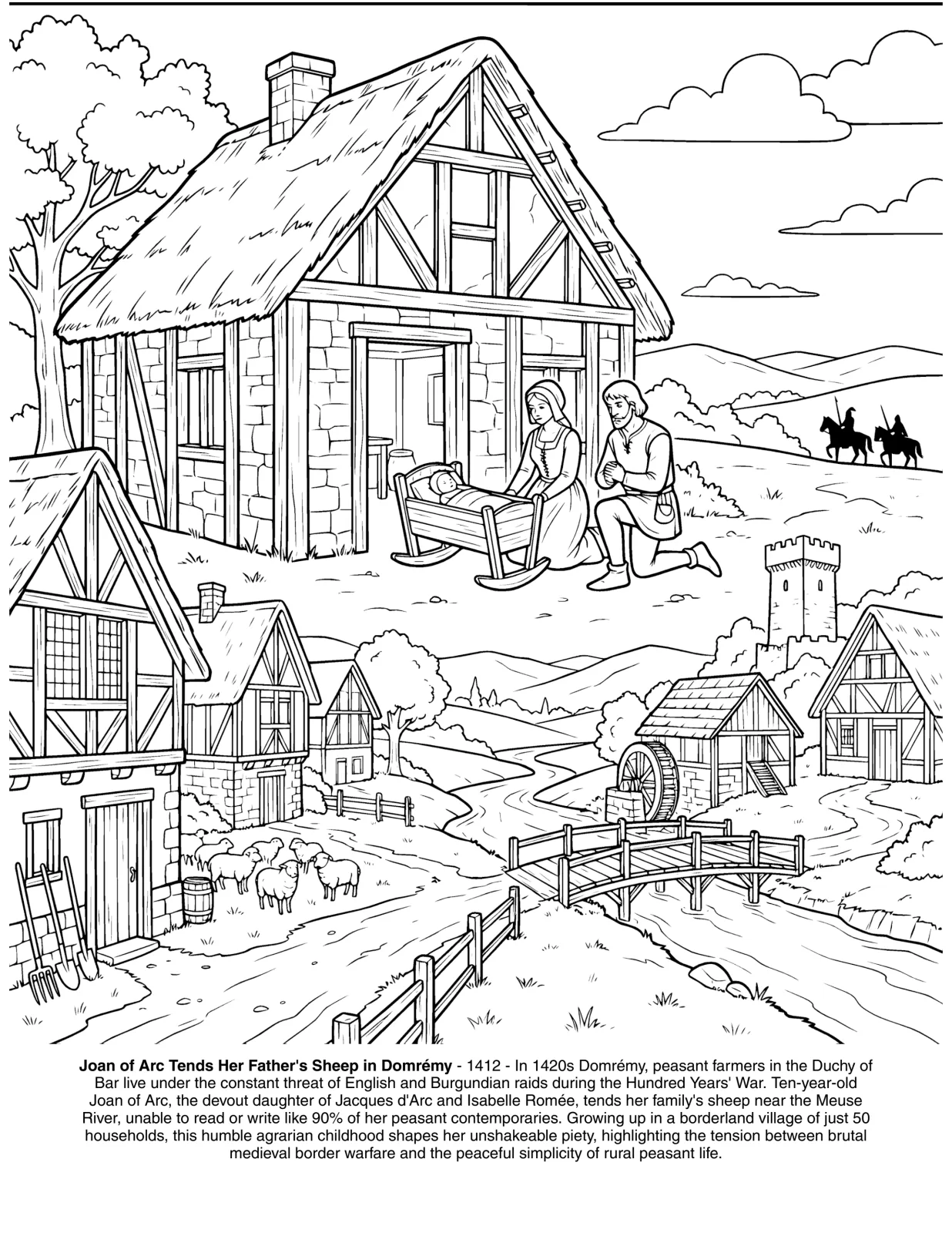
Before 1429, Joan was a peasant girl in Domrémy, a village on the border of Lorraine loyal to the French crown. She could not read, spun wool and watched her father’s animals. At about thirteen, she began to hear voices she named as Saint Michael, Saint Catherine and Saint Margaret.
Her France was losing the Hundred Years’ War. The Treaty of Troyes in 1420 had disinherited the Dauphin Charles in favor of the English king, and England and its Burgundian allies held Paris and most of the north.
The voices grew insistent: she must go to the Dauphin and drive out the English. In May 1428, at sixteen, she persuaded a cousin to take her to Robert de Baudricourt, captain of nearby Vaucouleurs. He told her escort to take her home to her father for a slap.
An early scene from the Joan of Arc book, ready to color.
How did Joan of Arc reach the Dauphin?
Joan went back to Vaucouleurs in January 1429 and this time won Baudricourt over. In February she left with six men, dressed as a man and her hair cut short, and rode eleven days through Burgundian territory to Chinon, where she met the Dauphin Charles in early March 1429.
Legend says Charles hid among his courtiers to test her and she walked straight to him. What is certain is that she won a private hearing and told him something that convinced him.
Charles still had her examined for three weeks by theologians at Poitiers. They found nothing against her and advised him to use her. He gave her armor, a banner and a place with the army marching to relieve Orléans.
How did Joan of Arc lift the siege of Orléans?
Joan entered Orléans on 29 April 1429, six months into an English siege. In nine days the French took the English forts around the city one after another: Saint-Loup on 4 May, the Augustins on 6 May and Les Tourelles on 7 May. On 8 May, the English army withdrew.
At Les Tourelles, an arrow struck her between the neck and shoulder. She had it pulled out, had the wound dressed, and went back to the assault that evening, which is the moment the city never forgot.
Orléans still celebrates its liberation every 8 May. For France it was the turning point of the war, and in our book it is the page with the most fire and smoke on it.
What happened at Reims and after?
After Orléans, Joan’s army swept the Loire valley in June 1429, crushing the English at Patay on 18 June. She then pushed Charles north through enemy towns to Reims, where he was crowned in the cathedral on 17 July 1429 with Joan beside the altar holding her banner.
The coronation mattered more than any battle. It made Charles the anointed king in the eyes of his people and turned the English king’s claim into a foreign one.
From then on, things went wrong. The attack on Paris on 8 September failed and Joan was wounded in the thigh by a crossbow bolt. The king made a truce with Burgundy, and the siege of La Charité collapsed that winter. In December, Charles ennobled Joan’s family under the name du Lys.
Get 5 illustrations from our bestselling coloring books, for free.
You will receive in your mail box the link to download the 5 illustrations in high quality and PDF format.
How was Joan of Arc captured?
Joan was captured on 23 May 1430 outside Compiègne, which she had come to defend against the Burgundians. Leading a sortie, she was cut off as the drawbridge rose behind her, and an archer pulled her from her horse by her cloak. Her campaigning had lasted barely a year.
Her captor, Jean de Luxembourg, held her first at Beaulieu-les-Fontaines, then at his castle of Beaurevoir. There she jumped from a tower, some twenty meters, in a desperate escape attempt, and survived.
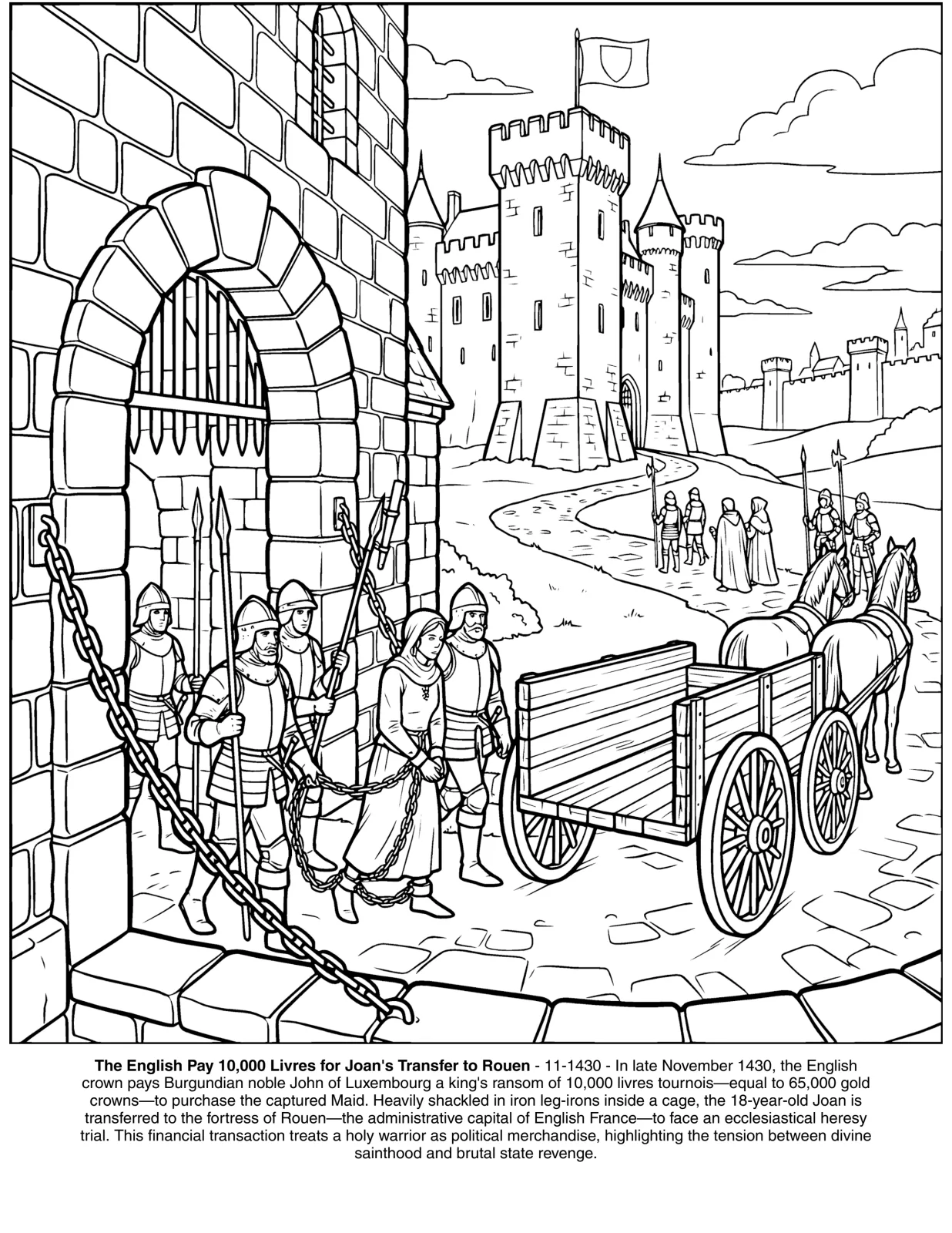
In November 1430 he sold her to the English for 10,000 livres. She was moved through Arras and Le Crotoy and reached Rouen, the English capital in France, at the end of December. Charles VII made no move to buy her back.
What happened at Joan of Arc’s trial?
Joan was tried for heresy, not witchcraft, by a church court at Rouen under Pierre Cauchon, bishop of Beauvais and a Burgundian partisan. The public sessions opened on 21 February 1431. Alone and unable to read, she faced dozens of theologians over three months, and her answers are recorded word for word.
Asked whether she was in God’s grace, a trap either way, she answered: “If I am not, may God put me there; and if I am, may God so keep me.” The judges moved on.
The case came down to her voices, her refusal to submit them to the Church’s judgment, and her men’s clothing. Some seventy charges were reduced to twelve articles.
How did Joan of Arc die?
Joan was burned alive as a relapsed heretic in the Old Market square of Rouen on 30 May 1431, aged 19. On 24 May, facing the fire, she had signed an abjuration and been sentenced to life in prison. Days later she put men’s clothes back on, which her judges declared a relapse.
She asked for a cross, and an English soldier made her one from two sticks. A priest held a crucifix up before her as the flames rose, and witnesses said she called on Jesus to the end.
Her ashes were thrown into the Seine. A cross on the square of the Vieux-Marché marks the spot today, beside the modern church dedicated to her.
The last pages of the Joan of Arc book.
How did Joan of Arc become a saint?
Joan’s road to sainthood took nearly five centuries. Charles VII ordered an inquiry in 1450, Pope Callixtus III authorized a retrial in 1455, and on 7 July 1456 her conviction was declared null. Pope Pius X beatified her in 1909 and Benedict XV canonized her on 16 May 1920.
Many timelines get these last steps wrong. The retrial did not declare her a saint or a martyr; it cancelled the first verdict as corrupt. Her beatification came in 1909, not 1905 as some timelines say, and the pope who canonized her was Benedict XV.
In 1922 she was named a secondary patron saint of France. She is also venerated as a patron of soldiers, which is why her story suits a confirmation or a saint’s-day gift. Our guide to Christian gifts that aren’t cheesy explains how to choose for each person.
How to color Joan of Arc’s story
Color her life in order, one scene per sitting: the voices in the garden, the ride to Chinon, Orléans, the crown at Reims, Compiègne and Rouen. Read each caption, then color. Her story covers only two years, so the order of events is everything.
Give each stage its own light. Try spring greens and soft gold for Domrémy, steel and royal blue with gold fleurs-de-lis for the campaigns, and dark stone and firelight for Rouen.
The book is an instant PDF. Print the first page tonight and reprint any scene to try a second palette; our guide on how to print a coloring book PDF covers the paper that holds colored pencil best. Buying it for someone else? It also sits in our gifts for history lovers.
Joan of Arc: your questions answered
What are the key dates of Joan of Arc’s life?
Born around 1412 in Domrémy; first voices around 1425; meets the Dauphin at Chinon in March 1429; lifts the siege of Orléans on 8 May 1429; Charles VII crowned at Reims on 17 July 1429; captured at Compiègne on 23 May 1430; burned at Rouen on 30 May 1431.
How old was Joan of Arc when she died?
She was 19. Joan was born around 1412 and was burned at the stake in Rouen on 30 May 1431.
Why was Joan of Arc burned at the stake?
A church court at Rouen, led by Bishop Pierre Cauchon and controlled by the English, convicted her of heresy. She abjured on 24 May 1431, then resumed men’s clothing, which the judges called a relapse. Relapsed heretics were handed over to be burned.
How long did Joan of Arc fight?
About a year of active campaigning, from Orléans in April 1429 to her capture at Compiègne in May 1430. Her whole public mission, from leaving Vaucouleurs to her death, lasted just over two years.
When did Joan of Arc become a saint?
Pope Benedict XV canonized her on 16 May 1920, after her beatification by Pius X in 1909. Her conviction had already been declared null on 7 July 1456.
Is there a Joan of Arc coloring book for adults?
Yes. The Joan of Arc coloring book by Motiv Colors follows her life in order, from the voices to Orléans, Reims, Compiègne and Rouen, with a dated caption for every scene. It is an instant PDF you print at home.
Color the two years that saved France
Two years, one crowned king, one girl at the center. In order, Joan’s story reads like what it was: a race against time she knew she would lose.
Every scene in the book is checked by a human before it ships. Print the first page tonight and start in her father’s garden.
We use cookies to enhance your browsing experience, serve personalized content and analyze our traffic. You can accept all cookies, reject non-essential ones, or manage your preferences.
Required for the website to function and cannot be switched off. They are usually set in response to actions you make, such as setting privacy preferences or logging in.
Allow the website to remember choices you make (such as language or region) to provide enhanced, personalized features.
Help us understand how visitors interact with the website by collecting and reporting information anonymously.
Used to track visitors across websites to display relevant advertising and measure campaign effectiveness.