The life of the Buddha in order: from Lumbini to Kushinagar
A sheltered young man sees an old man, a sick man and a corpse, and walks out of his life to find out why. Six years later he sits under a tree and does not get up until he understands.
This is the life of the Buddha in order, from his birth at Lumbini to his death at Kushinagar some eighty years later. You get one timeline with his age at every stage, the places you can still visit, what is history and what is legend, and the scenes to color.
The life of the Buddha at a glance
Siddhartha Gautama was born at Lumbini, in today’s Nepal, left home at 29, reached enlightenment at 35 under the Bodhi tree at Bodh Gaya, gave his first sermon at Sarnath, taught for 45 years across northern India, and died at about 80 at Kushinagar. Scholars place his life in the 6th or 5th century BC.
Age
Event
Place
0
Birth of Siddhartha; his mother Maya dies seven days later
Lumbini, Nepal
16
Marries Yashodhara
Kapilavastu
29
The Four Sights; birth of his son Rahula; the Great Renunciation
Kapilavastu
29 to 35
Studies with two teachers, then six years of fasting
Magadha
35
Accepts the Middle Way; enlightenment under the Bodhi tree
Bodh Gaya, India
35
First sermon to five companions in the Deer Park
Sarnath, India
35 to 80
Teaches across the Ganges plain; founds the order of monks and nuns
Rajgir, Shravasti, Vaishali
80
Final illness, death and parinirvana between two sal trees
Kushinagar, India
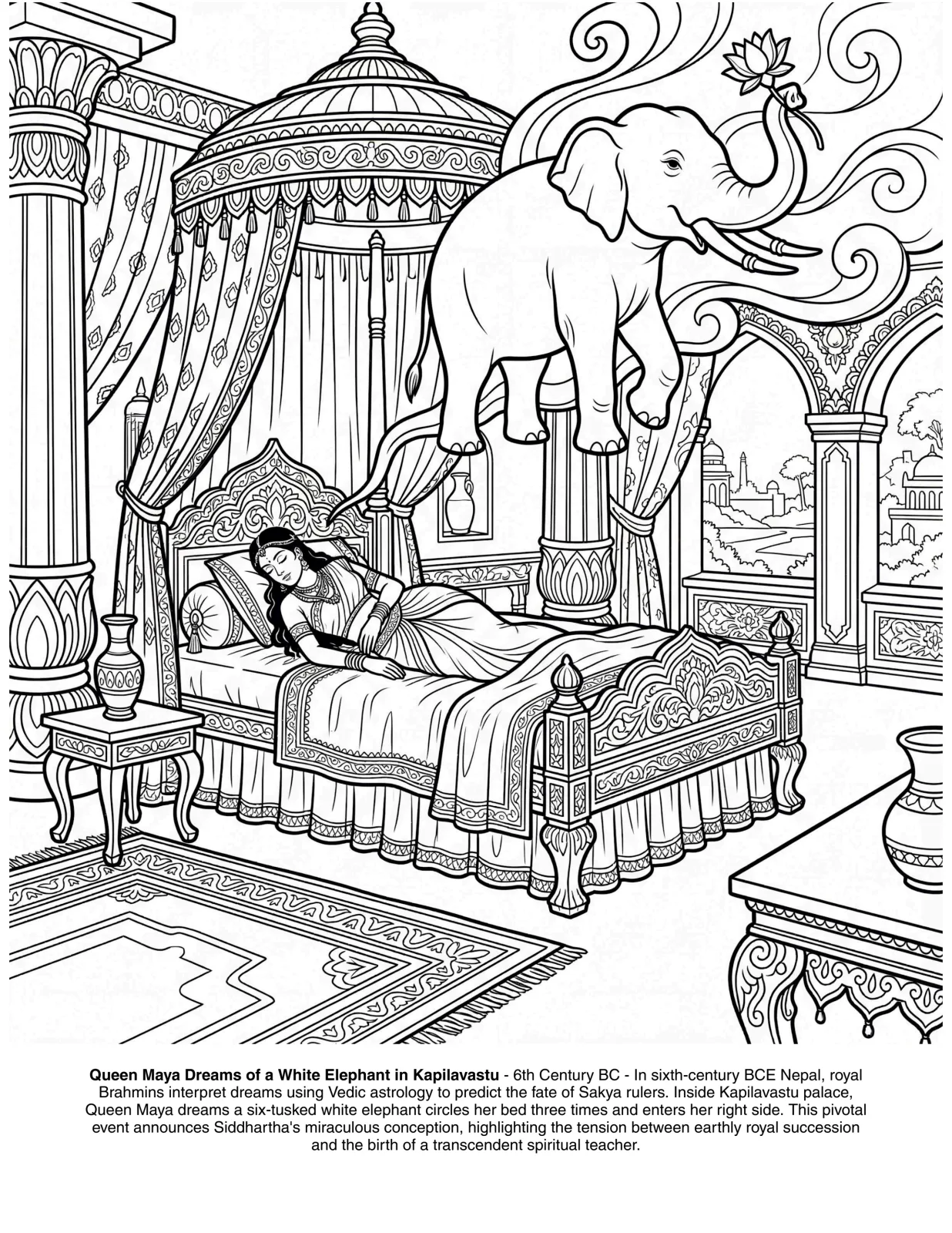
Our Life of Buddha coloring book follows the first half of this table scene by scene: the birth at Lumbini, the Four Sights, the night he left, the Bodhi tree and the first sermon in the Deer Park. Each page carries a short caption, so you color the story rather than a decoration.
No one knows exactly. The Theravada tradition gives 624 to 544 BC, older Western books give 563 to 483 BC, and many historians now prefer roughly 480 to 400 BC. All agree he lived about eighty years in the Ganges plain of northern India, a century or two before Alexander the Great reached the Indus.
The uncertainty comes from the sources. His teachings were passed down orally for centuries before they were written in the Pali Canon in Sri Lanka in the 1st century BC.
Some fixed points are solid, though. In 249 BC the emperor Ashoka set up a stone pillar at Lumbini inscribed “Here the Buddha was born”, and it still stands. Bodh Gaya, Sarnath and Kushinagar have been pilgrimage sites since at least Ashoka’s time.
Was Siddhartha really a prince?
He was born into the ruling family of the Shakyas, a small clan in the foothills of the Himalayas, but probably not a prince in the fairy-tale sense. The Shakyas were governed by an assembly of leading families, and his father Suddhodana was one of its chiefs. The palaces of gold came later.
Later biographies, above all the Buddhacarita written by the poet Ashvaghosa around the 2nd century AD, added the splendor: three palaces, one for each season, and a father who hid every sign of age and sickness from his son.
The early texts are plainer but no less striking. In one, the Buddha simply recalls that he was “delicately brought up” and that even as a young man he was troubled by the thought of old age, sickness and death.
What were the Four Sights?
The Four Sights are the encounters that made Siddhartha leave home: an old man, a sick man, a corpse and a wandering ascetic. Riding out with his charioteer Channa, he saw that age, illness and death come to everyone. The calm ascetic showed him that one could set out to find a way beyond them.
In the traditional telling, his father had planned his son’s whole life to keep these sights away. The gods put them in his path anyway, on four separate rides.
It is one of the most painted scenes in Buddhist art, and our book gives it a full page. Try four separate palettes, grey and faded for the old man, feverish for the sick man, bone and ash for the corpse, then saffron for the ascetic.
An early scene from The Life of Buddha, ready to color.
Why did Siddhartha leave home?
Siddhartha left home at 29 because he could no longer live in comfort knowing that he, his wife and his newborn son would all grow old, fall ill and die. One night he looked at Yashodhara and the baby Rahula asleep, did not wake them, and rode out with Channa on his horse Kanthaka.
Buddhists call this the Great Renunciation. At the river Anomā he cut off his long hair with his sword, exchanged his clothes for a hunter’s rough robe, and sent Channa and the horse home.
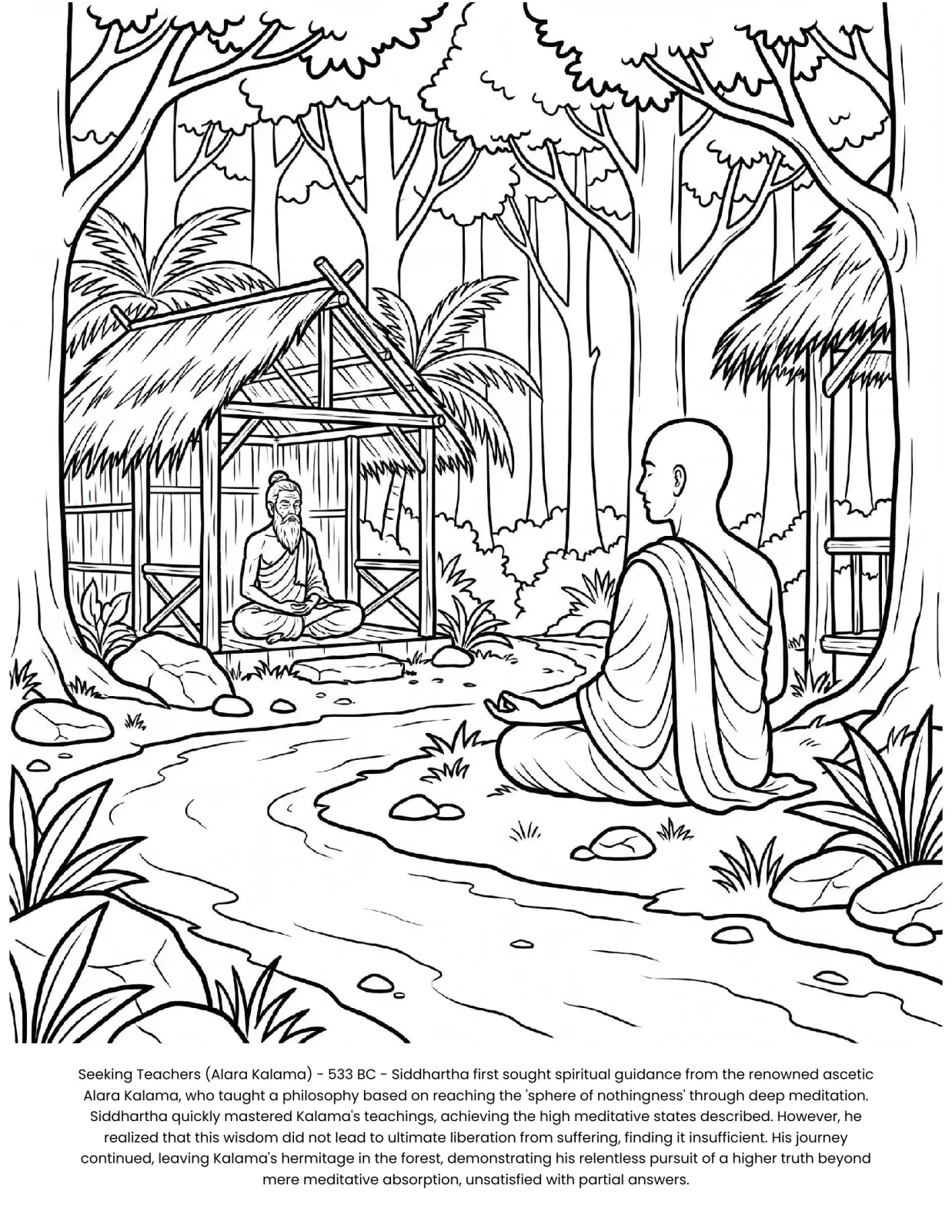
He became a wandering seeker, a common path in India at the time. He mastered the meditation of two famous teachers, Alara Kalama and Uddaka Ramaputta, then left each of them because their methods did not answer his question.
How did the Buddha reach enlightenment?
After six years of fasting so extreme he nearly died, Siddhartha accepted a bowl of milk-rice from a young woman named Sujata, chose a middle way between luxury and self-torture, and sat beneath a pipal tree at Bodh Gaya. During that night he reached enlightenment and became the Buddha, “the awakened one”. He was 35.
His five companions in fasting left him in disgust when he ate. He sat down anyway and vowed not to rise until he understood.
Tradition says Mara, the tempter, attacked him with armies, storms and his three daughters. Siddhartha touched the earth with his right hand to call it as witness, and Mara fled. That gesture, the right hand reaching down, is the one you see on countless statues.
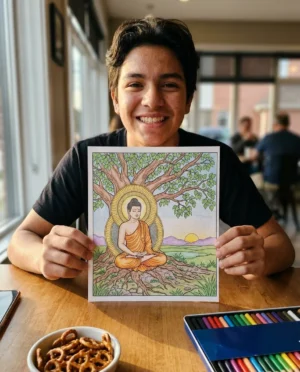
The tree’s descendant still grows beside the Mahabodhi Temple at Bodh Gaya. This is the central scene of our book, and the one most readers save for an unhurried evening.
Get 5 illustrations from our bestselling coloring books, for free.
You will receive in your mail box the link to download the 5 illustrations in high quality and PDF format.
What did the Buddha teach in his first sermon?
In his first sermon, in the Deer Park at Sarnath near Varanasi, the Buddha taught the Four Noble Truths and the Noble Eightfold Path to the five companions who had left him. Life involves suffering, suffering has a cause in craving, it can end, and the Eightfold Path is the way to end it.
Buddhists call this sermon the first turning of the wheel of the Dharma, which is why a wheel flanked by two deer marks Buddhist monasteries to this day.
The Middle Way he had found under the tree became the shape of the whole teaching: neither indulgence nor self-punishment. By the end of the sermon, one of the five, Kondañña, understood, and the Sangha, the community of monks, began.
What did the Buddha do for the next 45 years?
For 45 years the Buddha walked the Ganges plain teaching, resting only in the rainy season. He taught kings and outcasts alike, founded an order of monks and later of nuns, and gathered followers at Rajgir, Shravasti and Vaishali. Tradition records eight great events in his life, each tied to a place.
Lumbini: his birth.
Bodh Gaya: his enlightenment.
Sarnath: his first sermon.
Shravasti: the twin miracle, fire and water pouring from his body.
Sankassa: his descent from the heaven where he taught his mother.
Rajgir: the taming of Nalagiri, a mad elephant set on him by his jealous cousin Devadatta.
Vaishali: a monkey’s gift of a bowl of honey.
Kushinagar: his death and final nirvana.
His aunt Mahaprajapati, who had raised him, became the first Buddhist nun at Vaishali. His son Rahula became a monk, and his wife Yashodhara is said to have become a nun as well.
How did the Buddha die?
The Buddha died at about 80 in Kushinagar, after falling ill from a meal offered by a blacksmith named Cunda. Lying on his right side between two sal trees, he told his monks: “All conditioned things are subject to decay. Strive on with diligence.” Buddhists call his passing the parinirvana, the final release.
He made sure Cunda would not be blamed, telling his attendant Ananda that the last meal he ate before his death was as worthy as the one before his enlightenment.
His body was cremated and the relics divided among eight kingdoms, which built stupas over them. Before he died, he named four places worth a pilgrim’s journey: where he was born, awakened, first taught and died. Lumbini, Bodh Gaya, Sarnath and Kushinagar still draw pilgrims from across Asia.
How to color the life of the Buddha
Color it in order and slowly. Start with the birth at Lumbini, then the Four Sights, the night he left, the tree and the Deer Park. Read each caption before you begin a page, and let one scene be one evening.
Choose a palette from the tradition: saffron and ochre robes, the deep green of the pipal leaf, lotus pinks and pale gold. Deciding what each detail looks like is also how it stays with you, as we explain in learning history through coloring.
A page from the middle of the journey.
The book is an instant PDF, so you can print tonight and reprint the Bodhi tree as often as you want to revisit it. Our guide on how to print a coloring book PDF covers paper that holds soft pencil layers. It also makes a calm, thoughtful present, which is why it sits in our gifts for history lovers.
The Buddha’s life: your questions answered
What are the main events in the life of the Buddha?
His birth at Lumbini, the Four Sights, his departure from home at 29, six years of fasting, enlightenment at 35 under the Bodhi tree at Bodh Gaya, the first sermon at Sarnath, 45 years of teaching, and his death at about 80 at Kushinagar.
How old was the Buddha when he reached enlightenment?
He was 35. He had left home at 29 and spent about six years studying and fasting before he sat under the Bodhi tree at Bodh Gaya.
What are the Four Sights?
An old man, a sick man, a corpse and a wandering ascetic. Seeing them on rides outside his home showed Siddhartha that age, illness and death come to everyone, and that one could seek a way beyond them.
Where was the Buddha born?
At Lumbini, in the south of today’s Nepal near the Indian border. A pillar set up by the emperor Ashoka in 249 BC still marks the spot with the inscription “Here the Buddha was born”.
What were the Buddha’s last words?
According to the Pali Canon: “All conditioned things are subject to decay. Strive on with diligence.” He spoke them at Kushinagar, lying between two sal trees.
Is there a coloring book about the life of the Buddha?
Yes. The Life of Buddha coloring book by Motiv Colors follows Siddhartha in chronological order, from his birth at Lumbini through the Four Sights and the Bodhi tree to the first sermon at Sarnath, with a caption on every scene. It is an instant PDF you print at home.
Color the path, one scene at a time
A birth in a garden, four sights on the road, a night ride, a tree, a deer park. In order, the Buddha’s life reads as one long question and its answer.
Every scene in the book is checked by a human before it ships. Print the first page tonight and begin in the gardens of Lumbini.
We use cookies to enhance your browsing experience, serve personalized content and analyze our traffic. You can accept all cookies, reject non-essential ones, or manage your preferences.
Required for the website to function and cannot be switched off. They are usually set in response to actions you make, such as setting privacy preferences or logging in.
Allow the website to remember choices you make (such as language or region) to provide enhanced, personalized features.
Help us understand how visitors interact with the website by collecting and reporting information anonymously.
Used to track visitors across websites to display relevant advertising and measure campaign effectiveness.