JFK timeline: the life of John F. Kennedy in key dates
Forty-six years, of which barely a thousand days in the White House. John F. Kennedy’s life is short enough to hold in one table and packed enough that most timelines leave out half of it.
This JFK timeline puts every key date in order, from his birth in Brookline to the shots in Dallas and the days after. You get the life, the presidency and the assassination tagged in one table, each period explained, and the scenes to color.
JFK timeline at a glance
John F. Kennedy was born on 29 May 1917, survived the sinking of PT-109 in 1943, entered Congress in 1947 and the Senate in 1953, won the presidency in November 1960 and was inaugurated on 20 January 1961. He was assassinated in Dallas on 22 November 1963, aged 46, after 1,036 days in office.
Date
Period
Event
29 May 1917
Life
Born in Brookline, Massachusetts
Jun 1940
Life
Graduates from Harvard; thesis published as Why England Slept
2 Aug 1943
Life
PT-109 rammed and sunk by the destroyer Amagiri
Jan 1947
Life
Enters the House of Representatives
Jan 1953
Life
Enters the Senate after beating Henry Cabot Lodge Jr.
12 Sep 1953
Life
Marries Jacqueline Bouvier in Newport
May 1957
Life
Pulitzer Prize for Profiles in Courage
26 Sep 1960
Life
First televised presidential debate with Richard Nixon
8 Nov 1960
Life
Elected 35th president
20 Jan 1961
Presidency
Inaugurated: “Ask not what your country can do for you”
1 Mar 1961
Presidency
Creates the Peace Corps
17 Apr 1961
Presidency
Bay of Pigs invasion fails within three days
25 May 1961
Presidency
Asks Congress to land a man on the Moon this decade
3 Jun 1961
Presidency
Vienna summit with Nikita Khrushchev
13 Aug 1961
Presidency
The Berlin Wall goes up
16 to 28 Oct 1962
Presidency
Cuban Missile Crisis
11 Jun 1963
Presidency
Civil rights address to the nation
26 Jun 1963
Presidency
“Ich bin ein Berliner” in West Berlin
5 Aug 1963
Presidency
Limited Test Ban Treaty signed in Moscow
22 Nov 1963
Assassination
Shot in Dealey Plaza, Dallas; Lyndon Johnson sworn in
24 Nov 1963
Assassination
Jack Ruby shoots Lee Harvey Oswald
25 Nov 1963
Assassination
State funeral; burial at Arlington
24 Sep 1964
Assassination
Warren Commission report
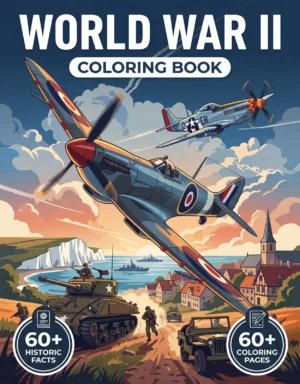
Our JFK coloring book follows the same order, from PT-109 and the Senate years to the debates, the Cuban Missile Crisis, the space race and Dallas. Every scene carries a short caption, so each page you color is a row of this table brought to life.
Color the thousand days, and the war that made him
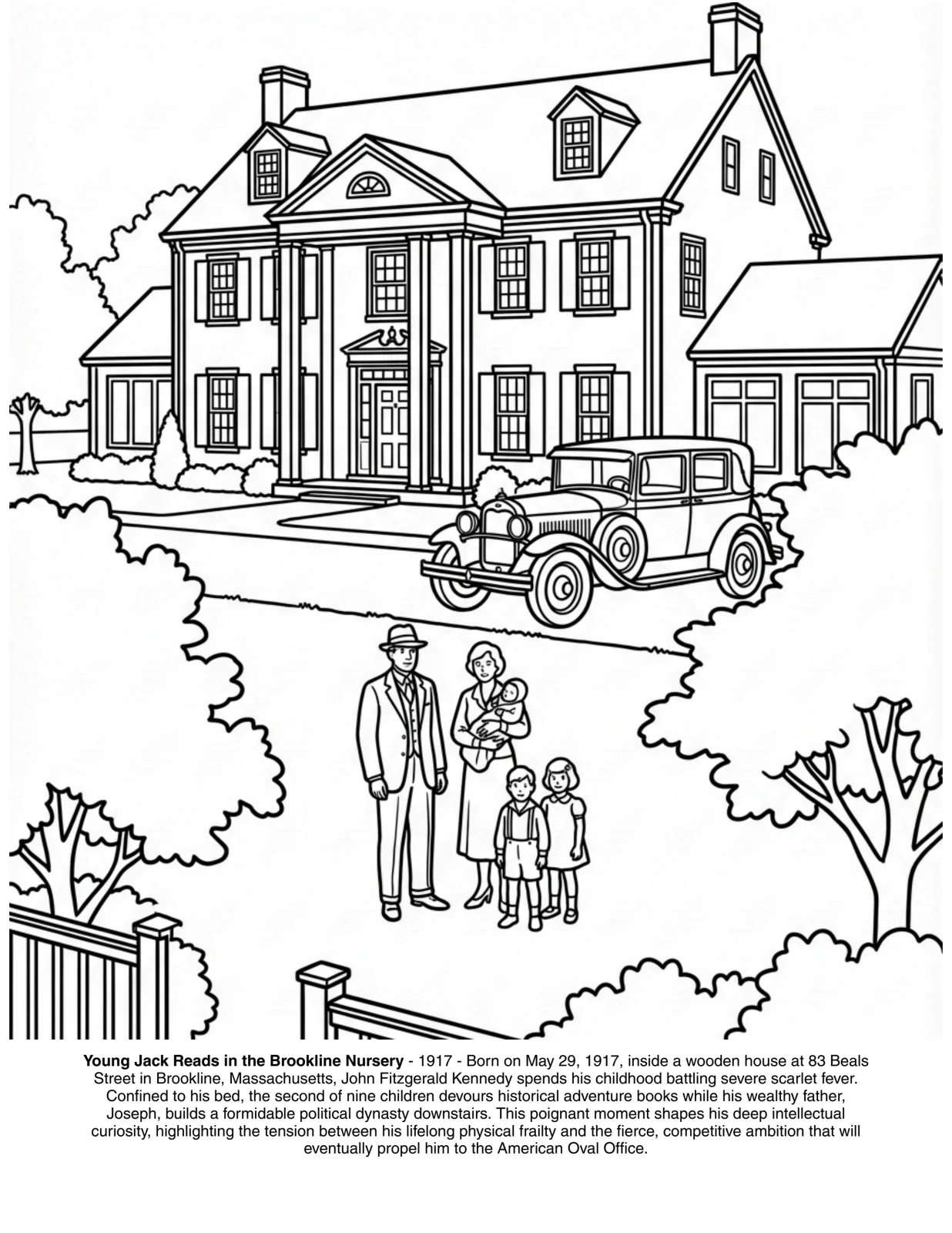
Before politics, John F. Kennedy was the sickly second son of a rich, ambitious Boston family. Born in 1917, one of nine children of Joseph P. Kennedy and Rose Fitzgerald, he spent much of his youth in hospitals, graduated from Harvard in 1940 and turned his senior thesis into a bestseller.
The thesis, Why England Slept, asked why Britain had rearmed so slowly against Hitler. His father, then ambassador in London, helped get it published in July 1940, and it sold well.
His health was worse than the public knew. He suffered from chronic back pain and, from 1947, was treated for Addison’s disease, a failure of the adrenal glands, which the family denied throughout his career.
What happened on PT-109?
On the night of 1 to 2 August 1943, Lieutenant Kennedy’s patrol torpedo boat, PT-109, was rammed and cut in half by the Japanese destroyer Amagiri in the Solomon Islands. Two of his crew died. Kennedy led the eleven survivors to an island several kilometers away, towing a badly burned man by a strap held in his teeth.
After days with little food and water, two Solomon Islander scouts, Biuku Gasa and Eroni Kumana, found them. Kennedy carved a message into a coconut husk, and the scouts paddled it to an Allied base. The crew was rescued on 8 August.
PT-109 made his name. A year later his elder brother Joe, the son meant for the presidency, was killed when his explosives-packed bomber blew up over England, and the family’s hopes passed to Jack. Our JFK book opens with this night at sea; for the wider war around it, see our World War 2 timeline.
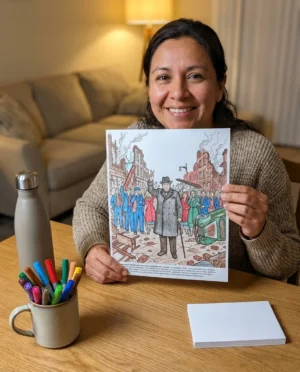
An early scene from the John F. Kennedy book, ready to color.
How did JFK rise from Congress to the White House?
Kennedy won a Boston seat in the House in 1946, beat the Republican Henry Cabot Lodge Jr. for the Senate in 1952, and built a national profile through the 1950s. In 1960 he won the Democratic nomination, out-debated Richard Nixon on television, and won one of the closest elections in American history.
He married Jacqueline Bouvier in 1953. While recovering from back surgery in 1954 and 1955 he worked on Profiles in Courage, portraits of senators who risked their careers on principle. It won the Pulitzer Prize in 1957, though his speechwriter Ted Sorensen did much of the writing.
The first debate, on 26 September 1960, was watched by about 70 million Americans. Kennedy looked rested and tanned; Nixon, recovering from illness, looked pale and sweating. Many radio listeners thought Nixon won. Television viewers did not.
On 8 November he won by about 113,000 votes out of almost 69 million, becoming, at 43, the youngest person ever elected president and the first Catholic.
What happened in JFK’s first year as president?
Kennedy’s first year mixed soaring promises with hard lessons. His inaugural address and the Peace Corps set the tone, but the Bay of Pigs invasion failed in April, Khrushchev bullied him at the Vienna summit in June, and in August East Germany sealed Berlin behind a wall.
The Bay of Pigs was a CIA plan inherited from Eisenhower: about 1,400 Cuban exiles landed in Cuba on 17 April 1961 and were defeated within three days. Kennedy took public responsibility, and his approval rating rose.
In between, he raised the stakes in space. Three weeks after Alan Shepard’s fifteen-minute flight, on 25 May 1961, he asked Congress to commit to landing a man on the Moon before the decade was out.
At Vienna on 3 and 4 June, Khrushchev threatened to cut off West Berlin. Kennedy told a reporter afterwards it was the worst thing in his life. In August the wall went up, and the city became the front line of the Cold War.
Get 5 illustrations from our bestselling coloring books, for free.
You will receive in your mail box the link to download the 5 illustrations in high quality and PDF format.
What happened during the Cuban Missile Crisis?
For thirteen days in October 1962, the United States and the Soviet Union came closer to nuclear war than ever before. On 16 October Kennedy was shown spy-plane photos of Soviet missile sites in Cuba. He chose a naval quarantine over air strikes, and on 28 October Khrushchev agreed to remove the missiles.
Kennedy announced the quarantine on television on 22 October. Soviet ships approached the line, and on 27 October an American U-2 pilot was shot down over Cuba.
The deal had a secret half: the United States would also remove its Jupiter missiles from Turkey, a promise kept quiet for years. Both men drew the lesson, and in 1963 they set up a direct hotline between Washington and Moscow.
This is the scene our JFK book treats at full intensity: a small group of men in a room, deciding the fate of the world. It is a page for slate grey, cold blue and a single red light.
What did JFK do in 1963?
In 1963 Kennedy turned toward civil rights and peace. In June he gave a peace speech at American University, asked the nation on television to treat civil rights as a moral issue, and told a crowd in West Berlin, “Ich bin ein Berliner”. In August the Limited Test Ban Treaty was signed in Moscow.
The civil rights address on 11 June followed the forced admission of two Black students to the University of Alabama that day. He sent a civil rights bill to Congress a week later. It passed only after his death, as the Civil Rights Act of 1964.
In Berlin on 26 June, hundreds of thousands of people filled the square in front of Schöneberg town hall. The phrase meant exactly what he intended, “I am a Berliner”, whatever the later jokes about doughnuts.
The year also brought grief. His son Patrick, born early in August, lived only two days.
What happened on 22 November 1963?
On 22 November 1963, at about 12:30, Kennedy was shot while riding in an open car through Dealey Plaza in Dallas, Texas. He was declared dead at Parkland Hospital at 1:00 p.m. Lyndon B. Johnson took the oath of office aboard Air Force One, with Jacqueline Kennedy beside him in her bloodstained suit.
Lee Harvey Oswald, a former Marine who had lived in the Soviet Union, was arrested that afternoon. Two days later, on 24 November, nightclub owner Jack Ruby shot him dead in the basement of Dallas police headquarters, live on television.
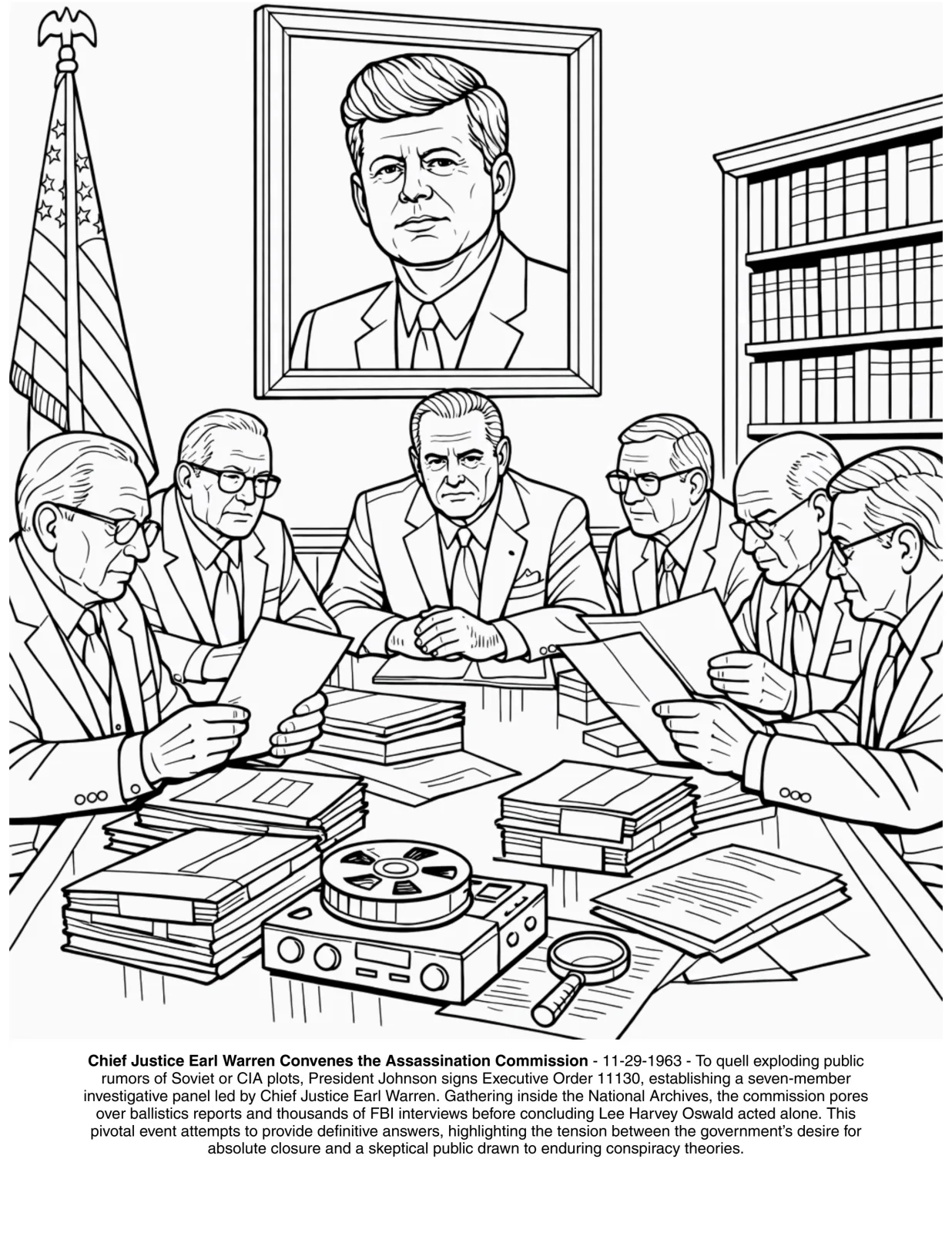
Kennedy was buried at Arlington National Cemetery on 25 November, where his widow lit the eternal flame. In September 1964 the Warren Commission concluded that Oswald had acted alone, a finding many Americans have doubted ever since.
One of the final scenes of the JFK book.
How to color the JFK timeline
Color it in order, one period at a time: the war, the Senate, the campaign, the crises, the space race, Dallas. Read each caption first and color the scene in one sitting. The thousand days go fast, and coloring them in sequence is the surest way to remember what came when.
Give each period its own palette. Navy and Pacific blue for PT-109, the black-and-white greys of 1960 television for the debates, then the pink of Jacqueline Kennedy’s suit for Dallas, a color everyone who lived through that day remembers.
Why does coloring help the dates stick? Because every choice of color makes you study the scene, as we explain in learning history through coloring. The book is an instant PDF, and our guide on how to print a coloring book PDF covers the settings that keep faces and fine lines crisp.
JFK: your questions answered
What are the most important dates in JFK’s life?
Born 29 May 1917; PT-109 sunk 2 August 1943; elected to Congress in 1946 and the Senate in 1952; married Jacqueline Bouvier on 12 September 1953; elected president on 8 November 1960; inaugurated 20 January 1961; Cuban Missile Crisis 16 to 28 October 1962; assassinated in Dallas on 22 November 1963.
How long was JFK president?
1,036 days, from his inauguration on 20 January 1961 to his assassination on 22 November 1963, which is why his presidency is often called “the thousand days”.
How old was JFK when he died?
He was 46. Kennedy was born on 29 May 1917 and died on 22 November 1963. At 43 he had been the youngest person ever elected president.
What was JFK’s biggest achievement?
Most historians point to his handling of the Cuban Missile Crisis in October 1962, which avoided nuclear war, followed by the Limited Test Ban Treaty of 1963. His Moon pledge and civil rights bill bore fruit after his death.
Who killed Lee Harvey Oswald?
Jack Ruby, a Dallas nightclub owner, shot Oswald on 24 November 1963 in the basement of Dallas police headquarters, as he was being transferred to the county jail. Ruby died in prison in 1967.
Is there a JFK coloring book for adults?
Yes. The John F. Kennedy coloring book by Motiv Colors follows his life in order, from PT-109 and the Senate to the 1960 debates, the Cuban Missile Crisis, the space race and Dallas, with a caption on every scene. It is an instant PDF you print at home.
Color the thousand days
Forty-six years, one night at sea, thirteen days in October and one afternoon in Dallas. In order, Kennedy’s life reads as a story of promise and interruption.
Every scene in the book is checked by a human before it ships. Print the first page tonight and start in the dark waters of the Solomon Islands.
We use cookies to enhance your browsing experience, serve personalized content and analyze our traffic. You can accept all cookies, reject non-essential ones, or manage your preferences.
Required for the website to function and cannot be switched off. They are usually set in response to actions you make, such as setting privacy preferences or logging in.
Allow the website to remember choices you make (such as language or region) to provide enhanced, personalized features.
Help us understand how visitors interact with the website by collecting and reporting information anonymously.
Used to track visitors across websites to display relevant advertising and measure campaign effectiveness.